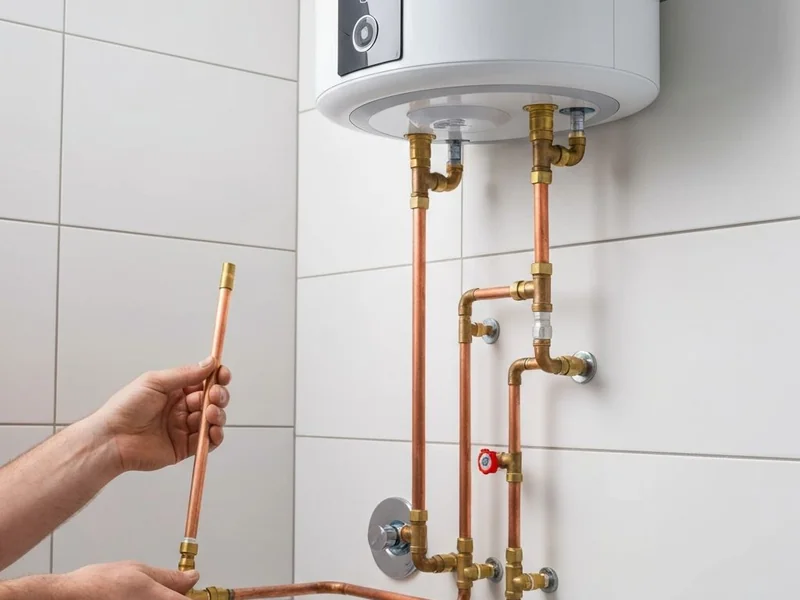
Woburn, MA 01801 stands apart from every other town on our service map for one reason: its water. While the neighboring towns run on soft MWRA water at 15 to 20 parts per million, Woburn blends roughly one-third MWRA water with two-thirds from its own Horn Pond wellfield — and the Horn Pond side measures about 83 to 89 parts per million hardness in recent town reports. That is moderately hard water, and it makes Woburn's the hardest blended supply we service. The practical consequence is real: sediment and scale accumulate in Woburn tanks measurably faster than in pure-MWRA towns, baking onto lower elements, rumbling in the tank bottom, and stressing the steel. Annual flushing is not a suggestion here; it is the maintenance that decides whether a Woburn tank reaches 12 years or gives out at 8.
We provide water heater leak repair throughout Woburn, MA 01801 — Woburn Center and Woburn Common, the Horn Pond neighborhoods, the Cummings Park/Mishawum area, and the subdivisions along the Route 128/I-95 and I-93 corridors. The housing is classic post-war suburbia: 1950s-to-1970s ranches, split-levels, and colonials, with older Victorians and two-families in the center and 1980s-plus subdivisions and condos filling in later. That means two aging systems failing at once — harder water stressing tanks from the inside, 60-year-old copper developing pinhole leaks from the outside — plus ranch crawl-space freeze exposure and Horn Pond-area damp basements. Our technicians diagnose in the right order: pipes, fittings, then tank. If water is pooling around your heater anywhere in 01801, call (833) 713-2101 — we will talk you through stopping the water in minutes, then come diagnose it properly.
Horn Pond Well Water: Why Woburn Tanks Fail Differently
The Horn Pond wellfield is the fact that organizes everything about water heater service in Woburn. The city draws about two-thirds of its supply from its own wells around Horn Pond, treated and blended with roughly one-third MWRA water. Recent town water reports put the Horn Pond treated water at about 83 to 89 parts per million hardness — moderately hard — against MWRA's soft 15 to 20. Blended at the tap, Woburn water carries meaningfully more dissolved minerals than any neighboring town's. Inside a water heater, those minerals do what minerals do: they precipitate out as water heats, settle to the tank bottom, and bake into sediment.
Sediment changes how a tank fails. A sediment layer insulates the bottom of the tank, so the burner or lower element overheats the steel beneath it trying to heat water through the insulation. Homeowners hear it first: rumbling, popping, crackling — trapped water flashing to steam under the sediment bed. Efficiency drops, recovery slows, and the overheated steel fatigues faster. On electric units, the lower element buries itself in sediment and burns out; we replace sediment-baked elements in Woburn more than anywhere else. The maintenance answer is unglamorous and effective: flush the tank annually, draining several gallons from the bottom valve until the water runs clear. In pure-MWRA towns flushing is optional; in Woburn it is the difference between a tank that reaches 12 years and one that rumbles itself to death at 8.
The second Woburn clock is the copper. The 1950s-to-1960s ranches, splits, and colonials that dominate the town went in with copper original, now 60-plus years old and entering pinhole-leak territory. Hot-water lines near the heater weep in fine mists that pool at the tank base — the classic mimic of a tank leak. So Woburn presents the double diagnostic: harder water stressing the tank from the inside, aging copper failing from the outside, both producing water at the same spot. Our standing rule: pressure-test the lines and inspect the connections before condemning the tank. Getting this wrong in either direction is expensive — replacing a healthy tank while the pinhole keeps weeping, or patching pipes while a sediment-killed tank keeps rumbling.
Two more local patterns complete the picture. Woburn's ranch crawl spaces run heater piping through unconditioned space that freezes and splits in January cold snaps — repair plus insulation and heat tracing, always together. And the Horn Pond-area neighborhoods sit over a high water table with damp basements, corroding tank bases from the outside even as the harder water works from the inside: a two-front attack that makes elevation, drain pans, and sump verification standard there. The older Victorians and two-families in the center add pre-war galvanized laterals with seized shutoffs, where every heater job starts with a valve that has not turned in decades.
Where Woburn 01801 Water Heaters Actually Leak
Across Woburn's 01801 neighborhoods, these are the failure points we diagnose most often.
Sediment-baked tanks and burned-out lower elements. The Woburn signature. Rumbling, popping, reduced hot water, and dead lower elements from the harder blended water. Annual flushing prevents it; a thorough flush and element replacement treats it. Neglected long enough, the overheated steel fails and the tank must be replaced.
Pinhole leaks in aging copper near the heater. 60-year-old copper weeping at the tank base, mimicking a tank leak. Pressure-test before quoting — the pipe repair costs far less than the replacement it impersonates.
Corroded tank-top fittings and seized shutoffs. Dielectric unions and nipples at the tank top, gate valves seized in the center's pre-war homes. Same-visit fitting repair plus the full-port ball valve upgrade.
Freeze-split crawl-space piping in ranches. January's pattern. Repair the pipe, insulate and heat-trace the runs — the second half is what prevents the repeat.
Base-ring corrosion in Horn Pond-area damp basements. High water table plus harder water: the two-front attack. Elevate the replacement, pan it, verify the sump pump. Call (833) 713-2101 and tell us your neighborhood and what you hear and see — rumbling plus water tells us a lot before we arrive.
What Happens When You Call (833) 713-2101
Rumbling, water, or both — the response is methodical. Every Woburn call follows three steps.
Step 1 — Stop the water over the phone. Call (833) 713-2101 and we guide you to the cold-water shutoff on the pipe entering the top of your heater. In Woburn's pre-war center homes the valve is often seized; if it will not turn, we direct you to the main house shutoff. For gas units, we talk you through setting the control to pilot. If the tank is rumbling but not leaking, we will talk you through a safe partial flush or schedule the service visit — do not ignore the rumbling.
Step 2 — Diagnose pipes, fittings, sediment, and tank — in that order. Our technician pressure-tests the supply lines and heater connections (the pinhole check), inspects the tank-top fittings and valves, assesses sediment load and element condition, and examines the tank shell and base ring. You get a plain explanation of exactly what failed — pipe, fitting, element, or tank — and a firm quote before any work begins.
Step 3 — Same-visit repair or replacement. Pipe, fitting, valve, and element repairs come out of our stocked vans immediately — including the full flush that a sediment-loaded Woburn tank needs. Tank replacements happen the same visit in most cases: full-port ball valve, dielectric unions, drain pan, elevation in damp basements, correct venting, and insulation on any crawl-space piping. We haul the old unit away and verify hot water with zero leaks at full temperature and pressure.
Request service today. In Woburn, rumbling is the tank asking for help and water is the tank giving up — answer the first before you meet the second. Call now and we will stop the water first, then fix the right thing.
Preventing the Next Leak in a Woburn Home
Woburn's failures are the most preventable on our service map — because the main driver is sediment, and sediment flushes out.
Flush annually. Actually do it. Drain several gallons from the tank's bottom valve once a year until the water runs clear. In Woburn this single habit prevents sediment-baked elements, rumbling, efficiency loss, and premature tank death. If the drain valve is seized or the flush runs muddy for many gallons, call us — a professional flush with element inspection is the next step.
Get the aging copper checked. Original 1950s-to-1960s copper near the heater should be pressure-tested and inspected for green corrosion spots and dimpling. When a tank replacement opens the system, address marginal copper at the same time — it is the efficient moment.
Winterize ranch crawl spaces. Insulate all exposed runs, add heat-trace cable on vulnerable sections, and seal the crawl space before the first hard freeze. Open access panels on the coldest nights.
Horn Pond-area homes: fight the dampness too. Verify the sump pump before storm season, run a dehumidifier in the damp months, inspect the tank base every fall, and elevate and pan every replacement.
Know your shutoff and your tank's age. Test the cold-water shutoff today — replace a seized gate valve with a full-port ball valve now. Check the tank's serial number; past 10 years without annual flushing, budget for a planned replacement on your schedule.
Repair or replace? Pipe, fitting, valve, and element repairs — plus professional flushing — are worth doing at any tank age, and in Woburn they resolve the majority of calls. A perforated tank, a submerged heater, or a heavily sediment-damaged tank past 10 years means replacement. Call (833) 713-2101 for the honest diagnosis.
Water Heater Leak Repair Across the 01801 ZIP and Nearby Towns
We serve all of Woburn, MA 01801 — Woburn Center and Woburn Common, the Horn Pond neighborhoods, the Cummings Park/Mishawum area, and the subdivisions along the Route 128/I-95 interchange and I-93 corridor — plus the neighboring towns. Route 128/I-95 and I-93 give our technicians fast access across the city, and we prioritize emergency leak calls ahead of routine work.
Every water heater leak repair in Woburn includes the details that prevent the next one: a full-port ball valve on the cold supply, dielectric unions at dissimilar-metal joints, a T&P discharge line terminating near the floor, correct venting pitch on gas units, a full system flush on every replacement, and insulation on any piping in unconditioned space. We test at full temperature and pressure before leaving — no weeping joints, no drips, hot water at every tap.
For planned replacements — the right move for any Woburn tank past its tenth birthday, especially without a flushing history — we schedule exact arrival windows and handle the complete job including old-tank haul-away. And if water is pooling around your heater right now, or the rumbling has become a roar: call (833) 713-2101. We will talk you through stopping it in the next two minutes, then come diagnose it properly — pipes, fittings, sediment, and tank, in that order, always.