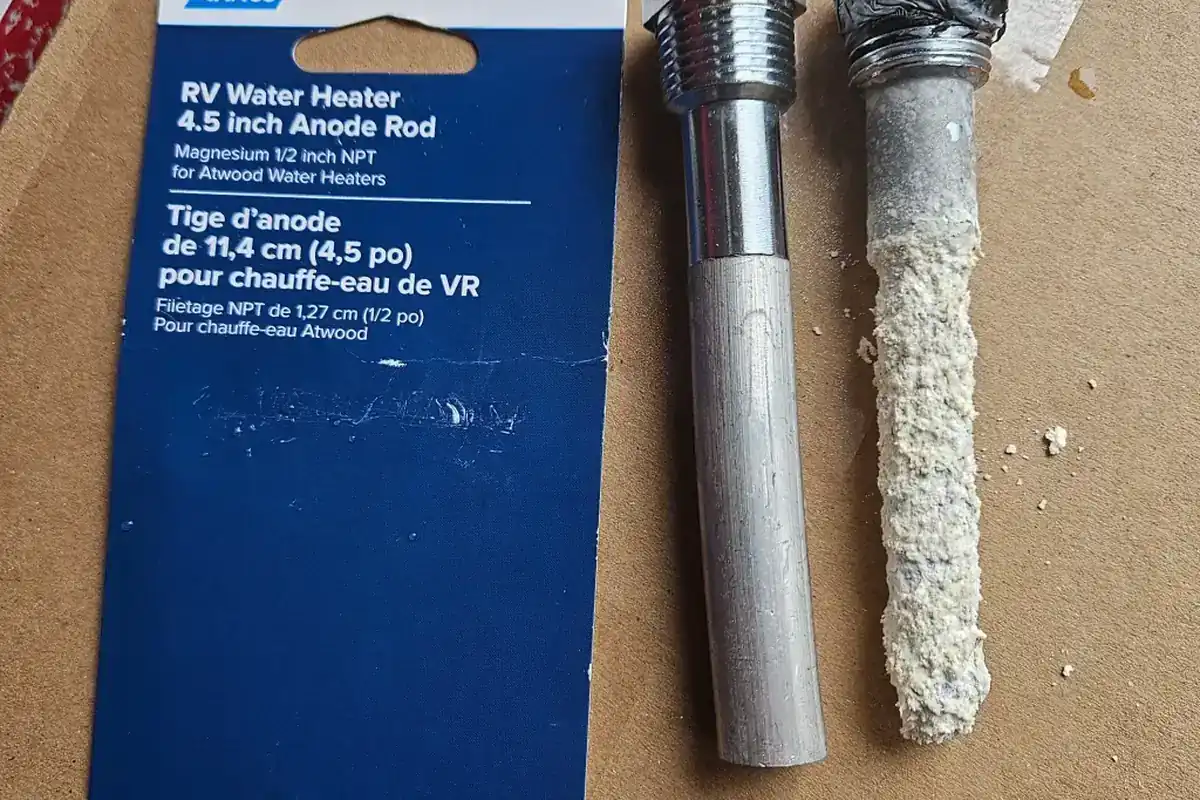
Inside every conventional tank water heater in Medford sits a part most homeowners never see and almost never think about: the anode rod. It is a long metal rod, usually magnesium or an aluminum-zinc alloy, suspended from the top of the tank and immersed in the stored water. Its job is deliberately self-destructive. Through galvanic corrosion, the rod attracts the corrosive forces in the water and dissolves over time so that the steel tank walls do not. It is a sacrificial component in the truest sense, and once it is fully consumed, the tank itself becomes the next thing the water attacks.
In the Boston metro area, anode rods live a shorter life than many owners expect. Medford drinking water comes from the Massachusetts Water Resources Authority system, supplied by the Quabbin and Wachusett reservoirs. That water is naturally soft and low in dissolved minerals, which sounds gentle on plumbing, but the disinfectant residual used to keep it safe steadily consumes magnesium anode rods. A rod that might last six years in another region can be depleted in three to four years here. The first warnings are subtle: hot water with a faint rotten-egg smell, a rusty tint that appears only in the hot tap, or a water heater that has simply reached its sixth or seventh birthday without anyone ever checking the rod.
Our technicians replace depleted anode rods in tank water heaters across Medford, MA 02155, from the tight basement utility corners of triple-deckers to the mechanical rooms of newer single-family homes. Where ceiling clearance makes a standard rigid rod impossible to install, we fit segmented or flexible rods designed for exactly that situation. Below is what a failing rod looks like, how the replacement is done, the materials we use, and what to expect when we service your heater.
Signs Your Anode Rod Is Worn Out
A depleted anode rod rarely announces itself with a dramatic failure. Instead it leaves a trail of small, easy-to-ignore symptoms that point back to the tank's interior. The most distinctive is a rotten-egg or sulfur smell in the hot water. This happens when a magnesium anode rod reacts with naturally occurring sulfates and sulfate-reducing bacteria in the water, producing hydrogen sulfide gas. If the cold water smells fine and only the hot water carries the odor, the anode rod is the prime suspect.
Rusty or discolored hot water is the second classic sign. When the rod is gone, corrosion shifts to the steel tank lining, and the first rust shows up in the hot water supply. A simple way to read the clue: run the cold tap for a minute, then the hot tap. If the cold runs clear and the hot runs brown or reddish, the problem is inside the heater, not the household piping. A metallic taste in hot water tells the same story in an earlier chapter.
Age is a signal on its own. If your tank water heater is five or more years old and the anode rod has never been inspected, there is a strong chance it is depleted, especially in this area. A visual check of the hex-head fitting on top of the tank can also reveal trouble: heavy rust or corrosion around the port suggests the rod below has been gone long enough for the tank steel to start corroding upward. Rumbling or popping sounds during heating cycles point to neglected maintenance in general, and a neglected heater almost always has a neglected rod.
How We Replace an Anode Rod, Step by Step
Anode rod replacement is a contained, methodical job. It takes far less time than most homeowners expect, but every step matters because the tank is under pressure and full of very hot water. Here is how our technicians handle it:
- Shut off the fuel and water supply. For a gas heater we turn the gas control to the pilot or off position; for an electric heater we switch the breaker off at the panel. Then we close the cold-water supply valve feeding the tank.
- Relieve tank pressure. We open a hot-water faucet somewhere in the house and briefly lift the temperature-pressure relief valve lever, giving the tank a safe path to vent pressure before anything is opened.
- Drain below the anode port. A garden hose is attached to the drain valve and several gallons are drawn off, dropping the water level below the top of the tank so the anode port can be opened without a flood.
- Locate and free the old rod. The rod lives under a hex-head fitting on the tank top, sometimes hidden beneath a plastic cap. These fittings seize badly after years of heat cycling, so we use a 1-1/16-inch socket with a breaker bar, bracing the tank so it does not twist or tip.
- Extract and inspect. The old rod is pulled straight up and examined. A rod worn down to a thin wire or its steel core is confirmation the replacement was overdue; a rod still thick with metal tells us the tank has been well protected.
- Select and install the new rod. We choose the rod type based on your water chemistry, any odor history, and the ceiling clearance above the heater. Threads are wrapped with Teflon tape, the rod is threaded in and torqued to a proper seal.
- Refill, purge, and restart. The tank is refilled completely, air is purged through the hot taps, connections are checked for seepage, and the heater is returned to normal operation with the burner or elements verified firing.
Anode Rod Types and the Materials We Install
Not all anode rods are the same, and the right choice depends on your water, your heater, and the space above it. Magnesium rods are the standard in most new heaters. They provide the most aggressive corrosion protection, which is valuable in soft water, but they are also the most likely to trigger rotten-egg odor in water that carries sulfates. Aluminum-zinc alloy rods are the common answer when odor is the complaint. They corrode a little less eagerly than magnesium, which usually stops the hydrogen sulfide reaction while still protecting the tank.
For heaters installed under low basement ceilings, we carry segmented (flexible) rods. These are built from short linked sections that bend as they feed into the tank, so they can be installed where a rigid three-to-four-foot rod could never be maneuvered. Many Medford triple-decker basements need exactly this. Finally, powered (impressed-current) anode rods work on a different principle entirely: instead of sacrificing metal, they use a small electrical current from a wall outlet to suppress corrosion. They never deplete, which makes them the long-term option for heaters in tight spaces or for owners who want to stop thinking about rod replacement.
On the tools side, the job calls for a 1-1/16-inch socket, a breaker bar or impact driver for seized fittings, Teflon tape or pipe joint compound rated for potable water, a garden hose, and a drain bucket. The material that matters most, though, is the rod selection itself, and that decision is made on site after inspecting the old rod and asking about your water's smell and history.
Safety Precautions During Anode Rod Service
Opening any port on a water heater means dealing with stored energy: hot water under pressure, and in gas models, an open fuel supply. Our technicians treat every anode rod job with the same precautions we bring to larger repairs. Pressure is always relieved before the port is touched, because a pressurized tank can force scalding water out of an opened fitting without warning. The fuel supply is shut off and verified before work begins, and on gas heaters the pilot is relit and the burner observed through a full heating cycle before we leave.
Electric heaters get a hard disconnect at the breaker, confirmed with a meter, since an element energized in a partially drained tank will burn out in seconds. The tank itself is braced before heavy wrenching, because a forty- or fifty-gallon tank full of water can shift on its stand when a breaker bar applies real torque to a seized hex head. If a fitting is corroded to the point of stripping, we stop and address it with extraction tooling rather than forcing it, since a broken port can turn a rod replacement into a tank replacement.
For homeowners, the main safety note is about what not to do: never remove an anode rod and leave the port empty or plugged with a plain fitting. The rod is not optional trim. Running a tank without one voids most manufacturer warranties and lets internal corrosion proceed unchecked, which is how heaters fail years early.
Why Medford Homes Wear Out Anode Rods Faster
Medford sits on the MWRA water system, and that shapes everything about anode rod life here. MWRA water from the Quabbin and Wachusett reservoirs is notably soft, around ten milligrams per liter of hardness, with a pH adjusted into the neutral range and a monochloramine disinfectant residual. Soft, treated water is easy on fixtures but measurably harder on magnesium anodes: the chloramine residual in particular accelerates the rod's sacrificial consumption. In practice, rods in Medford-area heaters often need attention at the three-to-four-year mark rather than the five-to-six years quoted in national manuals.
The housing stock adds its own wrinkles. Much of Medford was built out in the early 1900s through the 1950s, and many homes still run tank heaters installed a decade or more ago in basement utility corners with seven-foot ceilings and a few inches of clearance above the tank. A rigid replacement rod physically cannot be installed in those spaces, which is why segmented rods are a routine part of our service calls here rather than a specialty item. Basement humidity and occasional dampness also corrode the exposed hex-head fitting on the tank top, which is why seized, rusted ports are so common on our local jobs.
Winter plays a role too. New England freeze cycles drive cold groundwater temperatures down, so heaters work harder and cycle more often from December through March, and every heating cycle is another round of thermal expansion working on the tank's interior. Serving Medford, MA 02155, we check anode condition as a matter of course during maintenance visits, because in this water and these basements, the rod is almost always the first thing to go.
Anode Rod Replacement FAQs
Homeowners usually meet their anode rod for the first time when something smells wrong or the water turns rusty. These are the questions we hear most often on replacement calls around Medford, with straight answers drawn from what we actually find inside local tanks.