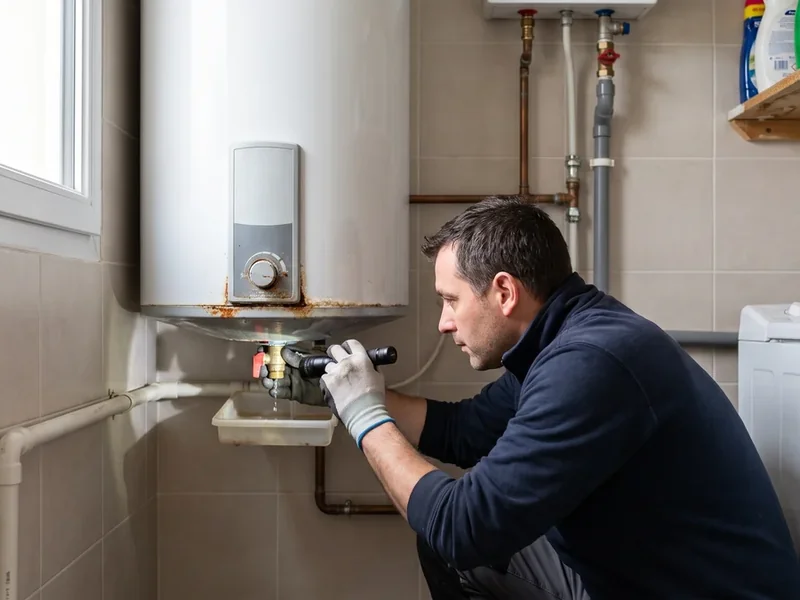
Stoneham, MA 02180 is a town of well-kept post-war suburbia: 1950s-to-1970s ranches, split-levels, and colonials dominate the neighborhoods, with 1920s-to-1940s colonials and capes around Stoneham Square and the Main Street (Route 28) corridor, and the wooded slopes of the Middlesex Fells — Spot Pond, Bear Hill, the Stone Zoo — rising at the town's edge. It is, by local standards, a dry town: the higher ground drains well, and homes near the Fells have some of the driest basements in the area. That dryness is genuinely good news for water heaters, because outside-in base corrosion — the dominant tank killer in damper towns — is a minor factor here.
But Stoneham has its own clock ticking. The copper plumbing installed in the post-war building wave is now 60-plus years old and entering its pinhole-leak years, and hot-water lines near the heater are where those pinholes show up first. In Stoneham, the 'leaking water heater' is very often a leaking pipe near the water heater — and the technician's first job is telling the two apart. We provide water heater leak repair throughout Stoneham, MA 02180 built around that diagnostic discipline: pipes first, fittings second, tank third. Stoneham is a full MWRA water and sewer member with soft water at about 15 to 20 parts per million, so scale is a non-issue; age, pinhole copper, and freeze-exposed installs drive the calls. If water is pooling around your heater anywhere in 02180 — Stoneham Square, the Fells neighborhoods, Bear Hill, or the Route 28 corridor — call (833) 713-2101. We will talk you through stopping the water in minutes, then come diagnose it properly.
Stoneham's Two Plumbing Eras and What Each Means for Leaks
Stoneham's housing was built in two great waves, and each left a different plumbing legacy. The 1920s-to-1940s colonials and capes around Stoneham Square and the town center went in with galvanized steel supply lines — much of it replaced with copper during updates over the decades, but with seized gate-valve shutoffs and corroded dielectric unions still common at the heater. The much larger 1950s-to-1970s wave — the ranches, split-levels, and colonials that define most of the town — went in with copper original, and that copper is now aging into the years when pinhole leaks begin.
Pinhole leaks deserve a clear explanation because they drive so many Stoneham calls. Copper does not rust like steel; it thins from the inside through a slow electrochemical process, accelerated by heat — which is why hot-water lines fail first. After 50 to 70 years, the wall thins to the point where a pinhole opens, often on the hot line within a few feet of the water heater. The weep is fine, almost a mist; it runs down the pipe, down the tank jacket, and pools at the base. Every visual cue says 'the water heater is leaking.' The tank may be perfectly sound. Our rule on every Stoneham call: pressure-test the heater connections and the nearby hot-water runs before condemning the tank. This one discipline prevents the most expensive misdiagnosis in 02180 — replacing a healthy tank while the pinhole keeps weeping.
Stoneham's split-levels add a second local pattern. The town has many of them, and their half-buried lower levels put the water heater in a semi-conditioned utility room with exterior-wall exposure. When that room goes unheated in a cold snap — a vacation, a closed-off zone — the supply piping near the heater can freeze and split. It is the same freeze mechanism as a crawl-space install, in a house type that does not look vulnerable. Ranch crawl spaces contribute the same calls: unconditioned-space piping to and from the heater freezing in January, with condensate lines on high-efficiency units needing proper pitch so they drain instead of freezing solid.
The counterweight to all of this is Stoneham's drainage. The high ground around the Fells, Bear Hill, and the town's hillier sections sheds water well, and Spot Pond-area lowlands are the exception rather than the rule. Tanks here live dry, which means they routinely reach 12-plus years — the best longevity on our service map. The maintenance conversation in Stoneham is therefore different: less about fighting dampness, more about watching the aging copper and the fittings, and planning the replacement at 12 years rather than reacting to a rupture at 14.
Where Stoneham 02180 Water Heaters Actually Leak
Across Stoneham's 02180 neighborhoods, these are the failure points we diagnose most often.
Pinhole leaks in hot-water copper near the heater. The Stoneham signature. Fine weeps in 60-year-old copper that pool at the tank base. Diagnosis before replacement, always: pressure-test the lines, inspect the connections. Fix the pipe — a far smaller job than a new heater.
Corroded tank-top fittings and seized shutoffs. In the pre-war homes with galvanized laterals, dielectric unions fail and gate valves seize; in post-war homes, aging supply valves weep. Water down the jacket mimics a tank leak. Same-visit fitting and valve repair, including the full-port ball valve upgrade that every heater job in older Stoneham plumbing should include.
Freeze-split piping in split-level utility rooms and ranch crawl spaces. Exterior-wall and unconditioned-space piping near the heater splitting in January cold snaps. Repair the pipe, then insulate and heat-trace the vulnerable runs — the second half prevents the repeat.
Weeping T&P relief valves and failed expansion tanks. Homes with pressure-reducing valves have closed systems; when the expansion tank's bladder fails, the relief valve drips constantly. Test system pressure, replace the expansion tank — not the heater.
End-of-life tank leaks in 12-plus-year units. On Stoneham's dry high ground, tanks earn their full life — and then the shell or base eventually goes. Rust staining at the base is the early warning; a perforated tank means replacement. Call (833) 713-2101 and tell us your home's era and where the water is — we will arrive with the diagnostic approach it requires.
What Happens When You Call (833) 713-2101
A leak is unwelcome, but the response is straightforward. Every Stoneham call follows three steps.
Step 1 — Stop the water over the phone. Call (833) 713-2101 and we guide you to the cold-water shutoff on the pipe entering the top of your heater. In Stoneham's older homes this is often a seized gate valve — if it will not turn, we direct you to the main house shutoff. For gas heaters, we talk you through setting the control to pilot. Minutes, and the emergency becomes a scheduled repair.
Step 2 — Diagnose pipes, fittings, and tank — in that order. Our technician pressure-tests the supply lines and heater connections first, because a pinhole copper leak is the most common 'tank leak' in 02180. Then fittings and valves, then the tank shell and base. You get a plain explanation of exactly what failed and a firm quote before any work begins — and if the tank is sound, we fix what is actually broken and say so.
Step 3 — Same-visit repair or replacement. Pipe and fitting repairs come out of our stocked vans immediately. Tank replacements happen the same visit in most cases, with the upgrades Stoneham homes need: full-port ball shutoff valve, dielectric unions at metal transitions, a drain pan where the basement is finished, and insulation on any piping in unconditioned space. We haul the old unit away and verify hot water at the tap with zero leaks at full temperature and pressure.
Request service today. A pinhole weep is an early warning from an aging system — not a wait-and-see situation. Call now and we will stop the water first, then fix the right thing.
Preventing the Next Leak in a Stoneham Home
Stoneham's failures are predictable by housing era, which makes prevention unusually effective.
Get the aging copper checked. If your home's copper is original 1950s-to-1960s work, have the hot-water lines near the heater pressure-tested and inspected — green corrosion spots and dimpling are the warnings. Catching pinhole failure early means a planned section repipe, not an emergency. When a tank replacement opens the system, that is the efficient moment to address marginal copper nearby.
Winterize split-level utility rooms and crawl spaces. Insulate all exposed runs, add heat-trace cable on vulnerable sections, and do not let the utility room go unheated in a cold snap. Open access panels on the coldest nights. This prevents the most common January emergency calls in Stoneham's splits and ranches.
Plan the replacement at 12 years — on your schedule. Stoneham's dry basements let tanks earn their full life, which makes a planned 12-year replacement the smart play: same cost as an emergency swap, zero water damage, and a convenient moment to upgrade the shutoff valve and address aging copper. Check the tank's serial number for its manufacture date today.
Know your shutoff. Find the heater's cold-water shutoff now and confirm it turns. Seized gate valves are the rule in pre-1960 Stoneham plumbing; a valve that will not close turns a drip into a flood. Replace it with a full-port ball valve before you need it.
High-ground homeowners: enjoy the dryness, watch the fittings. Your tank will likely reach 12-plus years — spend the maintenance attention on the tank-top fittings, the aging copper nearby, and the anode rod every few years instead of fighting dampness.
Repair or replace? Pipe, fitting, and valve repairs are worth doing at any tank age — and in Stoneham they are the most common fix. A perforated tank or a tank past 12-plus years needing major work means replacement. Call (833) 713-2101 for the honest diagnosis.
Water Heater Leak Repair Across the 02180 ZIP and Nearby Towns
We serve all of Stoneham, MA 02180 — Stoneham Square, the Main Street (Route 28) corridor, the Spot Pond and Middlesex Fells neighborhoods, Bear Hill, and the surrounding streets — plus the neighboring towns. Route 28 gives our technicians direct access through town, and we prioritize emergency leak calls ahead of routine work.
Every water heater leak repair in Stoneham includes the details that prevent the next one: a full-port ball valve on the cold supply, dielectric unions at dissimilar-metal joints, a T&P discharge line terminating near the floor, correct venting pitch on gas units, and insulation on any piping in unconditioned space. We test at full temperature and pressure before leaving — no weeping joints, no drips, hot water at every tap.
For planned replacements — the right move for any Stoneham tank approaching 12 years, and the efficient moment to address aging copper — we schedule exact arrival windows and handle the complete job including old-tank haul-away. And if water is pooling around your heater right now: call (833) 713-2101. We will talk you through stopping it in the next two minutes, then come diagnose it properly — pipes first, fittings second, tank third, always.