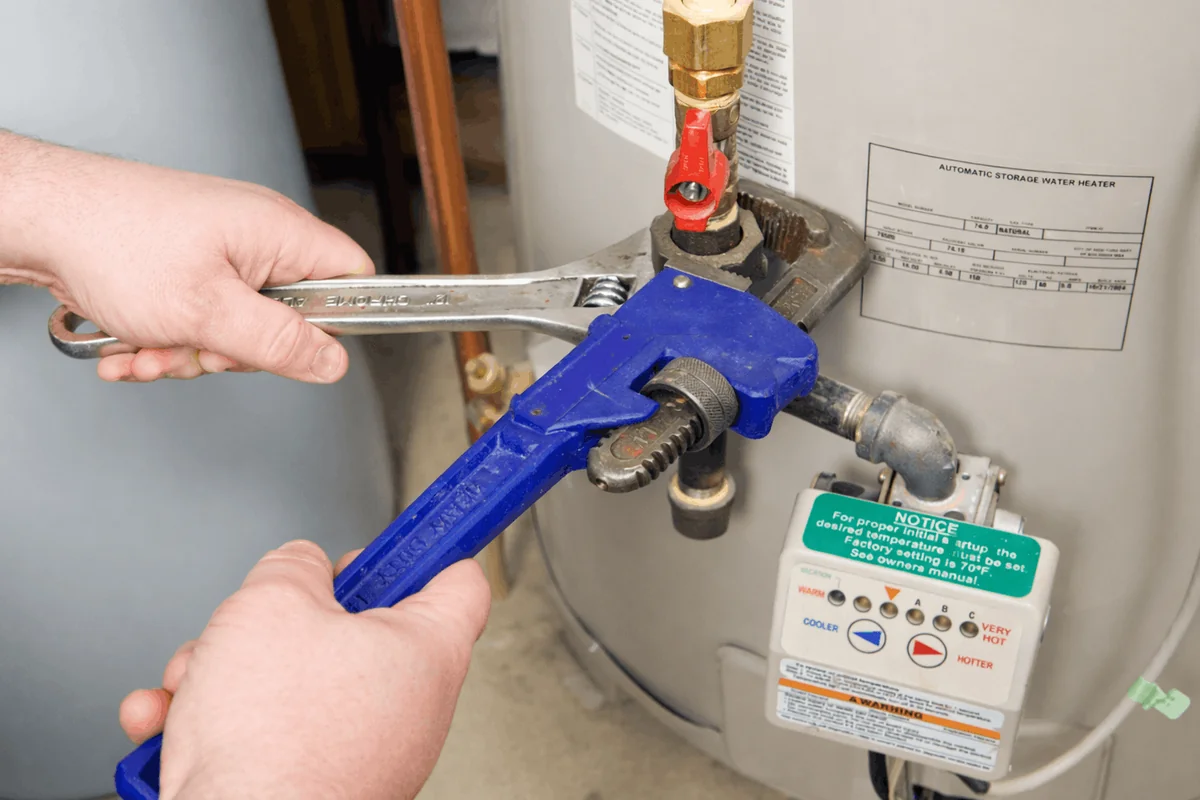
Water on the floor around a tank water heater triggers the same fear in every homeowner: the tank has burst and the heater is finished. Sometimes that fear is justified. But in our experience, most tank water heater leaks do not come from the tank at all. They come from the fittings, valves, and connections attached to it: a weeping temperature-pressure relief valve, a dripping drain valve, a corroded inlet connection, a seeping anode port. These are repairable problems with defined fixes, and the difference between a repair and a replacement comes down to one thing: finding exactly where the water originates.
That diagnosis is the heart of this service. Water travels. It runs down pipes, follows seams, pools at the lowest point, and appears inches or feet from its source. A puddle at the base of the heater might trace back to a fitting at the top. Condensation on cold water lines can mimic a leak entirely. Our technicians dry the area, inspect every connection point systematically, and watch where water reappears, because repairing the wrong source wastes the visit and leaves the real leak running.
We provide tank water heater leak repair throughout Medford, MA 02155, covering gas and electric tank heaters of all common sizes. Below are the leak sources we find, how each is diagnosed and repaired, the parts and materials involved, the safety rules for leak work, and the local factors that shape water heater leaks in Medford homes.
Where Tank Water Heater Leaks Come From
Leak sources on a tank water heater fall into two categories: the repairable and the terminal. Knowing which category you are in starts with knowing where to look. The temperature-pressure relief (TPR) valve is a frequent source. It sits high on the tank or on top, with a discharge pipe running down toward the floor. A relief valve that drips or runs continuously is either doing its job against excessive pressure or temperature, or it has failed internally. Either way it demands attention, because it is a safety device first and a leak source second.
The drain valve at the tank's base is the next common culprit: plastic factory valves crack, drip, or snap, and their threads can weep. Inlet and outlet connections on top of the tank leak when dielectric unions corrode, when supply-line fittings loosen from years of thermal cycling, or when installer-applied sealant finally gives up. The anode rod port can seep if the rod was replaced without proper thread sealant or if the port itself is corroding. On gas heaters, the area around the gas control valve stays dry by design, but the cold-water inlet nearby is a known weep point.
Then there is the category that ends the heater: the tank body itself. Water seeping from a welded seam, rust streaks bleeding down the jacket from under the top head, or dampness at the base with no fitting anywhere nearby all point to internal corrosion breaching the steel. A related deceiver is condensation, which forms on cold inlet pipes and on the tank in humid basements and drips convincingly. The diagnostic rule is simple: dry everything, wait, and watch where the water returns. Fittings leak from fittings. Tanks leak from seams. Condensation comes back everywhere and nowhere.
How We Diagnose and Repair Leaks, Step by Step
Every leak repair starts the same way: with the water traced to its exact origin before any part is touched. Our technicians work through the heater connection by connection:
- Make the area safe and dry. Fuel or power to the heater is shut off, the cold-water supply is closed, and the entire heater exterior, every fitting, valve, and seam, is dried completely. Standing water is extracted so new water is visible.
- Trace the source. With the supply briefly restored if needed, we watch where water reappears. Paper towels or dry cloths at each suspect joint make even slow seeps visible. The TPR discharge pipe is checked, the drain valve is inspected, and inlet, outlet, and anode connections are examined one by one.
- Repair fitting and connection leaks. Corroded dielectric unions are replaced, loose supply fittings are resealed with fresh Teflon tape or pipe joint compound and tightened, and seeping anode ports are resealed. Each repair is pressurized and checked dry before moving on.
- Replace failed valves. A dripping drain valve is replaced with a full-port brass ball valve. A faulty TPR valve is replaced with a new valve matched to the tank's pressure and temperature ratings, and its discharge pipe is confirmed to terminate correctly.
- Check system pressure. If the TPR valve was discharging, we check household water pressure and the expansion tank. High static pressure or a waterlogged expansion tank will defeat a new relief valve just as it defeated the old one, so the underlying pressure issue is addressed.
- Evaluate the tank body. If tracing points to a seam or the tank shell, we show the homeowner exactly what we found: rust streaks, weeping seams, or jacket dampness with no fitting source. A breached tank cannot be repaired, and we explain why replacement is the only lasting fix rather than attempting a patch.
- Return to service and verify. Repaired heaters are refilled, purged of air, brought back to temperature, and left with every connection verified dry.
Parts and Materials Used in Leak Repairs
The parts used in leak repair are specific to the source. For connection leaks we carry dielectric unions, which separate copper household piping from steel tank nipples to prevent galvanic corrosion, along with brass nipples, flexible supply connectors, and thread sealants: Teflon tape rated for potable water and pipe joint compound for tapered threads. A corroded union is never cleaned up and reused; the corrosion is the failure, and only a new union restores the connection.
Valve replacements use matched components. A new temperature-pressure relief valve must match the tank's BTU input and pressure ratings, which are stamped on the valve and the heater's rating plate. An undersized relief valve is a safety defect, not a bargain. Drain valves are upgraded to full-port brass ball valves rather than replaced with another failure-prone plastic fitting. Where pressure is the root cause, a replacement expansion tank, properly pre-charged to match household water pressure, resolves the cycling that was forcing the relief valve open.
The diagnostic kit matters as much as the parts: a water pressure gauge that records peak pressure, moisture detection for tracing, and leak-detection solution for verifying gas-tight joints on gas models. The principle behind every part choice is the same: the repair should leave the heater better sealed and better protected than it was before the leak appeared.
Safety Precautions During Leak Repair
Leak repair on a water heater is controlled work around pressurized hot water, and the safety sequence is fixed. Fuel or power is shut off and verified before diagnosis begins, because a heater that fires or energizes while partially drained or disassembled can be damaged or become dangerous. Pressure is relieved through a hot tap and the TPR valve before any fitting is loosened; opening a connection on a pressurized tank releases scalding water without warning.
The temperature-pressure relief valve gets absolute protection in our work. It is never capped, plugged, or bypassed, not even temporarily to stop a drip while parts are fetched. The relief valve is the tank's defense against catastrophic overpressure, and defeating it, for any reason and for any length of time, is one of the most dangerous things that can be done to a water heater. A discharging relief valve is telling you something; the correct response is to find out what, not to silence it.
Draining precautions apply whenever the tank is emptied: discharge water is routed through a secured hose to a safe drain point, hoses are checked so they cannot whip loose under pressure, and nobody works in the path of draining water. On gas heaters, every disturbed gas joint is leak-tested with detection solution before the heater is relit, and the burner is observed through a full cycle. On electric heaters, power stays off at the breaker, verified with a meter, until the tank is completely refilled and purged of air.
Local Factors: Tank Leaks in Medford Homes
Medford gives tank water heater leaks a particular local character. The housing stock, much of it built from the early 1900s through the 1960s, means many heaters are fifteen to twenty years old and operating on original-era connections: galvanized or copper supply lines joined to the tank with dielectric unions that have been corroding for decades. Failed unions at the inlet and outlet are among the most common leak sources we find in these homes, and they are a direct product of age meeting dissimilar metals.
Basement installs dominate here, and they change how leaks behave. A heater tucked behind stored belongings in a damp basement corner can seep for weeks before anyone notices, and by the time water is visible, it has often wicked into drywall, flooring, or a finished basement wall. Triple-deckers compound this: a single basement heater serving multiple units means a leak affects several households, and the person who discovers it may not know where the shutoff valves are. Condensation is also a genuine local factor; humid summer basements coat cold inlet pipes with moisture that drips convincingly, which is why our diagnosis always starts by distinguishing condensation from an actual failure.
Winter brings the freeze-driven leaks. New England cold snaps split supply lines and crack fittings in unheated spaces, and the resulting leaks appear suddenly when the thaw comes. The MWRA water supply itself is soft and relatively kind to tanks, but soft water does not stop galvanic corrosion at dielectric unions or age-related seam failure. Serving Medford, MA 02155, we trace every leak to its source before recommending repair or replacement, because in these older homes the visible puddle is rarely the whole story.
Tank Water Heater Leak Repair FAQs
Most leak calls start with the same worried question: is the tank finished? These are the questions Medford homeowners ask when water appears around the heater, answered from what our tracing actually finds.