Chelsea, MA 02150 is one of the densest cities in Massachusetts, and its water heaters live hard lives. The 1890s–1920s triple-deckers and multi-family workers' housing that define the city keep their heaters in cramped, often damp basements — many sitting on filled tideland with a high water table fed by the Mystic River and Chelsea Creek. Galvanized steel plumbing is still widespread in the old stock, copper retrofits are patchy, and coastal storm surge has flooded more than a few of these basements over the decades. The result is a leak profile dominated by bottom-up corrosion, submerged-heater replacements after nor'easters, and misdiagnosed relief-valve discharge — plus the pure logistics of getting a 50-gallon tank through narrow alleys and bulkheads on blocks with almost no off-street parking. This page explains how Chelsea's buildings, water, and waterfront shape its water heater failures, and how we handle leak repair across the 02150 ZIP.
Tideland, Triple-Deckers, and Salt Air: Chelsea's Housing Reality
Chelsea's housing stock is overwhelmingly 1890s–1920s triple-deckers and multi-family workers' housing, built dense on filled tidelands along the Mystic River and Chelsea Creek. That sentence contains nearly every reason Chelsea water heaters fail the way they do. The filled-tideland geology means high water tables across much of the city, so basements run damp year-round; a water heater sitting directly on damp concrete corrodes at the base faster than anywhere else in our service area, and tanks here fail from the bottom up more often than from any other cause. Sump pumps are common in Chelsea basements for exactly this reason — and a failed pump during a storm floods the heater along with everything else.
The plumbing in the old stock is galvanized steel, still widespread and only patchily retrofitted with copper. A century of galvanized pipe means corroded tank-top nipples, seized gate-valve shutoffs, and supply lines that shed rust into the tank. The heaters themselves live in cramped, often poorly ventilated basements where a slow leak can run undetected behind stored belongings for weeks. Newer apartment developments along the waterfront add modern construction to the mix, but the city's service profile remains dominated by the old triple-decker blocks — along Broadway, under the Tobin Bridge (Route 1), and along the Revere Beach Parkway (Route 16) corridor.
Then there is the coast. Chelsea's waterfront exposure means nor'easter storm surge and Chelsea Creek flooding have reached basements repeatedly, and any heater that has been submerged faces a non-negotiable rule: gas controls cannot be salvaged after submersion, so flooded heaters get replaced, not repaired. After every major coastal storm, Chelsea sees a predictable wave of replacement calls — and the smart move is scheduling the inspection promptly rather than running a compromised heater.
Soft MWRA Water in the 02150 ZIP — and What Actually Fails Here
Chelsea is a full MWRA water and sewer member — the MWRA's Operations Control Center is itself located in Chelsea — and the water here is soft, roughly 15 to 20 parts per million. Scale buildup inside tanks is minimal, which is one of the few easy wins in Chelsea's heater profile: heating surfaces stay clean and sediment-related efficiency loss is rare.
But in Chelsea, the water supply is almost never what kills a heater. The killers are environmental and mechanical: chronic basement dampness from the high water table corroding tank bases, coastal storm-surge submersion destroying gas controls, corroded galvanized fittings at the tank top, and missing or undersized expansion tanks letting thermal expansion weep out the relief valve. Soft water does not protect a tank sitting in a puddle, and it does not un-seize a fifty-year-old gate valve.
The sediment that does accumulate in Chelsea tanks comes from the buildings' own galvanized piping — rust and scale shed by century-old steel settling in the tank bottom. Annual flushing still helps, not because of the supply but because of the pipes. And the anode rod depletes on its normal schedule in soft water, so on tanks past year five we check it during service visits. In a triple-decker where a rupture affects multiple households' storage and potentially multiple units, the anode check is cheap insurance against the most disruptive failure in the building.
How Water Heater Leak Repair Works in Chelsea, MA 02150
How water heater leak repair works in Chelsea, MA 02150 starts with logistics, because Chelsea's density makes access the binding constraint. The old triple-decker blocks have almost no off-street parking, narrow alleys, and bulkhead-only basement access — getting a 50-gallon tank out and a new one in is a hand-carry job planned around parked cars and tight turns. When you call (833) 713-2101 we ask about the access path: bulkhead, interior stairs, alley width, and parking reality on your block. The crew arrives with the carry plan already made, not improvised at the curb.
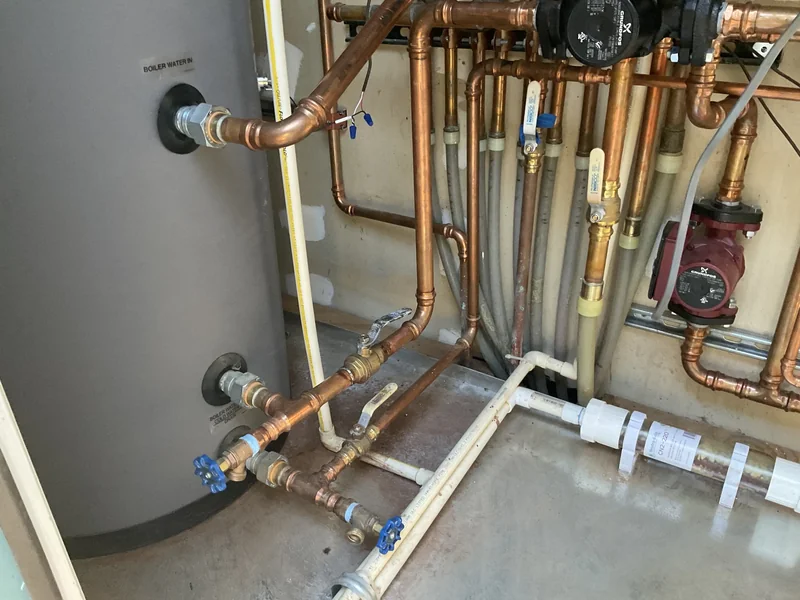
Diagnosis in Chelsea follows the local failure hierarchy. First the base: in these damp basements, bottom-up corrosion is the prime suspect, and rust at the bottom rim or a weeping drain valve answers the question fast. Then the fittings: corroded nipples and unions on the old galvanized feeds, and the shutoff valve — seized gate valves are the rule in this stock, and we plan their replacement with full-port ball valves as part of the job. Then the relief valve and expansion tank: undersized or missing expansion tanks on closed systems are common in Chelsea's older multi-family buildings, and thermal-expansion discharge gets misdiagnosed as tank failure until someone checks the tank's charge. Only after those are ruled out do we condemn the tank itself.
Replacement in a Chelsea basement is built for the environment: the new tank goes onto a corrosion-resistant stand, under it a drain pan piped to a safe drain, and beside it our recommendation for a leak sensor — because in a cramped basement full of storage, the sensor is the only early warning you will get. Flood-recovery replacements follow the submersion rule without exception: any gas heater that sat in floodwater is replaced, and we document the flood line for your records.
Chelsea's Four Signature Leak Patterns
Bottom-up corrosion leads Chelsea's leak patterns by a wide margin. The signature is rust weeping from the tank's bottom rim, a damp ring on the concrete encircling the base, or moisture that reappears after mopping no matter what. In the high-water-table basements near the Mystic River and Chelsea Creek, this is the failure that turns into a sudden rupture — the base lets go all at once, and forty-plus gallons hit a basement full of belongings. If you see base rust in Chelsea, treat it as urgent.
Second is the post-storm wave. After nor'easters push surge up Chelsea Creek or flood the low blocks, submerged heaters need full replacement — gas valves, burners, and controls that sat in water (especially salt water) cannot be returned to safe service. We see this pattern after every major coastal storm, and the right move is a prompt inspection: running a submerged heater "to see if it still works" is gambling with a gas appliance.
Third is relief-valve weeping from expansion-tank problems — the misdiagnosis special. Water dripping from the discharge pipe on the side of the heater looks like a tank leak, but the tank is fine; the closed plumbing system has nowhere to send expanded water because the expansion tank is missing, undersized, or waterlogged. The fix is an expansion tank, and it costs a fraction of a heater replacement. Fourth, the fitting leaks: corroded tank-top nipples and unions on galvanized feeds, dripping onto the jacket and mimicking tank failure — repairs, not replacements, when caught by someone who checks before quoting.
What Happens When You Call (833) 713-2101
Call (833) 713-2101 and the first thing we do is help you stop the water. We will ask where it is coming from — base, top fittings, relief-valve pipe, or general basement flooding — and whether you can reach the cold-water shutoff on the heater's feed. In Chelsea's old stock that valve is very often a seized gate valve; we will tell you plainly not to force it, because a snapped stem turns a leak into a flood, and we will prioritize getting a technician to you.
On arrival the technician works the Chelsea diagnostic sequence: base inspection for bottom-up corrosion, fitting and shutoff inspection on the galvanized feeds, relief-valve and expansion-tank check, and flood-line assessment if the basement has taken water. You get a straight explanation of the source — tank, fitting, expansion issue, or flood damage — and the options with honest scope: repair the connection, replace the expansion tank, or replace the heater, with the access plan (bulkhead carry, alley route, parking) already worked out.
Flood-recovery jobs get documentation of the water line and the failed components for your insurance records. Every replacement leaves with the Chelsea-spec details: tank on a stand, pan with a drain, new ball-valve shutoff, corrected dielectric unions on mixed-metal connections, and a walkthrough of every valve so the next leak gets stopped in seconds. In a triple-decker we also make sure the other units know where the building's main shutoff is — because the next emergency might not start at your heater.
Preventing the Next Leak in Chelsea
Prevention in Chelsea is about fighting dampness and knowing your valves. If your heater sits on bare concrete in a damp basement — which describes most of the old triple-decker stock — a drain pan with a drain line and a tank stand are the two highest-value upgrades in the city; they directly counter bottom-up corrosion, the failure most likely to end in a rupture. A ten-dollar leak sensor beside the tank buys the early warning a storage-packed basement will not give you.
Test your sump pump before storm season, not during it: pour water in the pit and confirm the pump runs and the discharge flows. A failed pump during a nor'easter floods the heater, and a flooded gas heater becomes a mandatory replacement. Know where your heater's shutoff is and whether it turns — if it is a seized gate valve, have it swapped for a ball valve at the next service visit; in a multi-unit building, make sure every unit knows the location.
For the galvanized-era plumbing, put the tank-top fittings on your watch list: white or green crust at the unions and nipples, or any dampness where the feed lines meet the tank, are advance warnings worth a service call before they become the leak. And take the ten-year mark seriously — in Chelsea's environment, a planned replacement at ten to twelve years beats a 2 a.m. rupture in a basement with three households' belongings every single time.