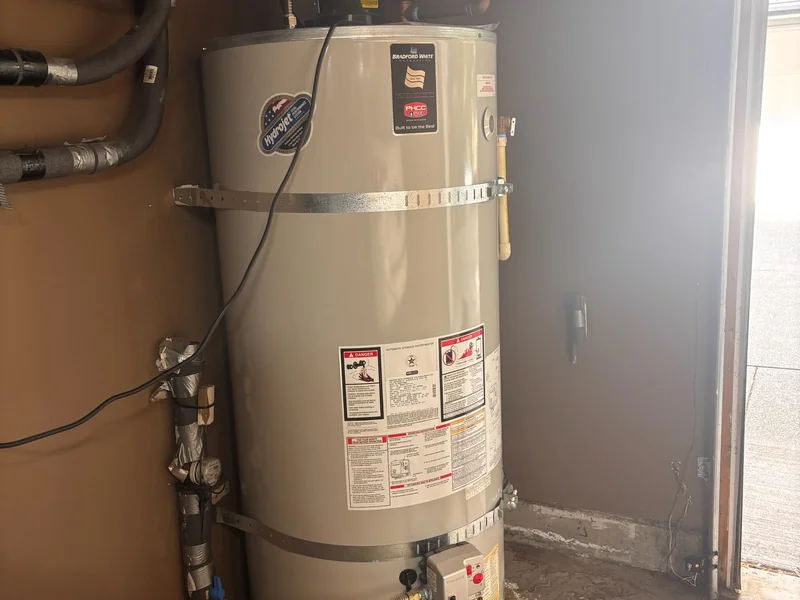
A water heater leak in Arlington, MA 02474 is rarely just a puddle. In a town where 1890s–1930s two-families and colonials dominate the housing stock, the tank almost always sits in a basement — often unfinished, sometimes with low ceilings and fieldstone walls — where a slow leak can soak into concrete for weeks before anyone notices, or where a sudden rupture can send forty-plus gallons across stored belongings. Add the high water table around Spy Pond and Alewife Brook, original galvanized feed lines with decades-old gate-valve shutoffs, and winters that freeze unconditioned spaces solid, and Arlington presents a specific set of water heater failure patterns. This page explains how those local conditions cause leaks, how we diagnose and fix them in 02474 homes, and what to do the moment you spot water where it should not be.
Why Water Heaters Fail in Arlington's 1890s–1930s Homes
Arlington's housing tells the story of nearly every water heater call we take here. The core stock — two-family homes and colonials built between the 1890s and 1930s — was plumbed with galvanized steel supply lines, and while many homes have had copper retrofits layered over the decades, the original galvanized often survives in the runs feeding the water heater itself. Triple-deckers near Massachusetts Avenue and East Arlington add stacked bathrooms above basement heaters, so a tank-top fitting leak can read as a ceiling stain two floors up before anyone looks at the tank. The 1950s ranches scattered through town and the post-1980 condo conversions have more modern copper and PEX, but their heaters are aging into the failure window too.
Foundations shape the damage pattern. Full basements are the norm in Arlington, with fieldstone walls in pre-1900 homes and poured concrete or block in later construction; crawl spaces are uncommon. That means the heater sits below grade in a space that ranges from semi-finished family rooms to rough stone-walled cellars — and in the low areas near Spy Pond and Alewife Brook, where the water table runs high, those basements stay damp year-round. A tank sitting directly on damp concrete corrodes from the base upward, and base corrosion is the failure mode most likely to turn into a sudden, catastrophic rupture rather than a polite drip.
The third local factor is the shutoff situation. Pre-1940 Arlington homes very often still have the original gate-valve shutoff on the cold feed to the heater. After fifty or more years those valves seize, and a seized shutoff turns a manageable leak into an emergency because the homeowner cannot stop the water feeding the tank. We treat a seized gate valve as part of the job, not an upsell: replacing it with a full-port ball valve during any heater service means the next leak gets stopped in seconds with a quarter turn.
Arlington's MWRA Water and What It Means for Your Tank
Arlington is a full member of the MWRA for both water and sewer, and MWRA water is notably soft — roughly 15 to 20 parts per million, about one grain per gallon, according to MWRA's own water-quality reports. For your water heater, soft water is mostly good news: it means very little mineral scale bakes onto the tank's heating surfaces, so you will not see the heavy sediment buildup that plagues hard-water towns. The tank lining itself lives a relatively gentle chemical life.
But soft water does not mean a maintenance-free tank. First, sediment in Arlington tanks comes from the home's own pipes, not the supply: old galvanized steel lines shed rust and scale that settles in the tank bottom, insulating the burner or lower element and forcing the heater to work harder. Second, soft water interacts with the tank's anode rod — the sacrificial metal rod that protects the steel lining — differently than hard water does, and depleted anodes accelerate tank failure. On older tanks we inspect the anode as part of any serious service call. Finally, the corrosion that kills Arlington heaters is usually environmental (damp basements, high water tables near Spy Pond and Alewife Brook) rather than water-chemistry driven, which is why placement details like drain pans and tank stands matter more here than descaling schedules.
How Water Heater Leak Repair Works in Arlington, MA 02474
Servicing a water heater in Arlington, MA 02474 starts with the house, not the heater. In the older two-families and colonials along the Massachusetts Avenue corridor and around Arlington Center and the Regent Theatre, the first question is access: many unfinished basements have low clearances and narrow bulkhead stairs with a turn at the bottom, and maneuvering a 50-gallon tank down those stairs is genuinely the hardest part of a replacement. We ask about stairwell width and ceiling height when you call so the crew arrives with the right equipment — and if a full-size tank will not make the turn, we will discuss compact or lowboy models that fit without compromising capacity more than necessary.
The second question is the shutoff. If your home still has a gate-valve shutoff that has not moved in decades, we plan for its replacement as part of the visit, because forcing a seized valve can snap the stem and turn a repair call into a flood. In the Spy Pond and Alewife Brook areas, we also plan for elevation: replacement tanks go onto a corrosion-resistant stand with a drain pan piped to a safe drain, which directly counters the base corrosion that the high water table causes.
Logistics matter too. Arlington's older streets near the Center and along the Minuteman Bikeway corridor can be tight for service vans, and bulkhead-only access means carrying the old tank out and the new one in by hand. We schedule realistic arrival windows and confirm access details up front, so the job starts when we arrive instead of after twenty minutes of problem-solving at the curb.
The Most Common Leak Calls We See in the 02474 ZIP
Across the 02474 ZIP, the calls fall into a handful of repeat patterns. The most common is the tank-top fitting leak: water dripping from the hot or cold nipples, the dielectric unions, or the supply shutoff itself, in a home with original galvanized piping. Homeowners assume the tank has failed; often the tank is fine and the repair is a fitting, a nipple, or a valve — a far smaller job. That is why we inspect fittings before quoting a replacement.
Next is base corrosion in the damp-basement zones near Spy Pond and Alewife Brook: rust weeping from the bottom rim of the tank, damp concrete in a ring around the base, or a drain valve that crumbles when touched. Once the base is compromised the tank cannot be saved, and these are the tanks most likely to rupture without further warning. If you see rust at the base, treat it as urgent.
We also see temperature-and-pressure relief valve discharge that homeowners mistake for a tank leak. On closed plumbing systems without a working expansion tank, thermal expansion pushes water out the relief valve's discharge pipe. The fix is an expansion tank, not a new heater — another case where diagnosis before replacement saves real money. And in the 1950s ranches, winter calls spike for a different reason: supply lines running through unconditioned spaces freeze and split near the heater, and the "leak" is a burst pipe, not a tank failure at all.
What Happens When You Call (833) 713-2101
When you call (833) 713-2101 about a leaking water heater in Arlington, the first thing we do is help you stop the damage. We will ask where the water is coming from, whether you can see the shutoff valve on the cold feed to the tank, and whether the leak is a drip or a flow. If you can safely close the shutoff, we will talk you through it; if the valve is seized — common in Arlington's older homes — we will tell you to leave it alone rather than risk snapping it, and we will prioritize your appointment.
On arrival, the technician's first job is diagnosis, not sales. We trace the water to its source: tank seam, base, fittings, relief valve, drain valve, or nearby piping. You get a plain explanation of what failed and why, with the options laid out — repair the fitting or valve, replace the tank, or in the case of a very old unit with multiple issues, replace proactively before it ruptures. If replacement is the right call, we confirm the new tank will physically fit your basement: stairwell clearance, ceiling height, and venting get measured before anything is ordered or carried in.
During the work we replace wear items that are already past their prime — seized gate-valve shutoffs get full-port ball valves, missing or corroded dielectric unions get corrected, and tanks in damp locations get pans and stands. When the job is done we fill, light, and test the unit, check for leaks at every connection, and walk you through the shutoff locations so the next leak — if there ever is one — gets stopped in seconds.
Keeping Your Arlington Water Heater Leak-Free
The cheapest water heater leak is the one that never happens, and in Arlington prevention is mostly about the basement environment and the fittings. If your tank sits on bare concrete in a damp basement — especially anywhere near Spy Pond or Alewife Brook — a drain pan and a tank stand are the two highest-value additions you can make; they attack base corrosion, the failure mode most likely to end in a rupture. A simple battery-powered leak sensor on the floor beside the tank costs little and buys you the early warning that an unfinished basement will not give you on its own.
Have the anode rod inspected once your tank passes the five-year mark, and plan on replacement somewhere around year ten to twelve rather than waiting for failure — in a finished basement, a planned swap is a routine half-day job while an emergency rupture is a flooring and drywall claim. And if your home still has a gate-valve shutoff on the heater feed, replace it with a ball valve at the next service visit; it is a small job that turns every future leak from a crisis into a ten-second task.
For the 1950s ranches, the winter checklist is different: insulate any hot-water piping that runs through unconditioned crawl spaces or exterior walls, and keep basement or utility-room temperatures above freezing during January cold snaps. Freeze-split pipes near the heater are entirely preventable, and they are among the most expensive winter calls we see.