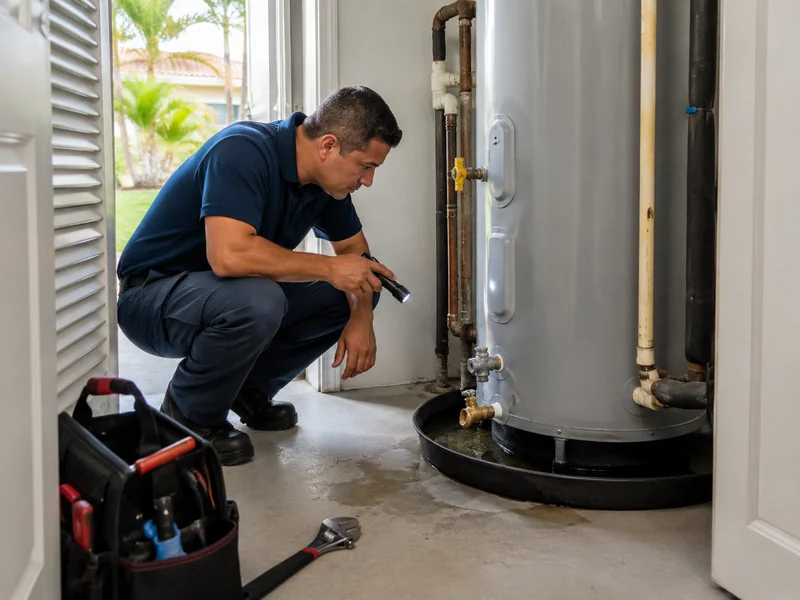
Finding water around your water heater in Arlington usually starts a guessing game nobody wins: is the tank itself failing, or is one of the old galvanized fittings above it weeping? In a town where 1890s to 1930s two-families still run original galvanized feed lines, the answer is the fitting more often than homeowners expect. Our leak-detection visits are built around that reality, isolating the true source with moisture meters, thermal imaging, and pressure testing before anyone talks about replacing a tank.
Arlington basements add their own complications. Low-clearance fieldstone cellars, narrow bulkhead stairs, and chronically damp slabs near Spy Pond and Alewife Brook all change how a leak looks and where it travels. We diagnose the heater in the context of the house around it, so the fix matches the actual problem.
Why Leak Detection in Arlington Starts at the Shutoff
In Arlington's pre-1940 two-families, the first thing a leak-detection visit confronts is often not the leak at all but the original gate-valve shutoff on the galvanized feed line, seized solid after decades. A shutoff that cannot close turns every leak into an emergency, so verifying and usually replacing it with a full-port ball valve is part of doing this job properly here. Once water can actually be stopped, the real diagnosis begins.
Soft MWRA water means Arlington tanks rarely die of scale. They die of depleted anode rods, corroded tank-top nipples where galvanized meets copper without sound dielectric unions, and base corrosion on damp slabs near Spy Pond and the Alewife Brook. Each failure leaves different evidence, rust streak patterns, mineral trails, meter readings, and a proper detection visit reads that evidence instead of assuming the tank is finished. That discipline is what keeps an Arlington homeowner from paying for a new heater when a fitting was the problem.
Arlington Housing Stock and What It Means for water heater leak detection
Arlington's housing stock is dominated by 1890s to 1930s two-family homes and colonials, with pockets of triple-deckers near Massachusetts Avenue and East Arlington, plus 1950s ranches and post-1980 condo conversions scattered through town. In pre-1940 homes the original galvanized steel supply lines are still common, with copper retrofits layered over them across decades of piecemeal upgrades. Water heaters here sit in basements almost without exception, usually unfinished or semi-finished, and full basements are the norm, fieldstone in pre-1900 homes and poured concrete or block in later ones.
For water heater leak detection, three Arlington facts matter most. First, the original gate-valve shutoffs on those old galvanized feeds seize with age, so any heater service should include replacing the shutoff with a full-port ball valve rather than fighting a valve that will not close in an emergency. Second, low-clearance unfinished basements with fieldstone walls and narrow bulkhead stairs make moving a 50-gallon tank the hard part of the job, so stairwell clearance has to be measured before delivery day. Third, the high water table near Spy Pond and the Alewife Brook keeps some basement slabs chronically damp, which rots heater bases from below, so a corrosion-resistant drain pan and elevating the tank on a stand pay for themselves here.
Arlington Water Supply and Winter Conditions
Arlington is a full MWRA water and sewer member, so the water reaching your heater is soft, roughly 15 to 20 parts per million or about one grain per gallon. Soft water means very little scale buildup inside the tank, which is good news for heating efficiency, but the sediment that does collect usually comes from the town's aging galvanized pipe network rather than the supply itself. It also means anode rods deplete on a different schedule than they do in hard-water towns, so the anode condition on an older tank is always worth inspecting during water heater leak detection.
Climate-wise Arlington follows the Boston Logan baseline, with January average lows around 22 to 23 degrees and hard freezes common from December through March. Pipes in unheated basements and exterior walls freeze every winter, and low-lying streets near Spy Pond and Alewife Brook see basement flooding during heavy rain. A water heater leak detection visit here factors in both risks: freeze exposure for supply lines and damp-slab corrosion for the tank itself.
How We Pinpoint a Water Heater Leak
A professional leak-detection visit is a diagnosis, not a guess. It starts with a full visual inspection of the tank jacket seams, the hot and cold connections on top, the temperature-and-pressure relief valve and its discharge pipe, and the drain valve at the base, because most Arlington leaks announce themselves at the fittings before the tank itself fails. From there we use electronic moisture meters on the surrounding floor and walls to map how far water has traveled, thermal imaging to trace hot-water migration behind and beneath the unit, and acoustic listening for pressurized sprays inside walls. The critical step is isolation: shutting the cold-water feed and watching system pressure tells us whether the tank, a supply line, or a drain component is the actual source.
That isolation step is what separates a real diagnosis from a tank sales pitch. In Arlington homes with layered old plumbing, the wet wall behind the heater often serves multiple floors, and condemning a tank for a supply-line leak wastes the homeowner's money. The visit ends with written findings, photos of what was found, and a clear recommendation: monitor it, repair the fitting, or replace the tank.
Tank Leak or Something Else? What We Rule Out First
More than half of suspected tank leaks turn out to be something else, and each alternative has a different fix. The most misdiagnosed is temperature-and-pressure relief valve weeping caused by thermal expansion on a closed plumbing system: when the expansion tank is waterlogged or undersized, pressure spikes lift the relief valve and it drips, which looks exactly like a tank leak but is fixed at the expansion tank, not the heater. Condensation is next, with cold-water tanks sweating in humid Arlington basements during summer and dripping onto the floor beneath. Loose dielectric unions and supply connections weep at the tank top, drain valves drip from worn washers, and pinhole leaks in nearby aging copper spray fine mists that collect at the heater base.
Each of these gets its own test during the visit: the relief valve gets a pressure reading, connections get dried and watched, and the tank jacket gets inspected for the rust streaks and blistering paint that mark a true tank-wall failure. Replacing a tank for a fitting problem is the most expensive mistake in this trade, and the whole point of detection-first service is to avoid it.
What Happens During a Leak-Detection Visit
If you find water around your heater before we arrive, the first step is the cold-water shutoff valve above the tank: turn it clockwise to stop the feed. If water is pooling near a gas burner, leave the gas valve alone and tell us when you call. Move stored items away from the water, and do not touch any electrical components standing in water.
On site, the technician runs a safety check first, then the visual inspection, meter readings, and isolation test described above. You get a plain-language explanation of what is leaking and why, with photos, and a written recommendation that separates urgent from watch-and-wait. Emergency visits handle active flooding and gas-adjacent situations the same day; scheduled visits suit slow seeps and mysterious damp spots. Either way, Arlington homeowners get the diagnosis before any repair or replacement is quoted, because the right fix depends entirely on the right identification.