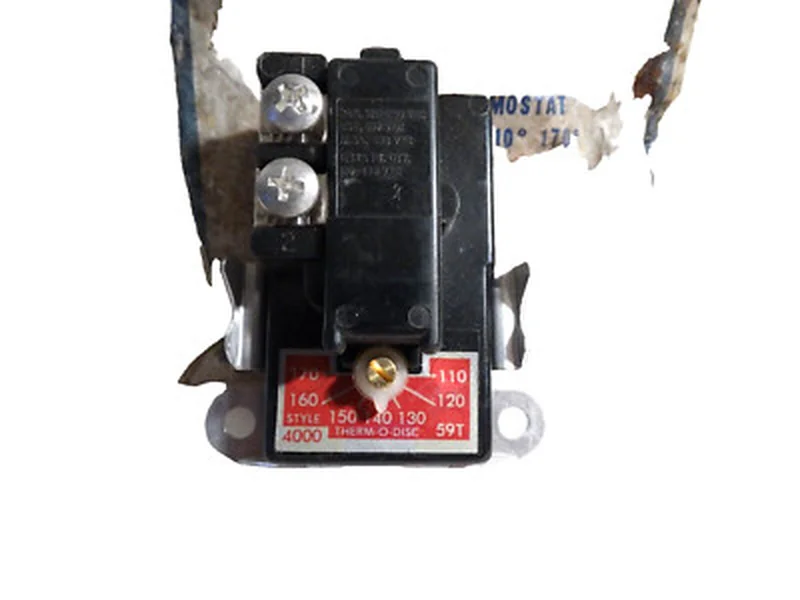
Every tank water heater has a thermostat. Electric models carry an upper and a lower thermostat behind access panels on the side of the tank, while gas models use a combination gas control valve with a built-in thermostat. Its job is simple: sense water temperature and cycle the burner or elements to hold the setpoint. When it fails, the heater either stops making hot water or, more dangerously, never stops heating.
In Woburn homes, thermostat failure usually announces itself as no hot water, scalding-hot water, lukewarm water that never gets hot, or a reset button that keeps tripping. Because a failed thermostat can mask itself as a dead heating element or a failed gas valve, our technicians test with a multimeter before replacing anything. The diagnosis determines whether you need a thermostat, an element, or a full control valve.
How Water Heater Thermostats Fail
Thermostats fail in a few predictable ways. Contacts weld shut from years of arcing, so the element or burner stays on and water climbs toward scalding temperatures until the high-limit safety trips. Or the sensing element drifts, the thermostat reads temperature wrong, and the tank short-cycles or never reaches the setpoint. On electric heaters the upper and lower thermostats work as a team: a dead upper thermostat kills all heating, while a dead lower thermostat leaves you with a tank that is hot on top and cold on the bottom.
Sediment is the silent accomplice. In Woburn, the city's blended well water still leaves sediment in the tank bottom from aging pipes and normal mineral fallout, and that sediment buries the lower thermostat and element, insulating them from the water they are supposed to sense. The result is lukewarm water and a thermostat that tests fine on the bench but cannot read temperature through baked-on sediment.
The warning signs to act on: water hot enough to scald, no hot water at all, the red reset button tripping repeatedly, or hot water that runs out far faster than it used to. A tripping reset button is the high-limit safety doing its job — resetting it without fixing the thermostat is how tanks overheat. If your water is suddenly scalding, treat it as urgent and shut the heater down.
Woburn Housing Stock and What It Means for Thermostat Replacement
Woburn is 1950s to 1970s ranches, split-levels, and colonials with older Victorians and two-families in the center and 1980s and later subdivisions and condos. The post-war stock runs original copper now aging into pinhole-leak years, pre-war center homes carry galvanized pipe, basement heaters are standard, and some ranches put units in crawl spaces. Full basements are common, ranches use crawl spaces and slabs, the Horn Pond area sits over a high water table, and drainage is otherwise decent.
For Thermostat Replacement, the water is the headline: about two-thirds of Woburn's supply comes from the city's own Horn Pond wellfield, with town reports measuring hardness around 83 to 89 parts per million against roughly 15 to 20 on the MWRA side — the hardest blended water on this list. That means measurably more sediment and scale accumulation in tanks, so annual flushing genuinely matters here, and sediment-baked lower elements with rumbling tanks are among our most common service calls. The 1950s to 1960s copper is at end of life, so pinhole leaks in hot-water lines near the heater get the same diagnostic discipline as Saugus and Stoneham. Ranch crawl spaces with unconditioned heater piping bring January freeze-split calls, which get insulated and heat-traced. And Horn Pond-area high water tables bring damp-basement bottom corrosion, handled with elevation and pans.
Woburn Water Supply and Winter Conditions
Woburn is an MWRA partial member: roughly one-third MWRA water, two-thirds from the city's own Horn Pond wellfield. Horn Pond treated water has measured about 83 to 89 parts per million hardness in recent town reports — moderately hard — against the MWRA's 15 to 20. That makes Woburn's blended supply the hardest water on this list by a wide margin, and Thermostat Replacement here is built around it: sediment assessment on every visit, annual flushing as genuine leak prevention, and descaling where scale is found.
Winters follow the regional freeze baseline with inland cold snaps, and the Horn Pond lowlands run damp. Thermostat Replacement in Woburn pairs the water work with the weather work: flushed tanks, insulated crawl-space runs, and verified sump operation where the water table warrants it.
What Happens During a Thermostat Replacement Visit
Thermostat replacement is a contained, methodical job. Here is how our Woburn technicians handle it:
- Shut off power at the breaker (electric) or turn the gas control to pilot or off, and verify with a meter that the heater is dead before any panel is opened.
- Remove the access panels and insulation to expose the upper and lower thermostats and elements, noting any scorching or water damage.
- Test both thermostats and both elements with a multimeter for continuity and proper switching — this is what separates a thermostat failure from an element failure.
- Drain a few gallons if needed for access, then replace the failed thermostat with a like-for-like rated part, checking wiring for heat damage.
- Set both thermostats to 120 degrees, the standard that balances scald safety and usable hot water.
- Restore power or gas, run a full heating cycle, and confirm the burner or elements cut out exactly at the setpoint.
- Verify the high-limit safety and the temperature-pressure relief valve operate correctly before leaving.
Ranch crawl spaces and split-level utility rooms need access verification at booking. Horn Pond-area homes with damp basements get a condition check before we dispatch heavy equipment. We also check the anode rod and tank sediment while the panels are off, since a thermostat failure in an older tank is often the first sign the whole heater is aging out.
Thermostat Replacement FAQs for Woburn
Woburn, MA 01801 homeowners ask us these questions about water heater thermostats. Here are direct answers.
Getting the Full Life Out of Your Thermostats in Woburn
Thermostats last longest in clean, dry conditions: a flushed tank, intact insulation over the access panels, and wiring that has never overheated. In Woburn, the city's blended well water, the single highest-value habit is an annual tank flush, because sediment burying the lower thermostat is the most common reason controls die early here. The flush takes less than an hour and protects the elements, the thermostats, and the tank itself.
Test the temperature at the tap once a year with a simple thermometer. If the water runs hotter than the 120-degree setting, the thermostat is drifting and deserves attention before it becomes a scald risk. And when a thermostat does fail in a tank past ten years, take the honest assessment seriously: a new control in a dying tank buys months, while a planned replacement buys a decade.