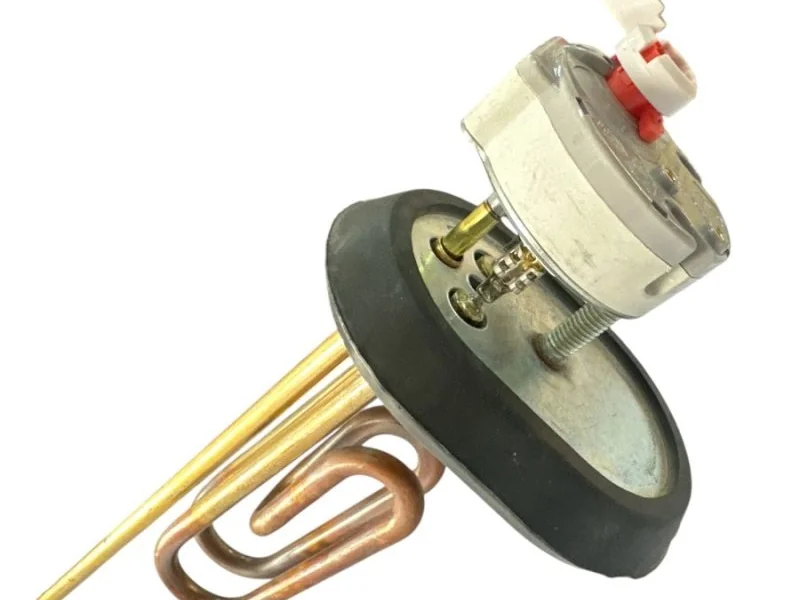
Every tank water heater has a thermostat. Electric models carry an upper and a lower thermostat behind access panels on the side of the tank, while gas models use a combination gas control valve with a built-in thermostat. Its job is simple: sense water temperature and cycle the burner or elements to hold the setpoint. When it fails, the heater either stops making hot water or, more dangerously, never stops heating.
In Everett homes, thermostat failure usually announces itself as no hot water, scalding-hot water, lukewarm water that never gets hot, or a reset button that keeps tripping. Because a failed thermostat can mask itself as a dead heating element or a failed gas valve, our technicians test with a multimeter before replacing anything. The diagnosis determines whether you need a thermostat, an element, or a full control valve.
How Water Heater Thermostats Fail
Thermostats fail in a few predictable ways. Contacts weld shut from years of arcing, so the element or burner stays on and water climbs toward scalding temperatures until the high-limit safety trips. Or the sensing element drifts, the thermostat reads temperature wrong, and the tank short-cycles or never reaches the setpoint. On electric heaters the upper and lower thermostats work as a team: a dead upper thermostat kills all heating, while a dead lower thermostat leaves you with a tank that is hot on top and cold on the bottom.
Sediment is the silent accomplice. In Everett, soft MWRA water still leaves sediment in the tank bottom from aging pipes and normal mineral fallout, and that sediment buries the lower thermostat and element, insulating them from the water they are supposed to sense. The result is lukewarm water and a thermostat that tests fine on the bench but cannot read temperature through baked-on sediment.
The warning signs to act on: water hot enough to scald, no hot water at all, the red reset button tripping repeatedly, or hot water that runs out far faster than it used to. A tripping reset button is the high-limit safety doing its job — resetting it without fixing the thermostat is how tanks overheat. If your water is suddenly scalding, treat it as urgent and shut the heater down.
Everett Housing Stock and What It Means for Thermostat Replacement
Everett's 1900 to 1930 triple-deckers and two-families in Glendale and Woodlawn give way to capes and ranches in the northern sections and large new apartment developments near the casino district. The old triple-decker stock still carries galvanized pipe with copper retrofits layered in, post-1980 construction runs copper and PEX, and basement heaters are standard in the houses. Full basements dominate, and the low-lying areas near the Malden and Mystic Rivers sit over high water tables with flood-prone basements.
For Thermostat Replacement, the triple-decker dynamics mirror Chelsea and Malden: stacked bathrooms above the heater and shared basements mean a leaking tank threatens finished lower units, so fast response wins the job. Industrial-era housing near the Malden River breathes corrosive damp basement air that accelerates tank-jacket and fitting corrosion, which makes stainless or powered-anode options worth discussing with owners. Narrow residential streets with tight parking in Woodlawn and Glendale mean tank delivery logistics get planned around bulkhead-only access. The newer large apartment complexes near the casino run commercial-scale systems under property-management contracts, a different buyer than the homeowner market entirely.
Everett Water Supply and Winter Conditions
Everett is a full MWRA water and sewer member with soft water near 15 to 20 parts per million. Tanks here are not fighting scale. They are fighting age, damp river-lowland basements, and in the industrial-era stock, corrosive basement air that attacks jackets and fittings from the outside while the soft water quietly depletes anodes on the inside.
Winters follow the regional freeze baseline, and the river-adjacent lowlands flood in heavy rain and nor'easters. Thermostat Replacement in the Malden and Mystic lowlands pairs heater work with a hard look at sump pump operation, because a heater sitting in a basement that floods every other spring needs elevation and drainage, not just a new tank.
What Happens During a Thermostat Replacement Visit
Thermostat replacement is a contained, methodical job. Here is how our Everett technicians handle it:
- Shut off power at the breaker (electric) or turn the gas control to pilot or off, and verify with a meter that the heater is dead before any panel is opened.
- Remove the access panels and insulation to expose the upper and lower thermostats and elements, noting any scorching or water damage.
- Test both thermostats and both elements with a multimeter for continuity and proper switching — this is what separates a thermostat failure from an element failure.
- Drain a few gallons if needed for access, then replace the failed thermostat with a like-for-like rated part, checking wiring for heat damage.
- Set both thermostats to 120 degrees, the standard that balances scald safety and usable hot water.
- Restore power or gas, run a full heating cycle, and confirm the burner or elements cut out exactly at the setpoint.
- Verify the high-limit safety and the temperature-pressure relief valve operate correctly before leaving.
Tight parking on Woodlawn and Glendale streets means we confirm van placement when booking. Bulkhead-only access is common, so tank size and stairwell clearance get verified in advance. We also check the anode rod and tank sediment while the panels are off, since a thermostat failure in an older tank is often the first sign the whole heater is aging out.
Thermostat Replacement FAQs for Everett
Everett, MA 02149 homeowners ask us these questions about water heater thermostats. Here are direct answers.
Getting the Full Life Out of Your Thermostats in Everett
Thermostats last longest in clean, dry conditions: a flushed tank, intact insulation over the access panels, and wiring that has never overheated. In Everett, soft MWRA water, the single highest-value habit is an annual tank flush, because sediment burying the lower thermostat is the most common reason controls die early here. The flush takes less than an hour and protects the elements, the thermostats, and the tank itself.
Test the temperature at the tap once a year with a simple thermometer. If the water runs hotter than the 120-degree setting, the thermostat is drifting and deserves attention before it becomes a scald risk. And when a thermostat does fail in a tank past ten years, take the honest assessment seriously: a new control in a dying tank buys months, while a planned replacement buys a decade.
Upper vs. Lower Thermostat: Which One Failed in Everett
An electric water heater's two thermostats divide the tank: the upper thermostat (with its built-in high-limit safety) controls the upper element and hands off to the lower thermostat once the top is hot. When the upper thermostat fails, you get no hot water at all or a tripped reset button. When the lower one fails, you get a tank of lukewarm water that runs out fast — the top heats, the bottom never catches up. In Everett, triple-deckers stack bathrooms above basement heaters in shared basements — one leaking tank threatens finished lower units, and the symptom pattern tells us which thermostat to test first before we open anything.
Testing is definitive: power off and verified dead, then continuity and calibration checks on each thermostat against a known temperature. soft MWRA water (about 15–20 ppm hardness) here, so we're not fighting the heavy scale that cooks thermostats in hard-water towns — failures in Everett are usually age, heat cycling, or moisture. industrial-era housing near the Malden River sits in corrosive damp basement air that attacks tank jackets and fittings. Replacement means seating the new thermostat flat against the clean tank wall (an air gap throws calibration off), setting both thermostats to the same temperature, and verifying the handoff with an amperage check on each element. Matched, seated, and tested — not just swapped.
Calibrating After Thermostat Replacement in Everett
A new thermostat installed without calibration is a guess, not a repair. Thermostats sense tank-wall temperature through direct contact, so the mating surface has to be clean and the thermostat seated flat — industrial-era housing near the Malden River sits in corrosive damp basement air that attacks tank jackets and fittings in Everett's older installations, where we often find corrosion or old insulation packed against the tank wall. We clean the contact area, seat the new unit, and set both thermostats to the same temperature: 120°F is the standard recommendation, hot enough for household use and dishwashers, cool enough to limit scald risk and standby loss.
Then we verify rather than assume: restore power, and check with a meter that each element draws its rated amperage in sequence — upper first, then the handoff to lower. triple-deckers stack bathrooms above basement heaters in shared basements — one leaking tank threatens finished lower units. If the upper element never hands off, or the high-limit trips during the test cycle, something else is wrong and we find it before leaving. narrow residential streets with tight parking make bulkhead-only access the norm in Woodlawn and Glendale. A thermostat replacement done right ends with the tank heating in the correct sequence at the correct temperature, confirmed by measurement.