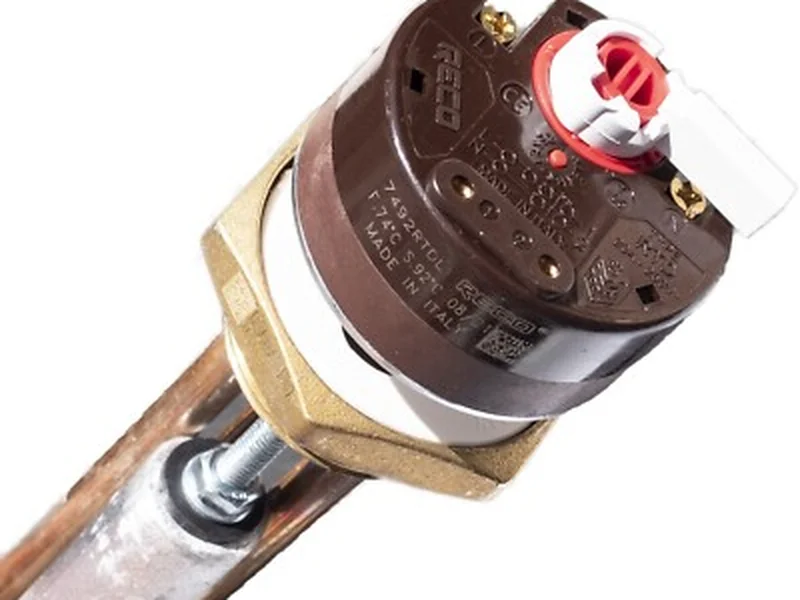
Every tank water heater has a thermostat. Electric models carry an upper and a lower thermostat behind access panels on the side of the tank, while gas models use a combination gas control valve with a built-in thermostat. Its job is simple: sense water temperature and cycle the burner or elements to hold the setpoint. When it fails, the heater either stops making hot water or, more dangerously, never stops heating.
In Cambridge homes, thermostat failure usually announces itself as no hot water, scalding-hot water, lukewarm water that never gets hot, or a reset button that keeps tripping. Because a failed thermostat can mask itself as a dead heating element or a failed gas valve, our technicians test with a multimeter before replacing anything. The diagnosis determines whether you need a thermostat, an element, or a full control valve.
How Water Heater Thermostats Fail
Thermostats fail in a few predictable ways. Contacts weld shut from years of arcing, so the element or burner stays on and water climbs toward scalding temperatures until the high-limit safety trips. Or the sensing element drifts, the thermostat reads temperature wrong, and the tank short-cycles or never reaches the setpoint. On electric heaters the upper and lower thermostats work as a team: a dead upper thermostat kills all heating, while a dead lower thermostat leaves you with a tank that is hot on top and cold on the bottom.
Sediment is the silent accomplice. In Cambridge, the city's own reservoir supply still leaves sediment in the tank bottom from aging pipes and normal mineral fallout, and that sediment buries the lower thermostat and element, insulating them from the water they are supposed to sense. The result is lukewarm water and a thermostat that tests fine on the bench but cannot read temperature through baked-on sediment.
The warning signs to act on: water hot enough to scald, no hot water at all, the red reset button tripping repeatedly, or hot water that runs out far faster than it used to. A tripping reset button is the high-limit safety doing its job — resetting it without fixing the thermostat is how tanks overheat. If your water is suddenly scalding, treat it as urgent and shut the heater down.
Cambridge Housing Stock and What It Means for Thermostat Replacement
The 02138 area around Harvard Square and North Cambridge mixes triple-deckers and two-families in Cambridgeport, East Cambridge, and Riverside with Victorians near Avon Hill and Harvard Square, mid-century apartment buildings, and modern luxury condos in Kendall Square and Alewife. Pre-1940 multi-families still carry galvanized pipe, heavily retrofitted with copper over the years, mid-century buildings run copper, and new construction uses PEX. Basement heaters serve the houses, many in finished basements near Harvard Square, while condos use closet or mechanical-room units. Full basements are standard in houses, new towers sit on slab or podium, and the water table runs high near the Charles River and Alewife Brook.
For Thermostat Replacement, triple-decker density in Cambridgeport and Riverside sets the diagnostic discipline: stacked units, shared basements, and old galvanized risers mean a suspected tank leak has to be checked against supply-line leaks before the tank is condemned, because the wet wall serves three floors. In the Kendall and Alewife condo towers, HOA work rules, elevator reservations for tank transport, and common-area shutoff coordination turn a residential call into commercial-style logistics. Basement heaters in flood-prone houses near the Charles and Alewife should be elevated and paired with working sump pumps, and post-flood heater inspections are a genuine seasonal call driver.
Cambridge Water Supply and Winter Conditions
Cambridge runs its own water system through the Cambridge Water Department, supplied by the Hobbs Brook, Stony Brook, and Fresh Pond reservoirs, with the MWRA interconnection reserved for emergencies. Cambridge has bought MWRA water during droughts, such as in 2016, so the supply mix can shift in dry years. Because the chemistry can differ from MWRA towns during those blends, Thermostat Replacement here stays clear of hard-water scale claims and focuses on what is verifiable: tank age, installation quality, anode condition, and the dampness of the basement around the heater.
Winters follow the regional freeze baseline, and Charles River and Alewife floodplain basements flood in nor'easters. A submerged gas heater is a replacement, not a repair, since gas controls cannot be salvaged after submersion, so post-storm Thermostat Replacement scheduling in the floodplain runs hot after every major event.
What Happens During a Thermostat Replacement Visit
Thermostat replacement is a contained, methodical job. Here is how our Cambridge technicians handle it:
- Shut off power at the breaker (electric) or turn the gas control to pilot or off, and verify with a meter that the heater is dead before any panel is opened.
- Remove the access panels and insulation to expose the upper and lower thermostats and elements, noting any scorching or water damage.
- Test both thermostats and both elements with a multimeter for continuity and proper switching — this is what separates a thermostat failure from an element failure.
- Drain a few gallons if needed for access, then replace the failed thermostat with a like-for-like rated part, checking wiring for heat damage.
- Set both thermostats to 120 degrees, the standard that balances scald safety and usable hot water.
- Restore power or gas, run a full heating cycle, and confirm the burner or elements cut out exactly at the setpoint.
- Verify the high-limit safety and the temperature-pressure relief valve operate correctly before leaving.
Kendall Square and Alewife condo towers require elevator reservations and HOA work-rule compliance for equipment moves, which we schedule ahead. In Cambridgeport and Riverside, narrow streets and limited parking shape every service call. We also check the anode rod and tank sediment while the panels are off, since a thermostat failure in an older tank is often the first sign the whole heater is aging out.
Thermostat Replacement FAQs for Cambridge
Cambridge, MA 02138 homeowners ask us these questions about water heater thermostats. Here are direct answers.
Getting the Full Life Out of Your Thermostats in Cambridge
Thermostats last longest in clean, dry conditions: a flushed tank, intact insulation over the access panels, and wiring that has never overheated. In Cambridge, the city's own reservoir supply, the single highest-value habit is an annual tank flush, because sediment burying the lower thermostat is the most common reason controls die early here. The flush takes less than an hour and protects the elements, the thermostats, and the tank itself.
Test the temperature at the tap once a year with a simple thermometer. If the water runs hotter than the 120-degree setting, the thermostat is drifting and deserves attention before it becomes a scald risk. And when a thermostat does fail in a tank past ten years, take the honest assessment seriously: a new control in a dying tank buys months, while a planned replacement buys a decade.