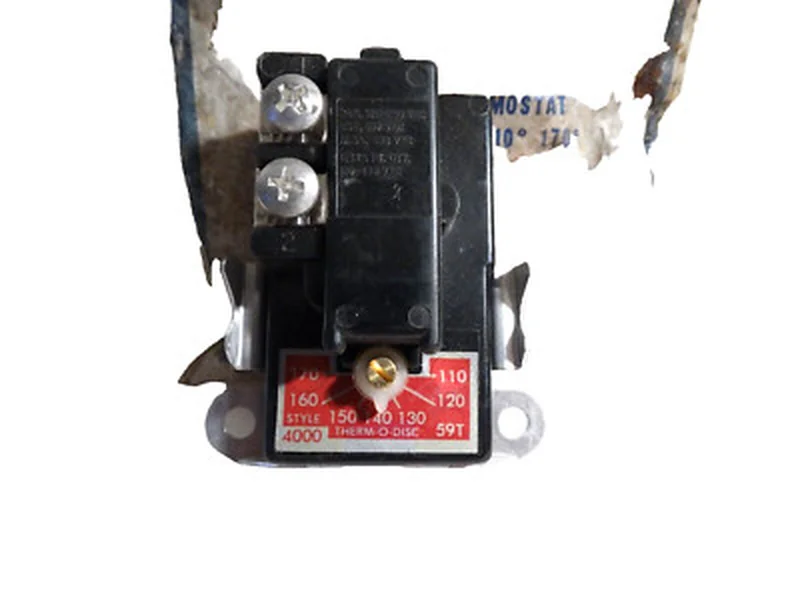
Every tank water heater has a thermostat. Electric models carry an upper and a lower thermostat behind access panels on the side of the tank, while gas models use a combination gas control valve with a built-in thermostat. Its job is simple: sense water temperature and cycle the burner or elements to hold the setpoint. When it fails, the heater either stops making hot water or, more dangerously, never stops heating.
In Brookline homes, thermostat failure usually announces itself as no hot water, scalding-hot water, lukewarm water that never gets hot, or a reset button that keeps tripping. Because a failed thermostat can mask itself as a dead heating element or a failed gas valve, our technicians test with a multimeter before replacing anything. The diagnosis determines whether you need a thermostat, an element, or a full control valve.
How Water Heater Thermostats Fail
Thermostats fail in a few predictable ways. Contacts weld shut from years of arcing, so the element or burner stays on and water climbs toward scalding temperatures until the high-limit safety trips. Or the sensing element drifts, the thermostat reads temperature wrong, and the tank short-cycles or never reaches the setpoint. On electric heaters the upper and lower thermostats work as a team: a dead upper thermostat kills all heating, while a dead lower thermostat leaves you with a tank that is hot on top and cold on the bottom.
Sediment is the silent accomplice. In Brookline, soft MWRA water still leaves sediment in the tank bottom from aging pipes and normal mineral fallout, and that sediment buries the lower thermostat and element, insulating them from the water they are supposed to sense. The result is lukewarm water and a thermostat that tests fine on the bench but cannot read temperature through baked-on sediment.
The warning signs to act on: water hot enough to scald, no hot water at all, the red reset button tripping repeatedly, or hot water that runs out far faster than it used to. A tripping reset button is the high-limit safety doing its job — resetting it without fixing the thermostat is how tanks overheat. If your water is suddenly scalding, treat it as urgent and shut the heater down.
Brookline Housing Stock and What It Means for Thermostat Replacement
Brookline's dense blocks around Coolidge Corner and Brookline Village hold 1890s to 1920s multi-family buildings and triple-deckers, while North Brookline and Chestnut Hill have Victorians and large colonials, plus garden-style apartment complexes and newer condos along Beacon Street. The oldest stock still has galvanized pipe, much of it replaced with copper during condo conversions, mid-century buildings run copper, and recent renovations use PEX. Heaters sit in basements in houses, many of them finished, and in unit closets in condos and apartments. Full basements are standard, some garden apartments sit on slab, and the Muddy River and Emerald Necklace lowlands carry a high water table.
For Thermostat Replacement, density is the story. In a triple-decker, one leaking heater can damage the unit below, so liability and response speed matter and round-the-clock emergency availability is a real selling point on Coolidge Corner blocks. Condo conversions are everywhere, and unit owners often do not know where their individual shutoff is when the heater sits in a common basement mechanical room, so the first minutes of a service call are frequently spent locating the right valve. In older triple-deckers with shared basement heater rooms, access needs tenant coordination, and documenting whose heater is whose before work starts avoids disputes later.
Brookline Water Supply and Winter Conditions
Brookline is a full MWRA water and sewer member with soft water near 15 to 20 parts per million. Like its neighbors, it gets minimal scaling but steady age-related failure: tanks here die of old galvanized fittings, depleted anodes, and damp basements far more often than of anything in the water itself.
The regional freeze baseline applies, and low areas near the Muddy River flood in heavy storms, which means basement heaters in the Emerald Necklace lowlands should be elevated and paired with verified sump pumps. In Brookline's expensive single-family stock, finished basements are common, so Thermostat Replacement routinely includes the finished-basement protection package: a pan with a real drain, a leak sensor, and a shutoff the homeowner can actually find and reach.
What Happens During a Thermostat Replacement Visit
Thermostat replacement is a contained, methodical job. Here is how our Brookline technicians handle it:
- Shut off power at the breaker (electric) or turn the gas control to pilot or off, and verify with a meter that the heater is dead before any panel is opened.
- Remove the access panels and insulation to expose the upper and lower thermostats and elements, noting any scorching or water damage.
- Test both thermostats and both elements with a multimeter for continuity and proper switching — this is what separates a thermostat failure from an element failure.
- Drain a few gallons if needed for access, then replace the failed thermostat with a like-for-like rated part, checking wiring for heat damage.
- Set both thermostats to 120 degrees, the standard that balances scald safety and usable hot water.
- Restore power or gas, run a full heating cycle, and confirm the burner or elements cut out exactly at the setpoint.
- Verify the high-limit safety and the temperature-pressure relief valve operate correctly before leaving.
Coolidge Corner blocks have almost no off-street parking, so we plan van placement and the tank carry in advance. Shared basement heater rooms in triple-deckers need tenant coordination, which we arrange when the appointment is booked. We also check the anode rod and tank sediment while the panels are off, since a thermostat failure in an older tank is often the first sign the whole heater is aging out.
Thermostat Replacement FAQs for Brookline
Brookline, MA 02446 homeowners ask us these questions about water heater thermostats. Here are direct answers.
Getting the Full Life Out of Your Thermostats in Brookline
Thermostats last longest in clean, dry conditions: a flushed tank, intact insulation over the access panels, and wiring that has never overheated. In Brookline, soft MWRA water, the single highest-value habit is an annual tank flush, because sediment burying the lower thermostat is the most common reason controls die early here. The flush takes less than an hour and protects the elements, the thermostats, and the tank itself.
Test the temperature at the tap once a year with a simple thermometer. If the water runs hotter than the 120-degree setting, the thermostat is drifting and deserves attention before it becomes a scald risk. And when a thermostat does fail in a tank past ten years, take the honest assessment seriously: a new control in a dying tank buys months, while a planned replacement buys a decade.