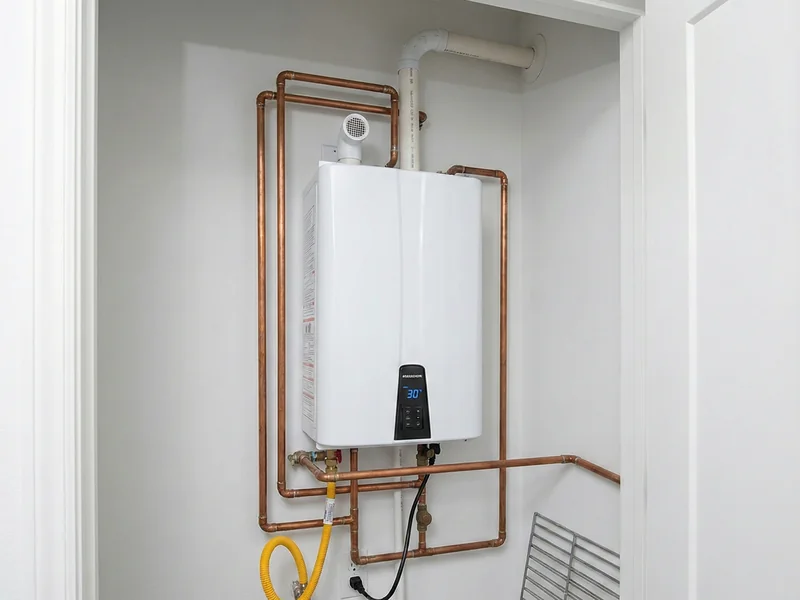
A tankless water heater does not store hot water. It heats water on demand as it flows through a compact heat exchanger, which eliminates the classic burst-tank flood but creates its own leak points: the heat exchanger itself, the cold and hot water connections, the pressure relief valve, the condensate drain on condensing models, and the internal O-rings and gaskets that seal the water path. When a tankless unit leaks in Revere, the water usually appears as a slow drip or a puddle beneath the wall-hung unit rather than a basement flood.
Because these units are sealed, wall-mounted appliances with electronic controls, diagnosis matters more here than on a tank heater. A drip from the bottom of the cabinet can originate at a fitting inches away, and an error code on the display often points at the same scale buildup that caused the leak. Our Revere technicians pressure-test the unit, inspect the exchanger, and trace the water to its source before quoting any repair.
Where Tankless Water Heaters Leak
Heat exchanger failure is the most serious tankless leak. Scale buildup insulates the exchanger walls, creating hot spots that stress the metal until pinholes or cracks open. Freeze damage is the other exchanger killer: in an unheated garage or on an exterior wall, a January cold snap can split the narrow waterways, and the unit will weep or stream water the next time it fires.
More common and far cheaper are connection leaks. The cold-water inlet and hot-water outlet unions, the isolation and service valves, and the pressure relief valve all use gaskets and O-rings that harden with age and heat cycling. On condensing models, the condensate trap and drain line clog or crack, and the unit drips acidic condensate that is often mistaken for a water leak. Venting problems can also push exhaust condensation back into the cabinet.
The warning signs Revere homeowners notice first: water pooling under the wall unit, a drip from the vent termination outside, an error code on the display, fluctuating water temperature, or white mineral crust forming around fittings. Any of these deserves a service call before the drip finds drywall, because a slow tankless leak inside a wall cavity does its damage silently.
Revere Housing Stock and What It Means for Tankless Water Heater Leak Repair
Revere is triple-deckers and two-families with 1920s to 1950s capes and bungalows near the beach, post-war ranches inland, and new waterfront developments. The old stock carries galvanized pipe, mid-century homes run copper, basement heaters are standard, and some beach cottages put heaters in crawl spaces or closets. Full basements are the norm, the water table runs high across the city on former marshland around Rumney Marsh, some mid-century builds sit on slab, and basement flooding is a known citywide issue.
For Tankless Water Heater Leak Repair, the water table dominates: more Revere heaters sit in chronically damp basements than anywhere else on this list, so bottom corrosion and failed drain valves dominate service calls and the tank base gets inspected first. Storm-surge submersion brings the clearest rule in the service area — beach-area heaters that take on salt water must be replaced, not repaired, because gas controls are non-salvageable after submersion. Beach bungalows and cottages with crawl-space heaters face freeze risk and flood risk in the same unit, so elevation plus insulation plus a drain pan is the standard recommendation. And the older triple-deckers with original galvanized risers follow the fitting-corrosion-first diagnostic rule: check the connections before condemning the tank.
Revere Water Supply and Winter Conditions
Revere is a full MWRA water and sewer member with soft water near 15 to 20 parts per million. The supply is the easy part of the Revere story. The hard part is everything the water table and the ocean do to heaters: chronic dampness rotting bases, and surge events ending heater lives outright.
Direct coastal exposure makes Revere one of the highest basement-flood-risk cities on this list — nor'easter storm surge hits the Revere Beach neighborhoods head-on. Tankless Water Heater Leak Repair here is scheduled around the storm calendar as much as the service calendar: pre-season elevation and pump checks, post-storm submersion inspections, and replacement waves that arrive on schedule after every major surge.
What Happens During a Tankless Leak Repair Visit
A tankless leak repair is a diagnostic visit first and a repair second. Here is the sequence our technicians follow in Revere homes:
- Shut down the unit safely: gas cock closed or breaker off, then the hot and cold isolation valves closed so the unit is isolated from house pressure.
- Relieve pressure and drain the exchanger through the service valves, catching the water to inspect it for scale and sediment.
- Pressure-test the water path and inspect every joint with a light and mirror: unions, service valves, relief valve, condensate trap, and the exchanger itself.
- Descale the heat exchanger with a pump and food-grade vinegar solution when scale is present, restoring heat transfer and stopping the overheating that caused the leak.
- Replace the failed components — gaskets, O-rings, unions, relief valve, or condensate parts — with parts rated for the unit.
- Verify venting slope and condensate drainage, clear any blockages, and confirm the unit's freeze-protection features are functional.
- Restart the unit, run hot water at full flow, and watch every repaired joint under working pressure before leaving.
Beach-area streets flood in storms, so we confirm access conditions after weather events. Crawl-space heaters in bungalows need clearance checks before the visit. Once the repair is verified, we walk you through what caused the leak and the maintenance interval that prevents a repeat.
Tankless Leak Repair FAQs for Revere
Homeowners in Revere, MA 02151 ask us the same questions about tankless leaks. Here are straight answers based on what we find in local homes.
Preventing the Next Tankless Leak in Revere
Most tankless leaks are preventable with two habits: annual descaling and annual inspection of the water connections. In Revere, soft MWRA water, descaling keeps the exchanger transferring heat cleanly so joints never see the overheating that makes them weep. The connection check takes minutes during any service visit: unions get inspected for crust, isolation valves get exercised so they do not seize, and the condensate drain gets flushed clear.
Placement matters too. If your unit hangs on an exterior wall or in an unconditioned space, insulation on exposed piping and a verified freeze-protection cycle are what stand between the exchanger and a January split. And if the unit is approaching fifteen years with a scaled exchanger and obsolete parts, a planned replacement beats an emergency one every time.