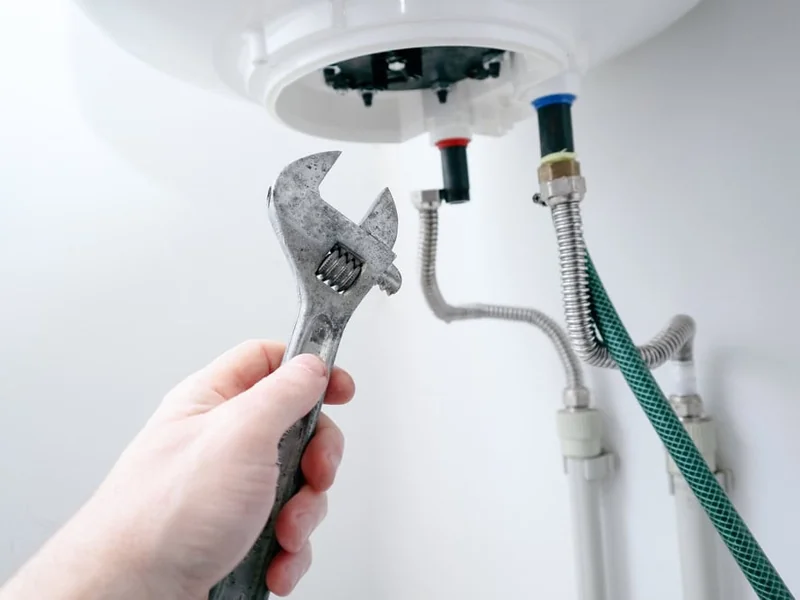
Somerville leak calls come from the densest heater market we service: triple-deckers stacked along every street, shared basements, bathrooms above heaters, and a gut-renovation cycle that hides decade-old tanks behind brand-new PEX. A leaking heater here threatens the unit below as a matter of course, and the diagnostic discipline — trace before judging, fittings before tank — matters more per square mile than anywhere else on our map.
Our technicians diagnose and repair leaking tank water heaters across Somerville, MA 02143, from Davis Square to Assembly Row. The Somerville protocol: identify whose heater in shared basements before touching anything; rule out supply lines from stacked bathrooms; check the renovation-mismatch tanks that look new from the pipes but are old at the core; and move fast, because density multiplies every leak. Below is the complete high-density playbook.
Whose Heater: Identification Before Wrenches
In Somerville's shared triple-decker basements, the first task is administrative: which of the two or three heaters serves the complaining unit, and is the water even from a heater? Stacked bathrooms above mean supply-line leaks travel down through floor assemblies to pool beside sound heaters. We trace hot-water lines, check labels, confirm with the owner or tenant — and document with photos — before any diagnostic work begins.
The wrong-heater mistake is the density tax: in a shared mechanical room with three similar tanks, it is easy to service the wrong one. Our identification protocol exists because the error is that easy and that expensive. Landlords: label every heater and shutoff by unit. It is the cheapest damage prevention in the building, and it makes every future service call faster.
The Renovation-Mismatch Tank
Somerville's gut renovations hide the leak call that surprises everyone: a building with new PEX throughout, and a twelve-year-old tank with a rusting base ring underneath it all. The pipes look new, so the tank gets no suspicion — until the base lets go. We assess heater age and condition independently of the visible plumbing on every call, because the mismatch is Somerville's signature trap.
The base-ring check is the key diagnostic on these calls: a decade-old tank in a damp shared basement corrodes from below regardless of how new the pipes are. When we find it, the conversation is the honest one — the renovation should have included the heater, and the timeline now is replacement planning, not repair optimism. New pipes do not rejuvenate old steel.
Speed in the Densest Market
A leaking heater in a Somerville triple-decker is a multi-household event within the hour: water through the floor assembly into the unit below, tenants calling the landlord, the landlord calling us. Shutoff speed is the controlling variable — and in shared basements, the person discovering the leak often does not know where the shutoff is. Our standing advice: label everything, verify valves turn, give tenants the one-line emergency instruction.
Our response is built for the density: realistic scheduling around the parking and access constraints, first-visit completion as the planned outcome, and the written record for the owner's files. In the densest heater market we service, the service model is speed plus accuracy — fast enough to limit the damage, disciplined enough to fix the right thing.
Fittings, Expansion, and the Full Trace
Even at Somerville volume, the diagnostic discipline does not shortcut: corroded tank-top nipples and failed dielectric unions on century-old risers, weeping T&P valves, dripping drain valves, waterlogged expansion tanks on closed systems — each imitates tank failure, each is a repair. We dry, trace upward with tissue and mirror, and judge the tank only on moisture from its own seams, wall, or base ring.
The expansion tank check is particularly valuable in the renovated buildings: new closed-system plumbing with an old or missing expansion tank produces relief-valve discharge that gets misread as tank failure in a building where everything else looks new. Minutes of testing, inexpensive fix, wrong-tank-replacement prevented. At Somerville's service volume, that discipline pays for itself weekly.
Tank Leak or Fitting Leak? How We Diagnose Before We Recommend
The most important moment in any water heater leak call is the diagnosis, because a large share of the "leaking tanks" we are called to are not leaking tanks at all. Water pooling at the base of a heater can originate from a corroded hot or cold nipple at the tank top, a failed dielectric union where copper meets steel, a weeping temperature-pressure (T&P) relief valve, a dripping drain valve, a waterlogged expansion tank on a closed plumbing system, or plain condensation sweating off cold inlet piping — every one of which is a targeted repair rather than a full replacement. Our technicians dry the area, then trace the moisture upward with tissue and an inspection mirror: tank-top fittings first, then the T&P discharge pipe, then the weld seams and base ring of the tank itself.
A true tank failure — a rusted-through weld seam, a pinhole in the glass-lined steel, a base ring eaten away by years of sitting in dampness — cannot be patched. The steel is compromised and the tank has to be replaced. But a T&P valve lifting under thermal expansion, or a drain valve that never sealed again after a flush, is a repair that restores the heater for a fraction of what a replacement involves. We also check the expansion tank's air charge on closed systems, because a saturated expansion tank turns normal heating cycles into pressure spikes that force water out of the T&P valve — and that gets misread as tank failure all the time. Honest diagnosis is the whole job: we show you exactly where the water is coming from before we recommend a fix.
Safety When Your Water Heater Is Leaking
A leaking water heater is a scalding and flooding hazard, not just a plumbing nuisance. First, stop the water: close the cold-water supply valve above the heater. If you cannot find it, or it is seized — common in older homes — shut the main house valve instead. For a gas heater, turn the gas control knob to the off position; for an electric heater, switch off its dedicated breaker. Do not touch a leaking electric heater's wiring compartment with wet hands or while standing in water — switch the breaker off from a dry position first.
Never plug the T&P relief valve's discharge pipe or cap the valve itself. It is the tank's last defense against overpressure, and defeating it can turn a manageable leak into a rupture. If the leak is severe, attach a garden hose to the drain valve and route it to a floor drain to slow the flooding while you wait for service. And if the basement has standing water around a gas heater, keep clear until it is inspected — submerged gas controls must be replaced outright, and standing water combined with electricity is never a combination to wade through.
Tank Leak or Fitting Leak? The Somerville Diagnostic
The most expensive mistake in water-heater service is condemning a tank for a fitting leak. Water runs downhill and along pipes, so a weep at the cold-water inlet nipple, a corroded dielectric union, or a sweating T&P discharge line all present as 'water at the base of the heater.' In Somerville, triple-decker density means the highest concentration of aging basement heaters per square mile — a genuine volume market for replacements — and one of the densest triple-decker concentrations around, gut-renovated multi-units, and new luxury developments, where original fittings are common, the fitting-first rule pays off constantly.
Our diagnostic starts dry: we wipe every connection, then watch with a flashlight while the tank heats and cools, because thermal expansion opens leaks that hide at rest. We check the tank-top nipples and unions first, then the T&P valve and its discharge piping, then the drain valve, and only then the shell and base seam. narrow one-way streets make parking the binding constraint on every service call. When the leak is a fitting, the repair is a fraction of a replacement — and we'll show you exactly where the water was coming from before we touch anything, so you're never taking our word for it.
When a Tank Leak Means Replacement in Somerville
The replacement decision comes down to three facts: the tank's age, where it's leaking, and what the base looks like. A tank under ten years old leaking from a fitting gets repaired. A tank over twelve leaking from the shell gets replaced. The gray zone — a ten-to-twelve-year-old tank with a repairable fitting leak and a rusty base — is where judgment matters, and in Somerville, gut-renovated multis often have fresh PEX repipes with the original tank still in place — mismatched system ages, we have that conversation honestly rather than defaulting to the bigger ticket.
one of the densest triple-decker concentrations around, gut-renovated multi-units, and new luxury developments in Somerville, and converted top-floor units with closet heaters put two floors below the leak path — pans, drains, and sensors are standard. If replacement is the call, we size it to the household — not just a like-for-like swap, but a check on whether the old capacity actually served the home — and we plan the logistics: narrow one-way streets make parking the binding constraint on every service call. A planned replacement takes a few hours and happens on your schedule; an emergency replacement after a rupture takes the same hours but on the tank's schedule, usually with water damage attached. The leak you have today is information. Use it.