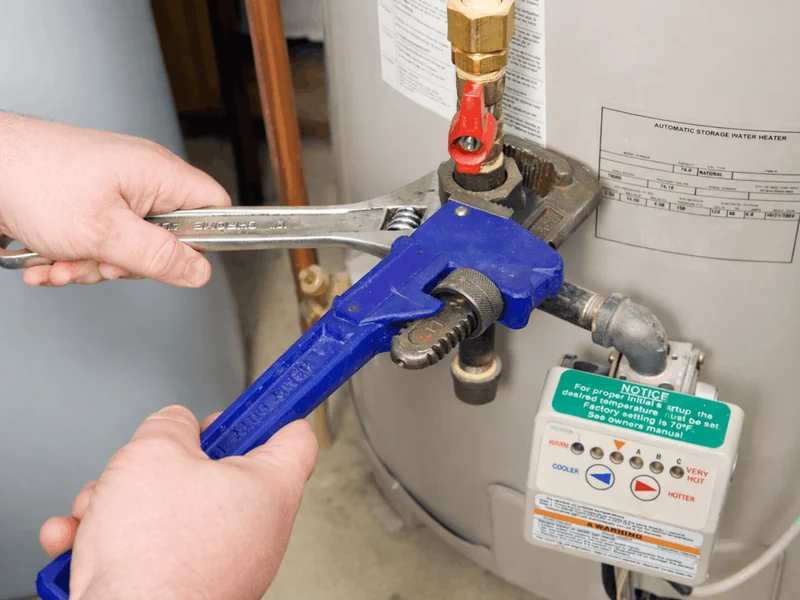
In Belmont, a leaking water heater is rarely just a plumbing problem — in a town where finished basements with home offices and media rooms are common, it is a flooring and drywall emergency. The good news is that many Belmont leak calls trace back to fittings rather than failed tanks: the town's 100-year-old Victorians are full of mixed galvanized-and-copper systems where dielectric unions at the heater connections corrode and weep, mimicking a tank leak convincingly.
Our technicians diagnose and repair leaking tank water heaters throughout Belmont, MA 02478, from Belmont Center Victorians to the ranches near Lone Tree Hill. The local diagnostic discipline matters: check the dielectric unions and tank-top nipples first, because replacing a tank over a twenty-dollar fitting failure is the mistake we are hired to prevent. Below is how we trace Belmont leaks to their true source, when repair beats replacement, and how to protect a finished basement from the next one.
The Dielectric Union Check: Belmont's First Diagnostic Step
In Belmont's Victorians, the water heater connections are a century-long experiment in mixed metals — galvanized steel meeting copper, sometimes with a dielectric union installed decades ago and sometimes with bare metal-to-metal contact. Those unions corrode, weep, and drip down the tank jacket in a way that pools at the base exactly like a tank failure. Our first move on any Belmont leak call is a close inspection of both tank-top connections with a light and a mirror before we look anywhere else.
More than once, a Belmont homeowner braced for a full replacement has watched us tighten or replace a fifteen-dollar union and dry the floor. When the unions are sound and the nipples are solid, we move down the diagnostic ladder: T&P discharge, drain valve, expansion tank charge, and finally the tank seams and base ring. The discipline matters because the fix for a fitting leak and the fix for a tank leak are entirely different jobs, and only one of them involves carrying a new heater down the stairs.
Finished Basements: Speed, Pans, and Sensors
A 50-gallon tank holds enough water to ruin finished flooring, baseboards, and drywall across a Belmont lower level — and the difference between a scare and a five-figure restoration is measured in minutes. Emergency shutoff speed is the variable homeowners control: know where the cold-water shutoff above the heater is, confirm it actually turns, and keep the path to it clear. Seized gate valves get replaced with quarter-turn ball valves on our visits, because a shutoff that does not shut is decoration.
The hardware that earns its keep in finished basements is a leak pan plumbed to a drain, paired with a smart shutoff sensor that closes the water supply the moment it detects moisture. On new installs in Belmont's higher-value homes we recommend both as standard — they are inexpensive relative to what they protect. For existing heaters, a standalone sensor on the floor beside the tank is the single highest-value addition a homeowner can make this year.
Dirt Floors and Silent Leaks in Pre-1900 Basements
Belmont's oldest homes — the pre-1900 Victorians with stone foundations — sometimes still have dirt or perpetually damp floors in the cellar corners where heaters sit. A slow leak there does not puddle; it drains into the soil and vanishes, which means a tank can weep for weeks before anyone notices. By the time the symptom surfaces — rusty hot water, a failed lower element shorted by moisture, a damp smell that will not clear — the tank is usually past saving.
There is no reliable early-warning system for a leak you cannot see, which is why proactive replacement at ten to twelve years is the right strategy for these homes rather than running the tank until it announces itself. During service we also check the floor around the heater with a moisture meter, since chronic dampness accelerates base-ring corrosion from the outside. A heater on a dirt floor should sit on a solid stand with a pan — not directly on soil — from the day it is installed.
Winter Freeze Splits vs. Tank Leaks in Belmont Ranches
January brings a different leak call from Belmont's 1950s ranches: hot-water lines routed through crawl spaces or unconditioned areas freeze, split, and then flood when they thaw — and the water often appears near the heater, sending homeowners down the wrong diagnostic path. A split pipe leaks only when the system is pressurized and the ice has cleared; a tank leak is steadier and independent of temperature swings. We sort the two by pressure-testing and by tracing the water's actual path.
The fix for freeze-split piping is insulation, heat trace on the vulnerable runs, and in the worst layouts, rerouting — not a new water heater. But the event is still a useful warning: the thermal shock and pressure spike of a freeze-thaw cycle stress every fitting on the system, so we inspect the heater's connections, T&P valve, and expansion tank after any freeze event. Winterizing the piping protects both the pipes and the heater they serve.
Tank Leak or Fitting Leak? How We Diagnose Before We Recommend
The most important moment in any water heater leak call is the diagnosis, because a large share of the "leaking tanks" we are called to are not leaking tanks at all. Water pooling at the base of a heater can originate from a corroded hot or cold nipple at the tank top, a failed dielectric union where copper meets steel, a weeping temperature-pressure (T&P) relief valve, a dripping drain valve, a waterlogged expansion tank on a closed plumbing system, or plain condensation sweating off cold inlet piping — every one of which is a targeted repair rather than a full replacement. Our technicians dry the area, then trace the moisture upward with tissue and an inspection mirror: tank-top fittings first, then the T&P discharge pipe, then the weld seams and base ring of the tank itself.
A true tank failure — a rusted-through weld seam, a pinhole in the glass-lined steel, a base ring eaten away by years of sitting in dampness — cannot be patched. The steel is compromised and the tank has to be replaced. But a T&P valve lifting under thermal expansion, or a drain valve that never sealed again after a flush, is a repair that restores the heater for a fraction of what a replacement involves. We also check the expansion tank's air charge on closed systems, because a saturated expansion tank turns normal heating cycles into pressure spikes that force water out of the T&P valve — and that gets misread as tank failure all the time. Honest diagnosis is the whole job: we show you exactly where the water is coming from before we recommend a fix.
Safety When Your Water Heater Is Leaking
A leaking water heater is a scalding and flooding hazard, not just a plumbing nuisance. First, stop the water: close the cold-water supply valve above the heater. If you cannot find it, or it is seized — common in older homes — shut the main house valve instead. For a gas heater, turn the gas control knob to the off position; for an electric heater, switch off its dedicated breaker. Do not touch a leaking electric heater's wiring compartment with wet hands or while standing in water — switch the breaker off from a dry position first.
Never plug the T&P relief valve's discharge pipe or cap the valve itself. It is the tank's last defense against overpressure, and defeating it can turn a manageable leak into a rupture. If the leak is severe, attach a garden hose to the drain valve and route it to a floor drain to slow the flooding while you wait for service. And if the basement has standing water around a gas heater, keep clear until it is inspected — submerged gas controls must be replaced outright, and standing water combined with electricity is never a combination to wade through.