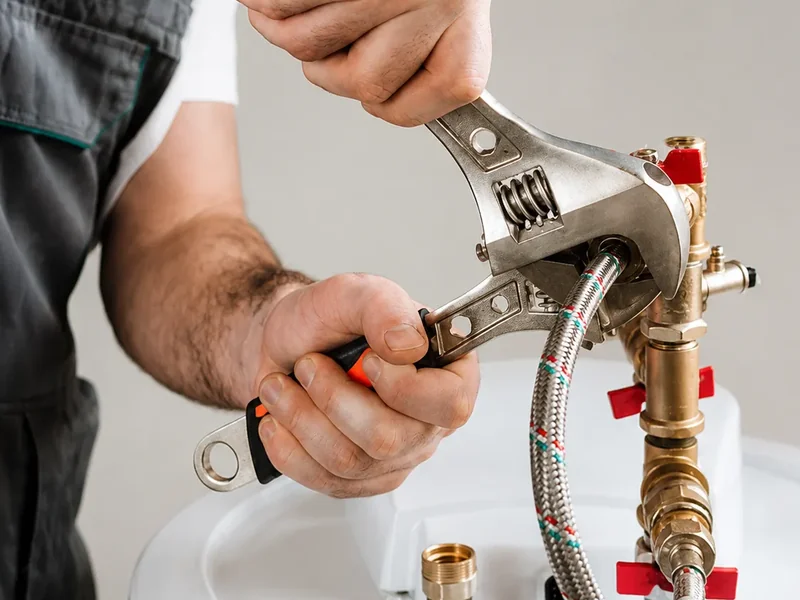
A puddle spreading across a basement floor in Arlington usually starts a familiar debate: is the water heater itself leaking, or is it something cheaper? In Arlington's 1890s–1930s two-families, the honest answer is that the leak is frequently not the tank at all. Original galvanized nipples and aging dielectric unions at the tank top corrode in this town's damp basements, and they weep water that pools at the base exactly the way a tank failure would — which is why diagnosis has to come before any talk of replacement.
Our technicians diagnose and repair leaking tank water heaters across Arlington, MA 02474, from the Spy Pond neighborhood to the Massachusetts Avenue corridor. Two local facts shape nearly every leak call here: gate-valve shutoffs on old galvanized feed lines seize solid, so stopping the water in an emergency is harder than it should be, and the high water table near Alewife Brook keeps many basement floors chronically damp, which rots tank base rings from below. Below is how we trace a leak to its true source, what we repair versus what we replace, and how Arlington homeowners can protect the next heater.
Fitting Leaks vs. Tank Leaks in Arlington's Old Two-Families
When we answer a leak call in an 1890s–1920s Arlington two-family, the first thing we do is look up, not down. The original galvanized nipples at the tank top and the dielectric unions connecting old steel to newer copper are the most common actual sources of water found at the heater's base. They corrode from the inside out in Arlington's damp basements, weep slowly down the tank jacket, and pool at the floor — a perfect imitation of a tank failure that costs far less to fix.
Our diagnostic routine is deliberately skeptical: we dry everything, then watch with tissue and a mirror to trace each damp trail to its origin. A rusty streak running down from a tank-top nipple, a green-crusted dielectric union dripping steadily, a T&P valve discharging because the expansion tank is waterlogged — each of these is a targeted repair. Only when the moisture genuinely originates at a weld seam, a pinhole in the tank wall, or the base ring itself do we recommend replacement. In this town, skipping that discipline means replacing tanks that had years of life left.
Seized Shutoffs Turn Small Leaks Into Emergencies
Arlington's original galvanized feed lines come with gate-valve shutoffs that have not moved in decades, and in a leak emergency that matters enormously. A homeowner who discovers water spreading across the basement floor reaches for the shutoff above the heater, finds it frozen solid, and watches the leak continue while hunting for the main house valve — which may itself be an equally seized gate valve from the same era. Minutes of extra water on a finished basement floor, or hours of it on an unfinished one, change the scale of the damage.
This is why we treat a ball-valve upgrade as part of nearly every Arlington heater job, not an upsell. A full-port ball valve with a quarter-turn lever gives the next emergency a reliable, instant shutoff, and it makes all future service — element swaps, anode checks, flushing — straightforward instead of nerve-wracking. If your Arlington home still has a gate valve above the water heater, consider having it replaced before you need it in a crisis.
Bottom-Up Corrosion in Damp Arlington Basements
Near Spy Pond and the Alewife Brook lowlands, the water table sits high enough that many basement slabs stay damp for weeks after heavy rain. Heaters sitting directly on that concrete wick moisture into the base ring, and steel in constant contact with damp concrete corrodes steadily from the outside in. We inspect the base ring first on every Arlington leak call in these neighborhoods, because bottom-up corrosion is the dominant tank failure mode here — the tank top can look fine while the base is quietly rusting through.
Prevention is straightforward and worth doing at replacement time: set the new heater on a stand or sturdy platform to break contact with the slab, and fit a corrosion-resistant drain pan underneath. The pan will not save a tank that is already rusting, but on a new install it keeps minor seepage and condensation away from the base ring for the life of the heater. In the dampest basements we also verify the floor drain is clear — a pan that cannot drain is just a shallow bathtub.
Getting a Replacement Tank Into an Arlington Basement
When diagnosis says the tank itself has failed, the next challenge is purely physical. Arlington's older homes mean narrow bulkhead stairs, low fieldstone basement ceilings, and tight turns at the bottom of the steps — maneuvering a 50-gallon tank down that path is genuinely the hardest part of the job. We measure stairwell clearance and ceiling height before the new tank is ordered, because a tank that cannot make the turn has to go back.
Removal runs the same obstacle course in reverse, with the added complication that the old tank is full of sediment and water that will not fully drain through a seized plastic drain valve. We plan the extraction route, protect finished stair treads and flooring along the way, and stage the new heater — on its stand, in its pan — before the old one leaves, so the household's time without hot water is measured in hours, not days. Parking near the bulkhead entrance matters too; on Arlington's tighter two-family streets we coordinate arrival so the carry distance stays short.
Tank Leak or Fitting Leak? How We Diagnose Before We Recommend
The most important moment in any water heater leak call is the diagnosis, because a large share of the "leaking tanks" we are called to are not leaking tanks at all. Water pooling at the base of a heater can originate from a corroded hot or cold nipple at the tank top, a failed dielectric union where copper meets steel, a weeping temperature-pressure (T&P) relief valve, a dripping drain valve, a waterlogged expansion tank on a closed plumbing system, or plain condensation sweating off cold inlet piping — every one of which is a targeted repair rather than a full replacement. Our technicians dry the area, then trace the moisture upward with tissue and an inspection mirror: tank-top fittings first, then the T&P discharge pipe, then the weld seams and base ring of the tank itself.
A true tank failure — a rusted-through weld seam, a pinhole in the glass-lined steel, a base ring eaten away by years of sitting in dampness — cannot be patched. The steel is compromised and the tank has to be replaced. But a T&P valve lifting under thermal expansion, or a drain valve that never sealed again after a flush, is a repair that restores the heater for a fraction of what a replacement involves. We also check the expansion tank's air charge on closed systems, because a saturated expansion tank turns normal heating cycles into pressure spikes that force water out of the T&P valve — and that gets misread as tank failure all the time. Honest diagnosis is the whole job: we show you exactly where the water is coming from before we recommend a fix.
Safety When Your Water Heater Is Leaking
A leaking water heater is a scalding and flooding hazard, not just a plumbing nuisance. First, stop the water: close the cold-water supply valve above the heater. If you cannot find it, or it is seized — common in older homes — shut the main house valve instead. For a gas heater, turn the gas control knob to the off position; for an electric heater, switch off its dedicated breaker. Do not touch a leaking electric heater's wiring compartment with wet hands or while standing in water — switch the breaker off from a dry position first.
Never plug the T&P relief valve's discharge pipe or cap the valve itself. It is the tank's last defense against overpressure, and defeating it can turn a manageable leak into a rupture. If the leak is severe, attach a garden hose to the drain valve and route it to a floor drain to slow the flooding while you wait for service. And if the basement has standing water around a gas heater, keep clear until it is inspected — submerged gas controls must be replaced outright, and standing water combined with electricity is never a combination to wade through.