Electric water heaters in Everett split along the town's housing eras: triple-deckers and two-families in Glendale and Woodlawn with basement heaters fed by aging galvanized pipe, and post-1980 construction — including the large apartment developments near the casino — with copper or PEX and cleaner water paths. Heating elements fail differently in each: sediment burial in the old stock, age and thermostat wear in the new.
Our technicians test and replace heating elements throughout Everett, MA 02149, from triple-decker basements off Revere Beach Parkway to the newer developments near Encore Boston Harbor. Soft MWRA water keeps lime scale minor everywhere here; the sediment is rust and debris from old pipe, and near the Malden River the damp basement air adds wiring-corrosion to the failure mix. Below is how we diagnose element problems in Everett's housing, how replacement is done safely, and the maintenance rhythm that fits each era.
Sediment Burial in the Triple-Decker Stock
The 1900–1930 triple-deckers of Glendale and Woodlawn feed their heaters through original galvanized pipe that has been shedding rust flakes for the better part of a century. That sediment settles directly onto the lower heating element, burying it in an insulating blanket until the sheath overheats and burns through. The tenants' complaint is always the same: hot water that disappears halfway through the second shower, because only the upper element is still heating.
Soft MWRA water is irrelevant to this failure — the sediment is pipe corrosion, not water hardness. Rumbling and popping during heating cycles are the audible warning that the burial is underway. Our protocol: flush the tank completely before the new element goes in, fit a low-watt-density element that runs cooler under sediment load, and set the building on an annual flushing schedule. In Everett's old stock, the flush is the maintenance — everything else follows from it.
Damp Basements, Corroded Terminals, and 240 Volts
Near the Malden River, basement air does not just corrode gas valves — it attacks electric heater wiring with equal enthusiasm. Moisture creeps into the access compartments behind the element covers and corrodes wire terminals and thermostat contacts. A corroded terminal runs hot and drops voltage, producing the maddening pattern of a heater that tests fine one visit and underperforms the next. On 240-volt equipment, terminal condition is a safety matter, not a performance footnote.
We clean and inspect every connection while the power is verified off, and we test thermostats and the high-limit switch as a matter of course — because a tripped ECO or a failing upper thermostat mimics a dead element exactly, and the damp environment ages thermostats faster. Floodplain homes get an additional check: any history of submersion means full electrical diagnostics, since water-compromised controls can test fine dry and fail under load.
Newer Developments: A Different Element Story
The large apartment developments near the casino district and Everett's post-1980 construction tell a cleaner story: copper or PEX supply lines, modern risers, far less pipe corrosion reaching the tank. Elements here fail from age and duty cycle rather than sediment burial — and the failures skew toward thermostats and high-limit switches, especially where heaters sit in warm mechanical closets that age controls faster.
Service in these buildings runs through property management: work windows, common-area protection, and documentation. The diagnostic discipline does not change — meter-test elements, thermostats, and ECO before replacing anything — but the maintenance advice does: with low sediment loads, the flushing schedule can be lighter, while thermostat testing deserves more emphasis. We read what the tank actually shows us and set the rhythm accordingly.
Seized Drain Valves and Service Access
Element replacement requires draining the tank below the element port, and Everett's older installs are full of cheap plastic drain valves that seize or snap when touched. We carry brass replacements and upgrade the failed valve on the spot — a heater that cannot be drained cannot be serviced, and in a sediment-heavy town a working drain valve is what makes annual flushing possible at all.
Access in the triple-decker basements is the other practical factor: elements mount through the tank's side, so we need working room beside the unit, and in cellars where the heater is wedged between the foundation wall and the furnace, getting a socket squarely on the port takes patience. Bulkhead-only access adds carry time for equipment. We assess all of it before quoting, because the honest estimate accounts for the basement, not just the part.
How Electric Water Heater Elements Work — and How We Replace Them
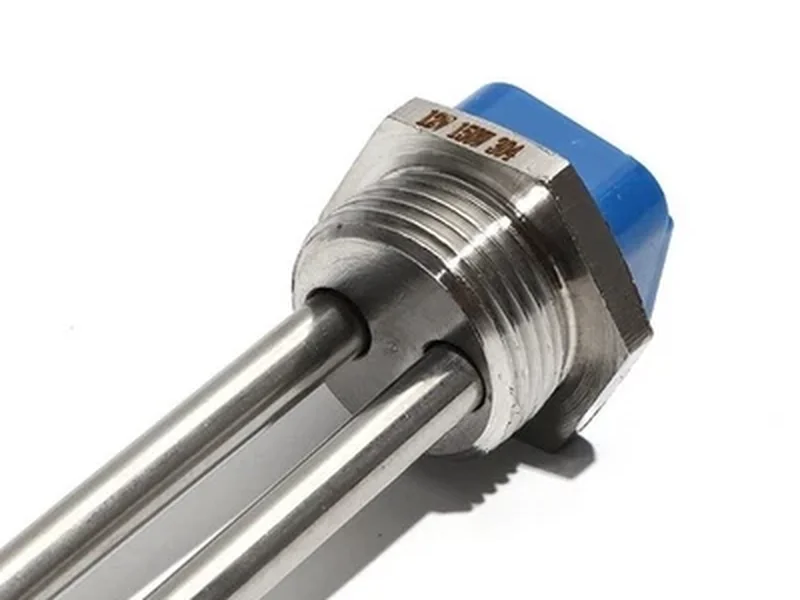
An electric tank water heater heats with two elements — an upper and a lower — each governed by its own thermostat, with the upper thermostat carrying a high-limit (ECO) safety switch. Only one element fires at a time: the upper heats first, then hands off to the lower, which does most of the daily work warming the full tank. Elements are simple resistive coils sealed inside a metal sheath, and they fail in predictable ways. Sediment is the great killer. As minerals and debris settle to the tank bottom, they bury the lower element in an insulating blanket, so it overheats trying to heat through the sludge and eventually burns through its sheath. A dry-fired element — one powered before the tank is fully refilled — destroys itself in seconds. Age, voltage mismatch, and corroded wiring connections account for the rest.
Diagnosis starts at the breaker panel with a multimeter. We check continuity and resistance across each element and test both thermostats plus the high-limit switch before condemning anything, because a tripped ECO or a failed upper thermostat produces the same no-hot-water symptom as a dead element, and replacing the wrong part wastes everyone's time. Replacement is methodical: power off at the breaker and verified dead with a meter, cold water shut off, tank drained below the element port, wires disconnected and labeled, the old element unthreaded with an element socket, the new element seated with a fresh gasket. Then the step that matters most — the tank is completely refilled and air is purged from the hot taps before the breaker goes back on. We match wattage and voltage exactly to the heater's rating plate, and in sediment-prone tanks we fit low-watt-density or lime-life elements, whose larger surface area runs cooler and resists scale buildup far better than standard high-watt-density elements.
Electrical Safety Around Water Heater Elements
An electric water heater runs on a dedicated 240-volt circuit — enough to injure or kill. The breaker must be off and verified with a meter before any access cover comes off, because thermostats can re-energize an element without warning, and a "dead" heater is only dead once it has been tested. Water and electricity share the same metal box here, so we keep the work area dry and we never bypass the high-limit safety switch, which exists to prevent runaway overheating if a thermostat sticks in the closed position.
Homeowners should never restore power to a partially drained tank. An element exposed to air instead of water overheats almost instantly and burns out, turning a simple element swap into a repeat service call. If the breaker trips repeatedly, that is the system telling you something is wrong — usually a grounded element leaking current to the tank shell — and resetting it again and again risks damage to the wiring and the breaker itself. Scalding is the other hazard we watch: after an overheating event we always check the thermostat setpoint, because elements that failed under stress sometimes reveal thermostats that had been running the tank far above safe temperatures.