Electric water heaters in the 02114 ZIP serve two worlds: Beacon Hill rowhouses with compact tanks wedged into low basement corners, and West End high-rise condos where individual unit heaters sit in tight mechanical closets. Heating elements fail the same way everywhere — but in 02114, the constraints around the heater change the service: low ceilings, narrow stairs, HOA work rules, and in the towers, coordination with building management before any water is shut off.
Our technicians test and replace heating elements in electric water heaters throughout Boston, MA 02114, from brownstone basements off the Public Garden to condo units near North Station. The symptoms are familiar — fast-depleting hot water, lukewarm output, tripping breakers — but the setting is pure downtown Boston. Below is how we diagnose element failure, how we work within historic and high-rise constraints, and what 02114 residents should know before scheduling.
Element Symptoms in Rowhouses and High-Rises
The symptoms do not change with the ZIP code: hot water that runs out halfway through a shower points to the lower element, water that never gets past lukewarm points to the upper element or its thermostat, and a repeatedly tripping breaker points to a grounded element leaking current to the tank shell. What changes in 02114 is everything around the heater. In a Beacon Hill rowhouse, the tank is often a compact 40-gallon unit in a low basement corner — smaller tank, smaller margin, so a dead lower element is noticed within a single shower.
In the high-rise condos, the complication is diagnostic access: the heater sits in a unit closet, the breaker is in the unit panel, but the water shutoff may be in a common mechanical room. We coordinate with building management before draining anything, because closing the wrong valve in a tower affects neighbors. Diagnosis itself is standard — meter-testing resistance across both elements and checking the thermostats and high-limit switch — but it happens on a schedule the building approves.
Sediment, Old Pipes, and Soft Water in 02114
Boston's water comes through the BWSC system from MWRA reservoirs — soft water, low in dissolved minerals — so lime scale is a minor factor in element failure here. The sediment story in the rowhouses is instead about 150 years of layered plumbing: galvanized and even lead-era service lines, copper retrofits from every decade since, all shedding rust and debris that settles onto the lower element. Buried in that blanket, the element overheats and burns through its sheath.
BWSC's aggressive lead-service-line replacement program is relevant context for rowhouse owners: if your street has had its service line replaced, the fresh copper upstream actually reduces the rust load reaching your heater — a small, real benefit worth knowing. For towers, the water arrives through commercial-grade risers with far less pipe corrosion, so element failure there skews toward age and thermostat issues rather than sediment. We read the sediment level during every flush and adjust the maintenance advice to what we actually find.
Working in Low Basements and Tight Closets
Beacon Hill rowhouse basements are famously low — six-foot ceilings are generous in some — and the heater is usually wedged where it fits, not where it is convenient. Elements mount through the tank's side, so we need working room beside the unit; in the tightest corners, getting an element socket squarely onto the port is the hardest part of the job. We assess access honestly before quoting, because forcing an element in a cramped port risks damaging threads that cannot be repaired.
Dampness is the other constant. Rowhouse basements near the Charles run humid, and moisture creeps into the wiring compartment behind the element access panels, corroding terminals. We clean and inspect every connection while the power is off. In high-rise closets the issue is heat rather than dampness — stacked mechanical closets run warm, which ages thermostats faster — so we test the thermostats and high-limit switch as a matter of course during element service.
Winter Demand and the Downtown No-Hot-Water Call
January in Boston means incoming water near freezing and heaters working at maximum duty. In a compact 40-gallon rowhouse tank, there is no reserve to hide behind: a weak lower element that managed in October fails outright in the first cold snap, and the household discovers it mid-shower. High-rise units face the same physics with an added wrinkle — a dead heater in a tower means coordinating the repair around building work hours, which can add a day.
The practical advice for 02114 is seasonal: have both elements resistance-tested in the fall, especially in heaters over eight years old. It is a quick diagnostic that catches the marginal element before January does. And for rowhouse owners, keep the area around the heater clear — in a six-foot basement, the technician needs every inch of working room, and a clear path turns a difficult job into a routine one.
How Electric Water Heater Elements Work — and How We Replace Them
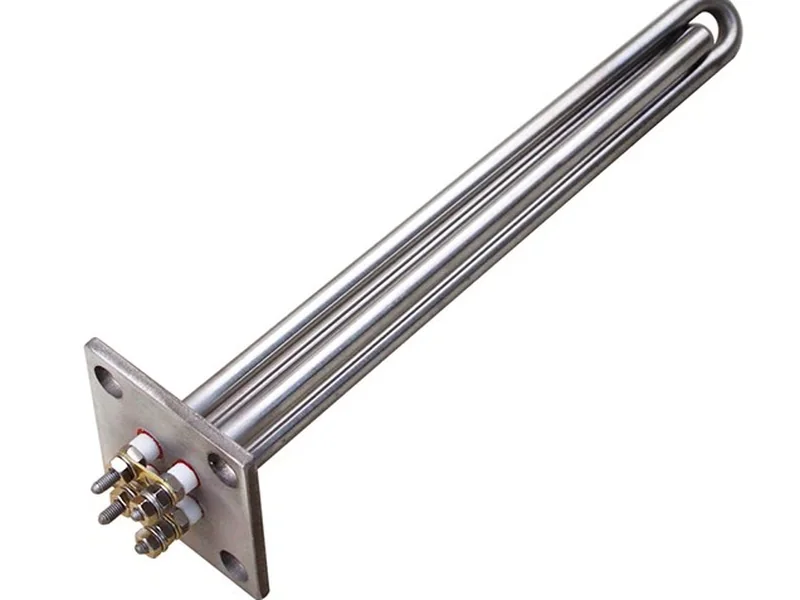
An electric tank water heater heats with two elements — an upper and a lower — each governed by its own thermostat, with the upper thermostat carrying a high-limit (ECO) safety switch. Only one element fires at a time: the upper heats first, then hands off to the lower, which does most of the daily work warming the full tank. Elements are simple resistive coils sealed inside a metal sheath, and they fail in predictable ways. Sediment is the great killer. As minerals and debris settle to the tank bottom, they bury the lower element in an insulating blanket, so it overheats trying to heat through the sludge and eventually burns through its sheath. A dry-fired element — one powered before the tank is fully refilled — destroys itself in seconds. Age, voltage mismatch, and corroded wiring connections account for the rest.
Diagnosis starts at the breaker panel with a multimeter. We check continuity and resistance across each element and test both thermostats plus the high-limit switch before condemning anything, because a tripped ECO or a failed upper thermostat produces the same no-hot-water symptom as a dead element, and replacing the wrong part wastes everyone's time. Replacement is methodical: power off at the breaker and verified dead with a meter, cold water shut off, tank drained below the element port, wires disconnected and labeled, the old element unthreaded with an element socket, the new element seated with a fresh gasket. Then the step that matters most — the tank is completely refilled and air is purged from the hot taps before the breaker goes back on. We match wattage and voltage exactly to the heater's rating plate, and in sediment-prone tanks we fit low-watt-density or lime-life elements, whose larger surface area runs cooler and resists scale buildup far better than standard high-watt-density elements.
Electrical Safety Around Water Heater Elements
An electric water heater runs on a dedicated 240-volt circuit — enough to injure or kill. The breaker must be off and verified with a meter before any access cover comes off, because thermostats can re-energize an element without warning, and a "dead" heater is only dead once it has been tested. Water and electricity share the same metal box here, so we keep the work area dry and we never bypass the high-limit safety switch, which exists to prevent runaway overheating if a thermostat sticks in the closed position.
Homeowners should never restore power to a partially drained tank. An element exposed to air instead of water overheats almost instantly and burns out, turning a simple element swap into a repeat service call. If the breaker trips repeatedly, that is the system telling you something is wrong — usually a grounded element leaking current to the tank shell — and resetting it again and again risks damage to the wiring and the breaker itself. Scalding is the other hazard we watch: after an overheating event we always check the thermostat setpoint, because elements that failed under stress sometimes reveal thermostats that had been running the tank far above safe temperatures.