Electric tank water heaters in Belmont live in two very different environments: the full basements — many of them finished — of the town's Victorians and colonials, and the crawl spaces and low utility areas of its 1950s ranches. Heating elements fail in both, but the causes diverge. In the older homes, rust sediment from aging galvanized and early copper systems buries lower elements; in the ranches, freeze-exposed piping and cold ambient temperatures make heaters work overtime.
Our technicians test and replace heating elements across Belmont, MA 02478, from Waverley two-families to the split-levels off Trapelo Road. Because so many Belmont basements are finished living space, an element-gasket weep or a slow tank-bottom leak carries real stakes here — a failed lower element often announces itself alongside the first signs of tank distress. Below is how we diagnose element failure, how replacement is done safely, and what Belmont's housing stock means for your heater's maintenance.
Element Failure Signs in Belmont Homes
The pattern is consistent: hot water runs out halfway through the second shower, or the water never gets past lukewarm regardless of the thermostat. The first points to the lower element — buried under sediment and burned out — and the second to the upper element or its thermostat. In Belmont's finished-basement homes there is often an earlier warning: a faint weep at an element gasket, leaving a rust-colored trail down the tank jacket that a homeowner spots while doing laundry.
That weep deserves attention beyond the element itself, because element-port corrosion and tank-wall thinning travel together on aging tanks. When we pull a failed element in a Belmont home, we inspect the port threads and the surrounding tank wall with a light and a mirror — if the steel around the port is thinning, replacing the element buys months, not years, and an honest conversation about the tank's remaining life follows.
Sediment, Mixed Metals, and Belmont's Older Systems
Belmont's pre-1940 homes still carry stretches of original galvanized pipe, and even the mid-century copper is now sixty-plus years old. Both shed debris — rust flakes from the galvanized, and mineral sediment loosened as old copper scales — that settles onto the lower element. Soft MWRA water means lime is not the main ingredient, but sediment does not need lime to kill an element: any insulating blanket forces the sheath to overheat.
Missing or corroded dielectric unions add a second failure path. Stray galvanic currents in mixed-metal systems accelerate corrosion at the tank's steel ports, including the element ports, which can seize an element in place so thoroughly that removal risks damaging the tank. We soak seized elements with penetrating oil and use proper element sockets rather than force — and when the ports are too far gone, we say so plainly instead of selling an element the tank cannot hold.
Ranch Crawl Spaces and Winter Element Strain
Belmont's 1950s ranches and split-levels often route hot-water lines through crawl spaces or unconditioned areas, and some tuck the heater itself into a low, cold-adjacent space. In January, those heaters fight a two-front war: near-freezing incoming water and constant heat loss from exposed piping. Elements cycle far more than their basement-installed counterparts, and the lower element — already the hardest-working part — wears out measurably faster.
Freeze-split piping near the heater is the winter emergency in these homes, but the slower story is element fatigue from endless reheating. Insulating exposed hot-water runs and heat-tracing the most vulnerable sections reduces the cycling load, which directly extends element life. For ranch owners, we recommend a fall element test — a quick resistance check across both elements — as part of winterizing, the same way you would service a furnace before the cold arrives.
Proactive Replacement in a High-Value Market
Belmont homeowners tend to maintain rather than react, and water heaters reward that instinct. A tank that has never been flushed, in a town with aging pipes shedding sediment, is a tank whose lower element is living on borrowed time. We see the best outcomes in Belmont homes on a simple rhythm: annual flushing, element resistance checks every few years, and planned replacement around year ten to twelve rather than waiting for a rupture.
The pre-1900 homes with stone foundations and dirt floors deserve special mention: a slow leak there drains into soil and can go unnoticed for weeks, which means the first visible symptom is sometimes a failed element shorted by water it sat in. In those basements, a leak sensor on the floor near the heater is inexpensive protection, and proactive tank replacement at ten to twelve years is not premature — it is the only reliable way to catch a failure you cannot see.
How Electric Water Heater Elements Work — and How We Replace Them
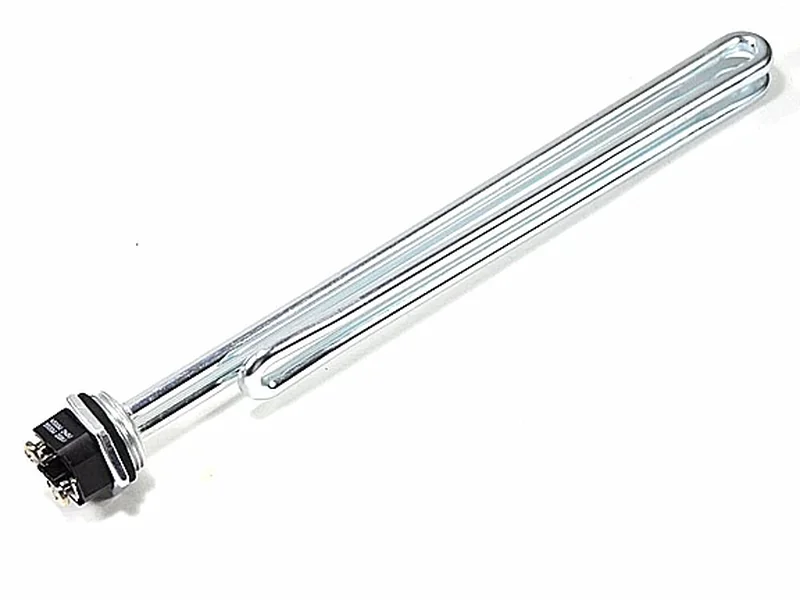
An electric tank water heater heats with two elements — an upper and a lower — each governed by its own thermostat, with the upper thermostat carrying a high-limit (ECO) safety switch. Only one element fires at a time: the upper heats first, then hands off to the lower, which does most of the daily work warming the full tank. Elements are simple resistive coils sealed inside a metal sheath, and they fail in predictable ways. Sediment is the great killer. As minerals and debris settle to the tank bottom, they bury the lower element in an insulating blanket, so it overheats trying to heat through the sludge and eventually burns through its sheath. A dry-fired element — one powered before the tank is fully refilled — destroys itself in seconds. Age, voltage mismatch, and corroded wiring connections account for the rest.
Diagnosis starts at the breaker panel with a multimeter. We check continuity and resistance across each element and test both thermostats plus the high-limit switch before condemning anything, because a tripped ECO or a failed upper thermostat produces the same no-hot-water symptom as a dead element, and replacing the wrong part wastes everyone's time. Replacement is methodical: power off at the breaker and verified dead with a meter, cold water shut off, tank drained below the element port, wires disconnected and labeled, the old element unthreaded with an element socket, the new element seated with a fresh gasket. Then the step that matters most — the tank is completely refilled and air is purged from the hot taps before the breaker goes back on. We match wattage and voltage exactly to the heater's rating plate, and in sediment-prone tanks we fit low-watt-density or lime-life elements, whose larger surface area runs cooler and resists scale buildup far better than standard high-watt-density elements.
Electrical Safety Around Water Heater Elements
An electric water heater runs on a dedicated 240-volt circuit — enough to injure or kill. The breaker must be off and verified with a meter before any access cover comes off, because thermostats can re-energize an element without warning, and a "dead" heater is only dead once it has been tested. Water and electricity share the same metal box here, so we keep the work area dry and we never bypass the high-limit safety switch, which exists to prevent runaway overheating if a thermostat sticks in the closed position.
Homeowners should never restore power to a partially drained tank. An element exposed to air instead of water overheats almost instantly and burns out, turning a simple element swap into a repeat service call. If the breaker trips repeatedly, that is the system telling you something is wrong — usually a grounded element leaking current to the tank shell — and resetting it again and again risks damage to the wiring and the breaker itself. Scalding is the other hazard we watch: after an overheating event we always check the thermostat setpoint, because elements that failed under stress sometimes reveal thermostats that had been running the tank far above safe temperatures.