Belmont's housing tells two stories: late-1800s to 1920s Victorians, colonials, and two-families around Belmont Center and Waverley, and 1950s ranches and split-levels across Belmont Hill and the western sections. Gas tank water heaters serve both eras, but they fail differently in each — the Victorians bring century-old mixed-metal plumbing and damp stone basements, while the ranches bring crawl spaces and utility closets where combustion air is harder to come by.
Our technicians replace gas control valves on tank water heaters throughout Belmont, MA 02478, from Leonard Street Victorians to the ranch blocks near Beaver Brook Reservation. The local patterns we see most: corroded dielectric unions where galvanized meets copper at the heater connections, pilot assemblies green with corrosion in damp lowland basements, and FVIR intake screens choked with dust in tight utility closets. Below is how we diagnose a failing valve in Belmont homes, what replacement involves, and the area-specific details worth knowing.
Pilot Problems in Belmont's Victorians and Ranches
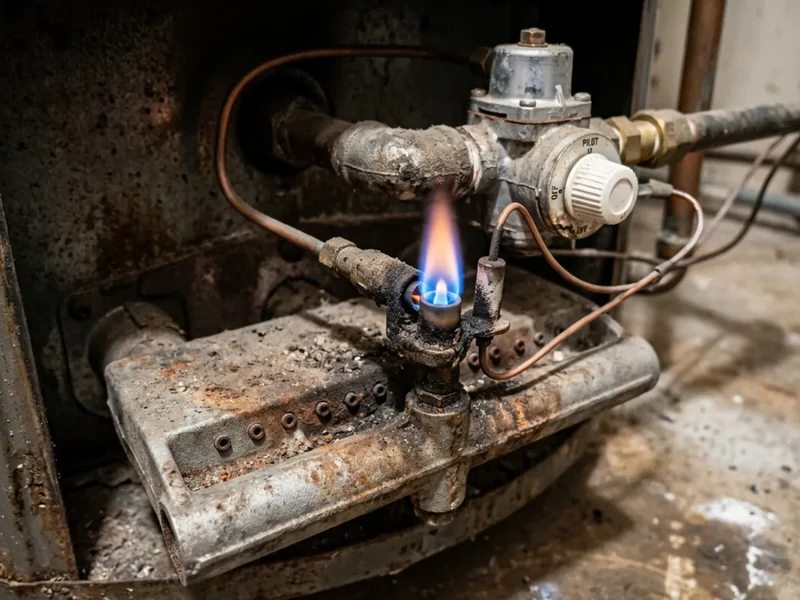
The signature complaint — a pilot that lights and then dies the moment the knob is released — usually means the thermocouple is too weak to hold the valve's pilot magnet open. In Belmont's Victorians, we also find pilot assemblies corroded by decades of damp basement air, particularly in pre-1900 homes with stone foundations where the heater sits near a dirt or perpetually damp floor. Green crust on the pilot tube fittings and a thermocouple that tests weak are the telltales.
The 1950s ranches present the opposite problem: heaters tucked into utility closets or low crawl-space-adjacent areas where combustion air is marginal. A gas heater starved of air soots up and behaves like a failing valve — lazy yellow burner flames, frequent pilot outages — when the real fix is air supply, not parts. We check flame character and combustion air before condemning any valve, because Belmont's closet installs make this misdiagnosis common.
Mixed Metals: Dielectric Unions and Century-Old Plumbing
Belmont's Victorians carry plumbing systems assembled across a century — original galvanized steel partially replaced with copper in the 1960s, 80s, or during condo conversions — and the water heater connections are where those dissimilar metals meet. Where dielectric unions are missing or long since corroded through, galvanic corrosion attacks the steel nipples at the tank top relentlessly. That corrosion does not stay at the top: it weakens threads, encourages seepage that runs down the jacket, and on the oldest installs works its way into the valve port threads below.
During a gas valve replacement we inspect every one of those transition points. If the dielectric unions are gone or crusty, we correct them as part of the job — a new valve threaded into a corroding system is a short-lived repair. This is also why we check the anode rod's condition on older Belmont tanks during valve service: in soft MWRA water, a depleted anode lets the tank itself join the corrosion party, and there is no point fitting a precision new valve to a tank that is rusting from the inside.
Finished Basements Raise the Stakes on Valve Leaks
A failing gas valve rarely leaks water itself, but valve service requires draining the tank below the valve port — and in Belmont's finished basements, any water on the floor is an emergency. Home offices, gyms, and media rooms sit where the heater is, so we plan every Belmont valve job around containment: the drain path is routed before a single fitting is loosened, and we verify the floor drain is clear before starting.
The longer-term protection is a leak pan with a drain and a smart shutoff sensor — high-value additions in a town where a 50-gallon tank sits above finished flooring. We also talk to Belmont homeowners about emergency shutoff speed: knowing exactly where the water shutoff and the gas control knob are, and that both actually turn, is what stands between a contained service call and a flooded lower level. Seized valves get replaced with quarter-turn ball valves while we are there.
Beaver Brook Lowlands: Dampness and Corrosion
The low-lying areas near Beaver Brook and the reservation see periodic basement seepage, and heaters in those homes live in the dampest air in town. Pilot assemblies, thermocouple connections, and the valve body itself corrode faster here — we see it as green oxidation on brass fittings and rust blooming on the valve housing screws. A valve that tests fine electrically can still misbehave when its pilot tube is partially restricted by corrosion debris.
For these homes we recommend elevating the heater on a stand at replacement time and fitting a corrosion-resistant drain pan, which together keep both seepage and everyday condensation away from the control assembly. And the standing rule applies: any valve that has been submerged — even briefly during a Beaver Brook seepage event — is replaced outright. Floodwater destroys the internal safety mechanisms in ways no inspection can verify, and a gas safety device is never the place to gamble.
How a Gas Control Valve Works — and What Replacement Involves
The gas control valve is the brass-bodied unit mounted low on the front of a gas water heater, the single point where the gas supply line, the pilot tube, and the thermocouple all converge. Inside that housing, a thermostat senses tank temperature through a probe seated in the tank wall and opens or closes the main burner valve to hold the setpoint. A separate safety circuit holds the pilot valve open only while the thermocouple — or thermopile on some models — generates its small millivolt signal from the pilot flame. If the pilot goes out, the signal dies and the valve snaps the gas supply shut. That fail-safe is what makes these valves trustworthy, and it is also why a dying thermocouple so often masquerades as a bad valve: the symptom looks identical until it is tested.
Most heaters built in the last two decades use FVIR (flammable vapor ignition resistant) designs, which seal the combustion chamber and add a thermal cutoff device into the assembly. On those units, a tripped thermal cutoff or a clogged flame-arrestor intake screen can mimic valve failure, so diagnosis has to rule those out before any parts are ordered. Replacement itself is precision gas-fitting work. We shut off the gas at the supply cock, close the cold-water inlet, and drain the tank below the valve port. Then we disconnect the gas supply line, the pilot tube, the thermocouple, and the igniter wire, and unthread the old valve from the tank spud. The new valve threads in with approved pipe sealant, every connection is remade, and then comes the step that matters most: the gas line is tested with leak-detection solution at full line pressure, the pilot is lit and observed for a steady envelope around the thermocouple tip, and the burner is run through complete heat cycles while we verify flame character, draft at the vent, and correct shutoff response at the thermostat. This is not a homeowner task — gas connections demand trained hands and proper testing.
Gas Safety: What to Do (and Not Do) Around a Suspect Valve
If you smell gas — the sharp rotten-egg odor of mercaptan — anywhere near your water heater, do not touch the valve, do not light anything, and do not flip electrical switches. Leave the house and call your gas utility's emergency line from outside, then call us. For a valve that simply misbehaves — a pilot that will not stay lit, a burner that short-cycles — turn the control knob to the off or pilot position and keep the area clear until a technician arrives.
Never attempt to disassemble a gas control valve. The internal seals, springs, and regulators are factory-set, and there are no field-serviceable parts inside the housing. Combustion air matters as well: a gas heater crowded into a small closet or a basement corner packed with storage can starve for air, causing sooting and carbon monoxide risk that looks exactly like a valve problem. After every valve replacement, we confirm the vent is connected and drafting properly, because a disconnected or back-drafting flue can spill combustion gases into the home. One more hard rule: any gas control valve that has been submerged in floodwater must be replaced, never dried out and reused. Water destroys the internal safety mechanisms even when the valve appears to work afterward, and we replace submerged valves as a matter of policy.