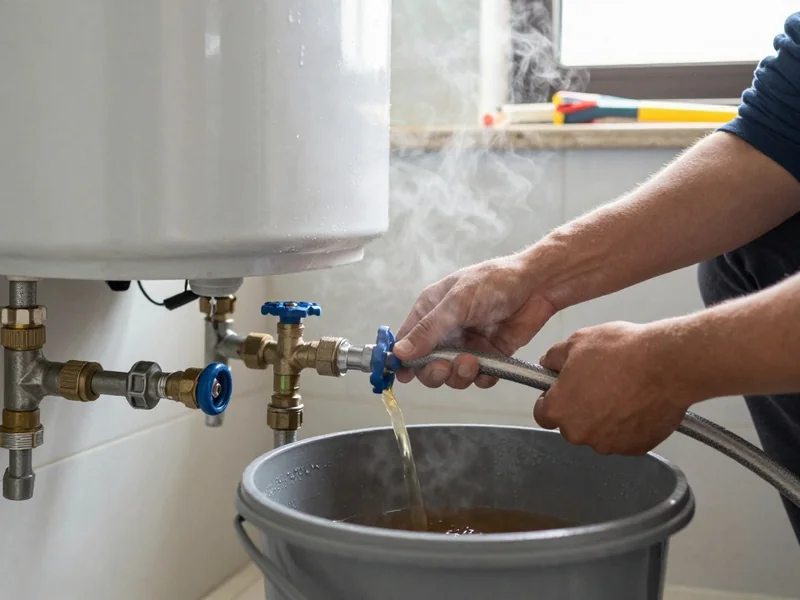
At the bottom of your water heater tank sits a small brass or plastic spigot that most Woburn, MA 01801 homeowners touch exactly twice in a tank's life: never, and then urgently. That is the drain valve, and it has two jobs. It lets a technician drain the tank for flushing out sediment, and it lets the tank be emptied for service or replacement. Factory-installed valves are often cheap plastic gate valves that go brittle with age and heat. They seize shut, snap off when forced, or weep constantly once disturbed. We replace failed drain valves with full-port brass ball-valve drains: a permanent upgrade that opens with a quarter turn, drains fast, and does not become the reason a simple flush turns into an emergency. If the valve on your Woburn tank drips, will not open, or will not close, the valve is the problem, and it is a fixable one.
What the Drain Valve Does and Why It Fails
The drain valve is the tank's service port. Every sediment flush, every element replacement, every tank swap starts at that valve: attach a hose, open it, and the tank empties. The problem is what manufacturers install there. Most residential tanks ship with a plastic drain valve, a cost-saving part threaded into a steel tank port. Years of heat cycling make the plastic brittle. Mineral deposits cement the washer in place. The first time anyone touches it, often a decade after installation, the handle snaps off in your hand, or the valve opens halfway and then refuses to close, or it weeps steadily from the stem. None of this means the tank is bad. It means a ten-dollar-grade part reached the end of its life.
Corrosion attacks from the outside too. In damp basements the valve body and the tank port threads corrode together, and the valve effectively welds itself to the tank. Forcing it is how valves break off flush with the port, which turns a valve swap into an extraction job. Our replacement is a full-port brass ball valve with a hose-thread outlet: quarter-turn operation, a bore nearly the full diameter of the pipe so sediment actually exits instead of clogging, and brass that will still turn freely in ten years. It is the part the factory should have installed, fitted after the fact.
Signs Your Drain Valve Needs Replacing
The clearest sign is a valve that drips or weeps from the spout or the stem, especially after anyone has touched it. A slow drip from the drain valve is one of the most common mystery puddles under a water heater, and homeowners often mistake it for a tank leak. If the puddle is directly beneath the valve and the tank shell is dry, the valve is almost certainly the culprit. A second sign is a valve that will not open at all. You attach a hose for a flush, put a wrench on the handle, and nothing moves, or the handle crumbles. That valve is seized, and forcing it risks snapping it off.
Other warning signs are subtler. A valve that opens but only trickles, even with full tank pressure behind it, is clogged with sediment packed into the small plastic bore, which also tells you the tank is overdue for a flush. Visible green or white crust on a brass valve body, or rust streaks running down from the valve onto the tank jacket, means the valve-to-tank joint is corroding. And any valve with a missing or broken handle is a valve you cannot operate in an emergency, which defeats its entire purpose. All of these are valve problems with valve solutions. The tank does not need to be replaced to fix any of them.
Sediment Country: Valves Under Maximum Load
Woburn's hard-blended water makes its drain valves work harder than anywhere else on this list. The sediment load in Woburn tanks, driven by 83 to 89 parts per million hardness on the Horn Pond side of the blend, packs into the small bore of plastic factory valves until they trickle when they should flow, and the rumbling tanks we see across Woburn are the audible signature of that sediment baking onto the tank bottom. The original plastic valves fail the full menu: embrittled from heat, cemented by mineral deposits far heavier than soft-water towns produce, handles snapping on the first flush attempt in years. We treat every Woburn valve as a sediment-compromised extraction and bring the tooling for it.
The brass ball-valve replacement is the essential upgrade in sediment country: the full-port bore passes the mineral load that chokes plastic valves, quarter-turn operation does not depend on washers that sediment has cemented in place, and brass does not embrittle in the heat. We flush the tank aggressively as part of the valve visit, because the new valve finally makes a real flush possible, and in Woburn a real flush is maintenance that measurably extends tank life. Annual flushing, feasible for the first time with a working full-port valve, is the standing recommendation we leave with every Woburn homeowner.
Pinholes, Freeze, and the Drained-Down Opportunity
The drained-down valve visit in Woburn is the efficient moment to address the town's other signatures. The 1950s to 1960s copper is in its pinhole years, so we trace before quoting and pressure-test the nearby hot lines: a weeping pinhole near the valve is the classic Woburn mimic, and the valve replacement must not become the wrong fix for a pipe problem. The ranch crawl spaces get the freeze-exposure check on the heater's supply lines, with insulation and heat-tracing quoted where unconditioned routing warrants it. The Horn Pond-area basements get the base-ring inspection and the pan conversation, since high-water-table dampness corrodes from the outside.
Seized shutoffs on the older feeds get replaced in the same visit as a matter of course: you cannot drain through the new valve without isolating the tank, and Woburn's older homes have the same seized gate-valve pattern as the rest of the inner ring. One visit, brass throughout, tank flushed, sediment baseline established, and the homeowner shown how to repeat the flush annually. In the hardest-water town on this list, that annual flush is the highest-value habit a tank owner can adopt.
What Happens When You Call
When you call (833) 713-2101, describe what the valve is doing: dripping, seized, broken handle, or stuck open. We will tell you what not to touch before we arrive, because a half-open valve on a hot tank is not a DIY moment. On site, our technician shuts off water and power or gas to the heater, lets the tank cool to a safe temperature, and drains it through whatever function the old valve still has, or through the relief valve line if the drain valve is completely dead. We extract the old valve, clean and inspect the tank port threads, and thread in the new full-port brass ball-valve drain with proper sealant. Then we refill the tank, purge air from the hot water lines, restore heat, and test the new valve open and closed in front of you so you can see it work.
Flushing Sediment Through a New Brass Valve in Woburn
A drain valve replacement is also the moment to deal with what's sitting at the bottom of the tank. a blended supply — about one-third MWRA and two-thirds from the city's own Horn Pond wellfield, measuring roughly 83–89 ppm on the Horn Pond side — the hardest blended water on this list in Woburn, which keeps scale lighter than in hard-water towns — but sediment still accumulates from aging pipe, especially where sediment-baked lower elements and rumbling tanks are common Woburn service calls. We see the evidence every week: tanks that rumble and pop during heating because a sediment blanket is insulating the bottom from the burner or lower element.
The service runs like this: shut off fuel and water, relieve pressure, thread on a hose, and open the old valve — or remove it if it's already failed. Once the tank is down, the new full-port brass valve goes in with proper thread sealant, and then we flush: short bursts of cold water stirred through the tank carry years of sediment out through the wide bore that a plastic valve could never pass. 1950s–60s copper at end of life brings pinhole leaks in hot-water lines near the heater. We refill, purge air, relight or re-energize, and verify the new valve seats drip-free under full pressure.
Sediment, Rumbling, and the Woburn Water Supply
Rumbling, popping, or a low growl from a tank water heater is the sound of water flashing to steam under a sediment blanket — and in Woburn, a blended supply — about one-third MWRA and two-thirds from the city's own Horn Pond wellfield, measuring roughly 83–89 ppm on the Horn Pond side — the hardest blended water on this list, the sediment story is mostly about pipe, not supply. sediment-baked lower elements and rumbling tanks are common Woburn service calls. That sediment settles on the tank bottom, insulates it from the burner or lower element, overheats the steel, and wastes fuel on every cycle.
Flushing only works if the drain valve cooperates, which is where most Woburn heaters fail the test: the factory plastic valve clogs on the first real sediment load or snaps when you force it. 1950s–60s copper at end of life brings pinhole leaks in hot-water lines near the heater. After the swap we flush in bursts — cold water in, sediment out through the wide bore — until the discharge runs clear. The rumbling usually stops on the next heating cycle, recovery improves, and the tank stops cooking its own bottom. It's the highest-value maintenance a tank heater can get, and it starts with a valve that actually opens.