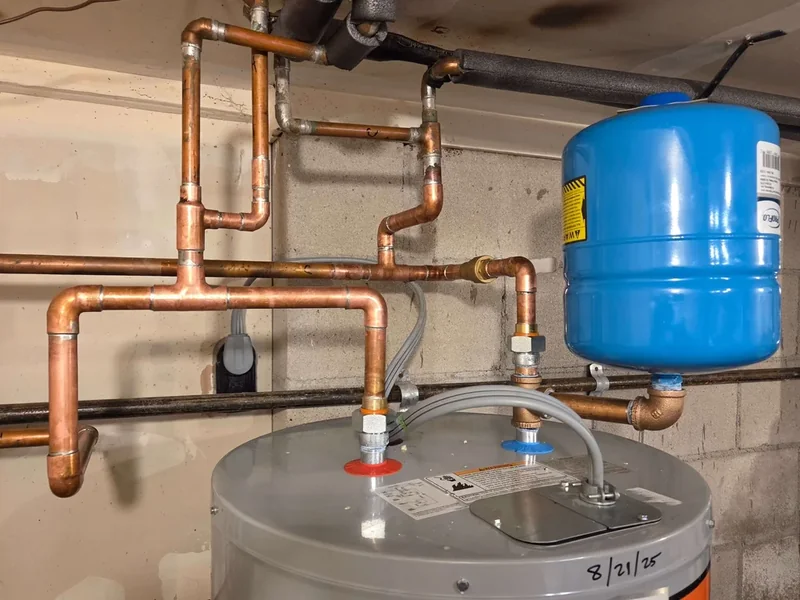
Moisture on the water heater sends homeowners into a panic every summer — and half the time, it's just condensation. But the other half, it's a real leak hiding behind the 'it's probably just sweat' assumption. This guide teaches you to tell them apart definitively: what each one looks like, the wipe-and-watch test, the gray areas where they mimic each other, and the seasonal rule of thumb that settles most cases.
The Summer Panic (and Why It Happens)
Here's the scenario that plays out every summer in Medford: homeowner sees moisture on the water heater, assumes the worst, and calls in a panic. The tech wipes it down, explains condensation, and leaves. No leak, no repair, no problem — except the worry. This guide exists so you can tell the difference yourself before you call, because while some 'sweat' is harmless, some of it is a real leak wearing a disguise.
What Condensation Looks Like
Condensation forms when warm, humid air meets a cold surface — the tank wall, chilled by incoming cold water. It's physics, not failure. Condensation looks like:
- General surface dampness — a uniform film or fine beads across the tank, not concentrated at one point.
- Moisture on cold-water inlet pipes — the coldest surfaces sweat first.
- Timing with weather — appears in humid summer weather, vanishes in dry winter air.
- No pooling, no drips, no stains — wipe it dry and it returns slowly as a film, not as running water.
Newly installed heaters condense more — a fresh tank full of cold water in a humid basement will sweat noticeably for the first day or two. That's normal and temporary.
What a Real Leak Looks Like
A real leak looks like:
- Localized wetness — moisture concentrated at a fitting, valve, seam, or the tank base, not spread evenly.
- Drips, runs, or pooling — water that flows and collects, not just a film.
- Rust streaks or mineral crust — condensation doesn't leave rust trails or white deposits; leaks do.
- Persistence regardless of weather — still wet in dry conditions, still dripping in winter.
- Water in the drain pan — pans don't fill from condensation alone.
The single best test: wipe everything bone-dry, wait a few hours, and check. Condensation returns as a general film; a leak returns at its source point. Our leak detection guide covers this dry-and-watch method in full.
The Gray Areas
The tricky cases where both explanations are plausible:
- Sweating that drips: heavy condensation can form drips that run down and pool slightly at the base — mimicking a tank-bottom leak. The differentiator: it's weather-dependent and leaves no rust or mineral traces.
- A leak masked by condensation: in humid weather, a small real leak hides inside general dampness. Dry-and-watch in drier conditions (or with a dehumidifier running) to isolate it.
- Flue condensation on gas units: moisture around the draft hood can indicate venting issues, not tank problems — worth a professional look because it involves combustion gases.
When in doubt, the warning signs guide helps you read the subtler evidence — and a service call for an ambiguous case is never wasted money.
Reducing Condensation (and Unmasking Leaks)
- Insulate cold-water pipes — pipe insulation stops the sweating at the coldest surfaces.
- Run a dehumidifier in a damp basement — it cuts condensation everywhere, not just on the heater, and makes real leaks easier to spot.
- Improve basement ventilation — moving air carries moisture away before it condenses.
- Don't confuse reduced condensation with a fixed leak — if you dehumidify and a wet spot remains, that's your answer: it was a leak all along.
The Seasonal Rule of Thumb
Seasonal pattern to remember: summer moisture is usually condensation; winter moisture is usually a leak. Cold dry winter air doesn't condense on tanks — so wetness in January deserves immediate attention, while wetness in August deserves the wipe-and-watch test first. Fold this into your seasonal care routine and you'll stop worrying every summer.
The Paper Towel Test
When you can't tell condensation from a leak, the paper towel test gives a definitive answer in a few hours. Dry the suspect area completely — every fitting, the tank jacket, the floor around the base. Then wrap dry paper towels snugly around each suspect joint and lay a dry towel flat on the floor under the heater. Walk away for two to four hours without running hot water.
Now read the towels. Condensation leaves a broad, faint dampness across the towel's surface, often on the cold-water inlet pipe and the tank's lower jacket. A leak leaves a localized wet spot or drip line at one specific point — a fitting, a seam, the TPR discharge. If the towels are dry, run a full hot-water cycle (a shower and a dishwasher load) and check again; some leaks only show under heating pressure. This simple test has resolved more “is it leaking?” debates than any gadget.
Medford Basements and Humidity
Medford's older basements are condensation factories in summer: stone or block foundation walls stay cool, humid outdoor air pours in through every gap, and the cold-water inlet pipe sweats like a glass of iced tea. That sweat runs down the pipe, pools at fittings, and drips onto the floor — a perfect imitation of a leak, usually worst in July and August and gone by October.
A dehumidifier sized for the space is the single biggest fix; keeping basement relative humidity under 50 percent dramatically cuts condensation on pipes and the tank jacket. Insulating the cold-water inlet pipe with foam sleeves stops the worst of the pipe sweating, and improving air circulation (even a small fan) prevents moisture from settling on cool surfaces. If the “leak” follows the humidity — worse on muggy days, absent in winter — you're almost certainly looking at condensation, and the dehumidifier is the repair.