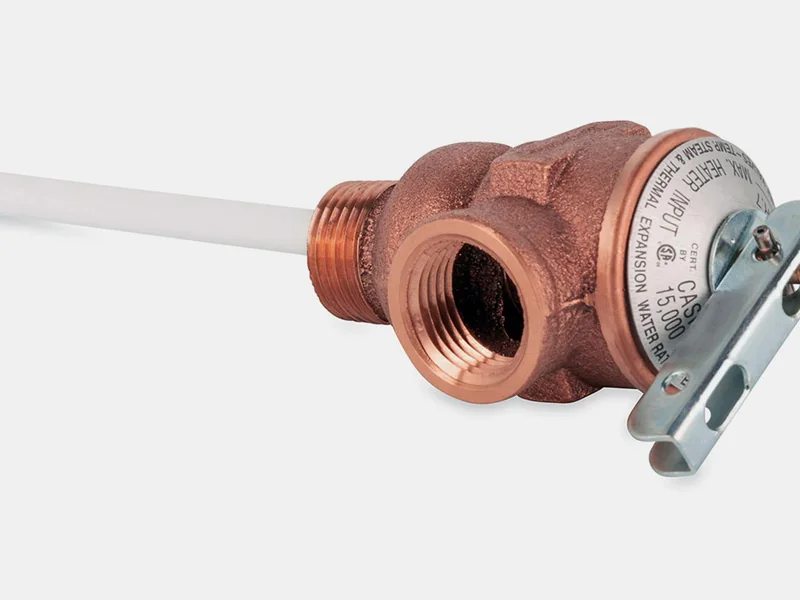
Water dripping from the temperature-pressure relief valve's discharge pipe is your water heater's safety system talking to you — and the message is usually about pressure, not the valve itself. Most TPR 'failures' are actually failed expansion tanks or overpressure conditions, and replacing the valve without diagnosing the cause just starts the drip again. This guide explains what the TPR does, the five causes of TPR leaks in order of likelihood, and the diagnostic sequence that finds the real problem.
What the TPR Valve Does (and Why You Never Cap It)
The temperature-pressure relief (TPR) valve is the single most important safety device on your water heater. If temperature or pressure inside the tank climbs to dangerous levels, the TPR opens and vents water through its discharge pipe — preventing a tank rupture or, in the nightmare scenario, a steam explosion. A TPR valve that's leaking is therefore communicating: either it's doing its job against a real overpressure/overheat condition, or it's worn out and crying wolf. Telling those apart is the whole game.
The cardinal rule: never cap, plug, or restrict the TPR discharge pipe. Blocking a working relief valve converts a leak into a potential rupture. If your TPR is discharging, the correct response is diagnosis, not suppression.
Why TPR Valves Leak: The Five Causes
- Failed expansion tank — the most common cause. The bladder ruptures, pressure spikes go unabsorbed, and the TPR vents them. Fix the tank, not the valve. See our expansion tank guide.
- Excessive system pressure — house pressure above 80 PSI, or a faulty pressure-reducing valve, keeps the system near the TPR's trip point.
- Overheating — a failed thermostat or gas valve letting temperature climb; the TPR vents scalding water.
- Worn-out valve — TPR valves fatigue; a valve that weeps at normal pressure and temperature has simply aged out.
- Debris under the seat — sediment or scale lodged in the valve prevents it from resealing after a test or a legitimate discharge.
Diagnosis in Order: Tank, Pressure, Heat, Then Valve
Work through these in order — they go from most common to least:
- Check system pressure with a gauge on a hose bib. Above 80 PSI static, or big spikes during heating, points at pressure — not the valve.
- Test the expansion tank — press the Schrader valve; water out means a ruptured bladder and your answer.
- Check water temperature at a tap with a thermometer. Above 140°F+ with the thermostat set to 120 points at overheating — thermostat or gas valve fault.
- Test the TPR itself — lift the lever briefly. It should flow strongly and reseat cleanly. Weak flow or failure to reseat means the valve is bad.
- Consider age — if pressure and temperature are normal and the valve still weeps, it's worn out.
This sequence matters because replacing the TPR valve without checking the expansion tank is the most common misdiagnosis in water heater service — the new valve inherits the same pressure spikes and starts weeping within weeks.
When a Leaking TPR Is an Emergency
A TPR valve that gushes continuously, discharges steaming/scalding water, or runs constantly is an emergency: shut the heater down per our shutoff guide and call immediately. A valve that weeps or drips intermittently at normal temperatures is urgent but schedulable — days, not weeks, because whatever's causing it (usually the expansion tank) is stressing the whole system meanwhile. Review the full triage in is it an emergency?
Annual TPR Testing and Discharge-Pipe Rules
Once a year: lift the test lever for a few seconds, confirm strong flow out the discharge pipe, and confirm it stops when released. If it doesn't flow, the valve may be seized — replace it. If it doesn't stop, debris or wear — replace it. Also verify the discharge pipe runs downward to within inches of the floor (or to a drain), is the same diameter as the valve outlet, and has no caps, valves, or threaded ends that could restrict flow. Fall is the natural time, folded into seasonal maintenance.
Replacing the Valve: Last Step, Not First
TPR replacement is quick when it's actually the valve: drain the tank below the valve level, unscrew the old valve, install the new one with sealant, and verify the discharge piping. But the valve is the last thing to replace, not the first — always confirm pressure, expansion tank, and temperature first. A TPR valve doing its job against a dead expansion tank is a hero, not a failure; shoot the right problem.
Discharge Pipe Mistakes That Defeat a Safety Device
The TPR valve is only as good as its discharge pipe, and this is where well-meaning installations go wrong. The pipe must run downhill by gravity to a visible termination — the whole point is that you can see water coming out of it. Common defeats: piping it into a wall or floor where discharge hides, capping or plugging the end, reducing the pipe diameter, or running it uphill so water sits against the valve.
The termination should end a few inches above a floor drain or the basement floor, in the open, where a discharge is impossible to miss. No threads on the end (so nobody can screw a cap onto it), no valves in the line, and material rated for hot water — a TPR discharging 210°F water will soften piping that wasn't meant for it. When a tech services your heater, ask them to eyeball the discharge routing; it takes thirty seconds and it is the most overlooked safety check in the basement.
TPR Discharge in Finished Basements
Finished basements complicate TPR discharge routing, because nobody wants a pipe dumping scalding water onto new carpet. The temptation is to route the discharge somewhere discreet — behind drywall, into a hidden corner — which defeats the visibility requirement and can soak framing silently for months. The right answer is a visible termination over a floor drain, laundry tub, or a properly drained pan.
If your finished basement has no floor drain near the heater, this is worth solving deliberately rather than improvising: options include routing to a laundry standpipe, a sump pit, or a condensate pump rated for hot water. And place a water alarm at the termination point. A TPR that starts discharging is announcing a pressure or temperature problem — you want that announcement loud and immediate, not muffled behind drywall.