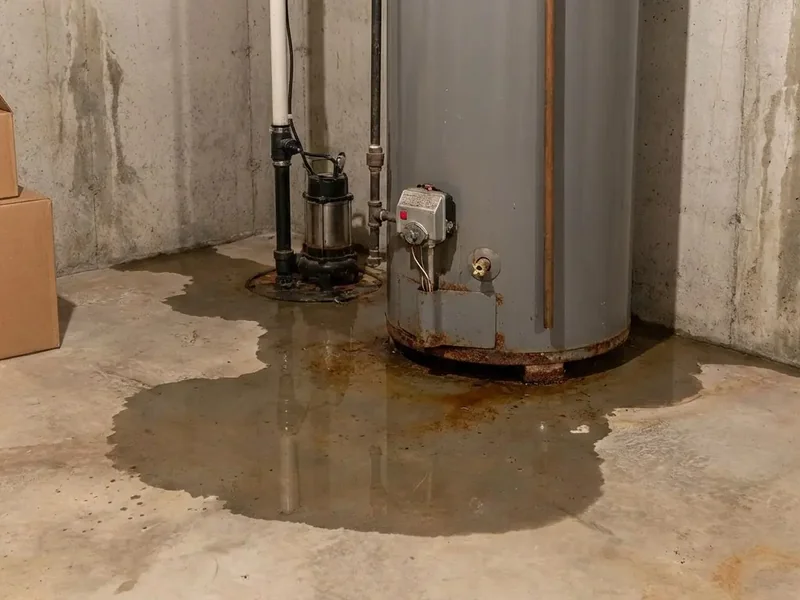
Water on the basement floor, and the first question is always the same: is this an emergency, or can it wait? The honest answer is that it depends entirely on where the water is coming from and how fast it's moving — and most homeowners can't tell at a glance. This guide gives you a clear triage framework: the true emergencies that need a call tonight, the problems that can wait for a scheduled visit, and the Medford-specific factors (winter, finished basements) that shift the calculus.
The Short Answer
Let's answer the question directly: a water heater leak is an emergency when water is actively spreading, when the tank itself is leaking (not a fitting), when there's any gas smell, or when water is reaching electrical components. Everything else — a slow drip from a valve, a damp pan, condensation — can usually wait for a scheduled visit. The hard part is telling which one you're looking at, and that's what this guide is for.
If you're reading this with water on the floor right now, skip to our emergency shutoff guide first — shut the heater down, then come back and calibrate.
Call Now: The True Emergencies
Call now — don't wait for morning — if any of these are true:
- Water is pooling and spreading across the floor, toward walls, or into finished space.
- The tank body itself is leaking — water seeping from the tank shell, seams, or base means the tank has failed structurally. It will not get better.
- You smell gas (rotten-egg odor) near a gas heater — leave the house and call the gas utility first.
- Water is contacting electrical parts — the heater's wiring compartment, nearby outlets, or the breaker panel area.
- The TPR valve is discharging heavily or continuously — the valve is venting dangerous pressure or temperature; the system needs immediate attention.
- It's mid-winter and the heater has failed completely — no hot water in a Medford January with pipes at risk is urgent even without a flood.
Can Wait for a Scheduled Visit
These deserve prompt attention — same week, not same hour:
- A slow, steady drip from the drain valve — annoying and wasteful, but contained. Put a bucket under it and schedule service. (See our drain valve guide.)
- Moisture in the drain pan with no active drip — monitor it; note whether it's growing.
- A TPR valve that weeps occasionally — often an expansion tank issue; needs fixing but isn't a midnight emergency.
- Condensation on the tank or pipes — common in humid weather; wipe it and watch whether it returns as actual dripping. Our leak vs. condensation guide helps you tell the difference.
- Rust stains with no active water — evidence of a past or intermittent leak; schedule an inspection before it becomes active.
The Medford Factors: Winter and Finished Basements
Two factors specific to Medford escalate borderline cases. First, winter: a failed heater in January isn't just a comfort problem — without hot water circulation and with the heating system working overtime, adjacent pipes are more freeze-prone, and a leaking tank in a freezing basement creates ice hazards and accelerates damage. Second, finished basements: many Medford homes have finished lower levels where a 'small' leak soaks carpet, drywall, and stored belongings within hours. If your heater sits above finished space, downgrade every 'can wait' item by one urgency level.
The 60-Second Triage
Not sure which category you're in? Run this 60-second triage:
- Is water spreading right now? Yes → shut it down per our shutoff guide and call.
- Is the tank body wet, or just a pipe/fitting? Tank body → emergency. Fitting → urgent but schedulable.
- Any gas smell or water near electricity? Yes → emergency, no debate.
- How fast is it? A drip you can count is schedulable; a stream you can't is an emergency.
When in doubt, call (833) 713-2101 and describe what you see — we'll tell you honestly whether it needs a truck tonight or an appointment this week.
Why 'Minor' Tank Leaks Still Deserve Speed
One more consideration: even a 'minor' leak from a tank that's rusting through is a countdown, not a stable condition. Tank-body leaks never heal and usually accelerate — today's weep is next month's rupture. So while a slow tank-body seep might technically wait a few days, don't let it wait weeks. The signs of a leaking heater guide covers what tank failure looks like as it progresses, and prevention covers how to avoid getting here at all.
How to Describe Your Leak When You Call
The five details that get you the fastest, most accurate help: 1) the flow — a slow drip, a steady stream, a spray, or standing water; 2) the location — top fittings, bottom of the tank, the TPR discharge pipe, or the tank body itself; 3) the fuel — gas or electric, because it changes the shutdown advice; 4) the unit's age — check the serial label; and 5) what changed — “it started after the cold snap” or “it's been damp for weeks and got worse today.”
A phone photo of the leak and the serial label is worth more than a paragraph of description. Text or describe it when you call: a tech who can see rust streaking down the tank body versus water beading at a top fitting already knows which truck stock and how much time to bring. The better your description, the fewer surprises — and the faster the fix.
The Overnight Decision: Can It Wait Until Morning?
Not every leak needs a midnight call, but the decision has to be honest. Ask three questions. Can you stop the water? If closing the cold-water inlet (or the main) halts the flow, the emergency is contained. Can you kill the heat safely? Gas off or breaker off removes the scald and combustion risk. Is anything still getting damaged? A contained drip into a floor drain in an unfinished basement is a morning problem; water spreading across a finished basement floor at midnight is not — it gets worse every hour you sleep.
If you can answer yes, yes, and no, shut everything down, put a bucket or towels in place, and schedule a morning visit. If the leak won't stop, you smell gas, or water is reaching electrical panels, outlets, or the furnace, that is a call-now situation regardless of the hour. When in doubt, shutting the water and power off and calling is never the wrong move — an unnecessary call costs far less than a flooded basement.