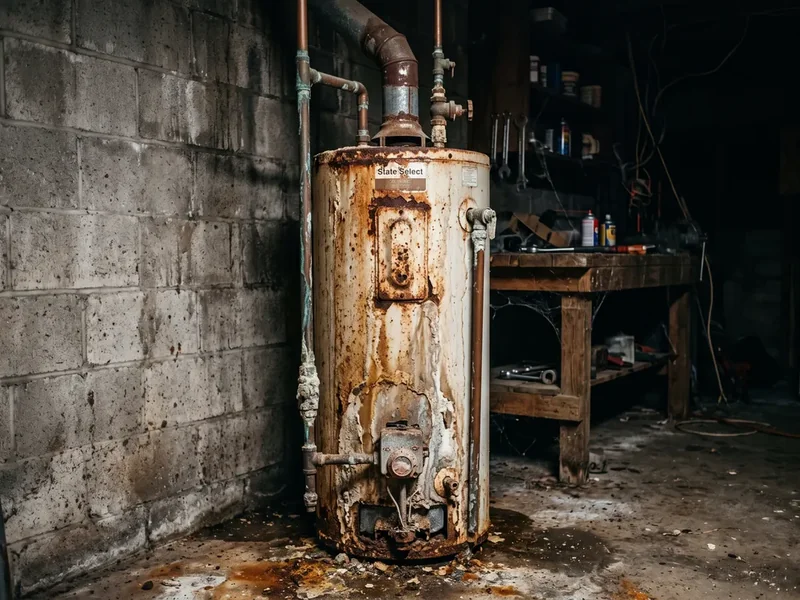
Medford doesn't have the hardest water in Massachusetts, but 'not the hardest' still deposits scale — and the city's older plumbing adds sediment that hardness tests don't measure. Over years, that buildup insulates the tank bottom, overworks the burner, burns out elements, and ends heaters early. This guide explains how Medford's water actually affects your heater, the warning signs of scale damage, the right flushing schedule, and the softener-versus-filter decision.
Medford's Water: Moderate Hardness, Real Sediment
Massachusetts water is often described as 'soft to moderate' — Medford's municipal supply typically runs moderate, not the rock-hard water of the Midwest. That's good news, but it's not a free pass. Moderate hardness still deposits scale over years, and Medford's older neighborhoods add a second problem: aging supply pipes that shed sediment and mineral particles into the tank. The result is a tank that accumulates grit at the bottom even in a moderate-hardness city.
Scale and sediment are different problems that team up. Dissolved hardness forms scale on the hottest surfaces (the tank bottom above the burner, or electric elements). Particulate sediment — rust flakes, sand, pipe scale — settles as grit. Both insulate the water from the heat source, and both shorten the tank's life. If you've noticed your heater getting noisier with age, noise diagnosis is usually where sediment shows up first.
How Sediment and Scale Actually Kill Tanks
Scale is an insulator. A layer of sediment on the tank bottom forces the burner to run longer to heat the same water — longer burner cycles, hotter tank-bottom temperatures, and more thermal stress on the steel. On electric heaters, scale bakes directly onto the heating elements, overheating them until they burn out. The cascade goes: sediment → overheating → weakened tank bottom → the pinhole leak that ends the heater's life. Regular flushing breaks this chain, which is why it anchors every leak prevention routine.
Signs Hard Water Is Winning
- Rumbling, popping, or crackling during heating — water trapped under sediment flashes to steam; the signature sound of a dirty tank.
- Longer recovery times — the burner runs and runs but hot water is slow to return.
- Higher gas or electric bills with no change in usage — the heater is working harder for the same output.
- Grit in aerators and reduced hot-water flow — sediment is escaping the tank and lodging in fixtures.
- Cloudy or gritty hot water that clears from cold taps but not hot.
These symptoms creep up over years, which is why homeowners normalize them. A heater that rumbles isn't 'just old' — it's telling you the tank bottom is buried.
When to Flush: The Medford Calendar
Fall, without question. A late-September or October flush clears the year's accumulation before the heating season, when the heater works its hardest and cold incoming water carries the most dissolved minerals. For Medford homes with older plumbing or noticeable sediment, add a second flush in spring. The full routine — flush, anode rod check, TPR test, and a look at the expansion tank — takes one service visit and covers the tank for the year. Our seasonal care guide lays out the complete calendar.
Softeners, Filters, and the Trade-offs
Water softeners are the obvious answer to hardness, but they're a trade-off for water heaters: softened water is more corrosive to the tank and eats anode rods faster. If you install a softener, commit to checking the rod every two years instead of three. Alternatives worth considering: a whole-house sediment filter (catches the particulate grit without changing water chemistry — ideal for older-pipe neighborhoods), and for tankless units, a scale-inhibitor cartridge on the inlet. None of these replace flushing; they reduce what the flush has to remove.
A Special Note for Tankless Owners
Tankless units are the most scale-sensitive heaters made — a sixteenth of an inch of scale in the heat exchanger measurably cuts efficiency, and heavy scaling triggers error shutdowns. If you have tankless in Medford, annual descaling isn't optional; it's the maintenance the warranty assumes you're doing. See our tankless leak causes guide for how neglected scale turns into leaks at the heat exchanger and fittings.
Medford's MWRA Water: What's Actually in It
Medford's drinking water comes from the MWRA system, fed by the Quabbin and Wachusett reservoirs in central Massachusetts. It is surface water — not well water — which means it arrives moderately hard rather than extremely hard, and it is disinfected with chloramine rather than plain chlorine. That matters for your heater in two specific ways.
First, the moderate mineral content still forms scale and sediment over time; “moderate” hardness over ten years of heating cycles builds a substantial sediment bed. Second, chloramine-treated water can be slightly more aggressive toward rubber components and anode rods than old-style chlorinated water. Neither fact means Medford water is bad for heaters — it is among the cleaner municipal supplies in the country — but it does mean the “we have good water, so we can skip maintenance” logic doesn't hold. The minerals are dilute, not absent.
A Flush That Actually Removes Sediment
Most homeowners who “flush” their heater open the drain valve, watch clear water run for two minutes, and close it — removing almost nothing. Sediment sits in a compacted bed at the tank bottom; clear water flows over the top of it. A flush that works looks different: shut off the inlet and power or gas, attach a hose, and drain the tank substantially. Then pulse the cold-water inlet on and off in short bursts. Each burst stirs the sediment bed and carries a slug of gritty water out the hose.
Use a light-colored bucket or watch the hose discharge against a white surface — you will see when the water runs sandy, then cloudy, then clear. Repeat the pulse-and-drain cycle until it stays clear. On a heater that hasn't been flushed in five-plus years, the first real flush can take 30 to 45 minutes and produce startling amounts of grit. That grit is exactly what was insulating your tank bottom and cooking your elements, so every bucket of it is money back.