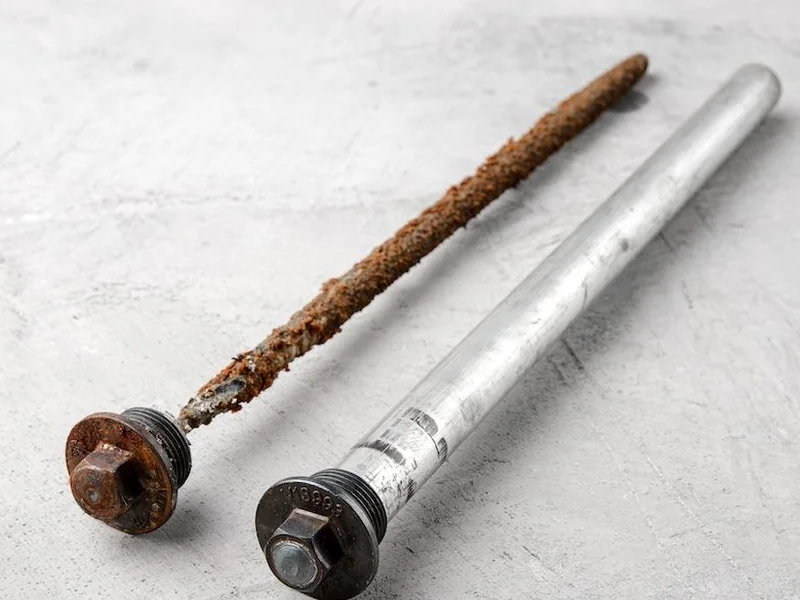
The anode rod is the cheapest part in your water heater and the most important one for stopping tank leaks. This sacrificial metal rod corrodes on purpose so the steel tank doesn't — and when it's used up, the tank walls start rusting from the inside out. Most Medford homeowners never think about the anode rod until the heater is already dripping. This guide explains how the rod works, the warning signs that it's spent, how often Medford's water conditions demand a check, and what replacement involves.
What the Anode Rod Actually Does
Inside every tank-style water heater, the water sits in contact with a steel tank lined with glass. Wherever that glass lining has even a pinhole gap, the steel is exposed — and water plus steel equals corrosion. The anode rod is a magnesium, aluminum, or zinc alloy rod threaded into the top of the tank, and it draws the corrosion reaction onto itself instead of the tank walls. That's why it's called sacrificial: it gives up its own metal so the tank survives.
Medford's housing stock matters here. Many homes in the city have original or decades-old tank heaters in basements where damp air accelerates external rust too. A fresh anode rod can't fix external corrosion, but it's the single biggest factor in whether a tank springs an internal leak at year 8 or survives to year 14. If you want to stop a water heater leak before it ever starts, the anode rod is where prevention begins.
Signs Your Anode Rod Is Spent
You can't see the rod without pulling it, but it announces itself through symptoms. Watch for:
- Rotten-egg smell in hot water only — the classic magnesium-rod reaction with sulfate in the water. A zinc alloy rod often fixes the smell without changing the tank.
- Hot water that smells metallic or looks discolored — rust particles from a tank that's losing its protection.
- The heater is 6+ years old and the rod has never been checked — most rods are significantly depleted by year five or six in regular use.
- Ticking or sizzling sounds — sediment bakes onto a failing rod's remnants and sizzles as it heats.
If you're already seeing signs your water heater is leaking, a rod replacement alone won't save a tank that has already rusted through — but it's still the right move for the replacement unit that goes in next.
How Often Should Medford Homeowners Check the Rod?
The industry standard is every three years, and that's a sensible cadence for Medford. A few local factors tighten or loosen that schedule:
- Water softener installed: softened water is more aggressive toward anode rods — check every 2 years instead of 3.
- Second homes or low-use heaters: less hot-water turnover actually preserves the rod longer, but stagnant tanks have their own problems.
- Older plumbing with galvanized pipe: more sediment and minerals reach the tank, working the rod harder.
Fall is the smartest time for the check. You beat the winter heating season when the heater works hardest, and a tech can combine the rod inspection with seasonal water heater care in a single visit.
Magnesium vs. Aluminum vs. Zinc: Which Rod?
Not all rods are the same, and the choice depends on your water and your nose:
- Magnesium — the best protection for most tanks, but the most likely to cause sulfur odor in well-fed or sulfate-heavy water.
- Aluminum/zinc alloy — the standard fix when hot water smells like rotten eggs. Slightly less protective than magnesium but dramatically less smelly.
- Powered (impressed-current) rods — an electric alternative that never depletes and produces no odor. Higher upfront cost, but ideal for softened-water homes where standard rods die fast.
A tech can pull your existing rod, read how it failed, and match the replacement to your water. The stub left behind tells the story: uniform thinning is normal aging, heavy pitting means aggressive water, and a rod eaten to a bare wire means it died years ago.
What Replacement Involves
Replacement is a straightforward service call when there's clearance above the tank — the rod is roughly as long as the tank is tall, so tight basement ceilings are the most common complication. The process:
- Shut off the gas or power and the cold-water inlet to the heater.
- Drain a few gallons to drop the water level below the rod port.
- Break the old rod's hex head loose with a breaker bar (this is where DIY attempts usually stall — factory rods are torqued hard).
- Thread in the new rod with pipe-thread sealant and restore the system.
Flexible segmented rods exist for low-clearance installations and work just as well. If the old rod snaps off or the port is seized, that's a job for a pro — forcing it can crack the tank's threaded boss and create the very leak you're trying to prevent. Most anode rod replacement visits take under an hour.
Anode Rod Care vs. Tank Replacement
Here's the honest math: an anode rod service costs a small fraction of a new water heater. Replacing the rod at year 5 and again at year 9 can push a tank's life well past its warranty — while ignoring it is the most common reason tanks fail early. But there's a cutoff: once the tank wall has perforated and is actively leaking, no rod will plug the hole. At that point the correct move is replacement vs. repair arithmetic, not another rod.
The sweet spot is preventive: if your heater is under 10 years old, not leaking, and has never had its rod checked, a rod inspection is the highest-value maintenance you can buy for it.
Reading a Spent Rod: What the Stub Tells a Tech
When a technician pulls your anode rod, the remains read like a medical chart for your tank. A rod that has thinned evenly along its length died a normal death doing its job. Heavy pitting and cratering point to aggressive water chemistry working the metal harder than usual. A rod eaten down to a bare steel wire with chunks of alloy clinging to it died a long time ago — and every month since has been borrowed time for the tank walls. A rod coated in white calcium scale tells a different story: Medford's moderately hard water laid mineral armor over the metal, blocking it from protecting the tank even though plenty of rod was left.
The practical rule techs use: a new rod is about 3/4 inch thick. When it has worn below roughly half that diameter, or the steel core wire is exposed anywhere along its length, it is done. Catching it at that stage — rather than years later — is the difference between a quick swap and shopping for a new heater.
Anode Rods in Medford's Multi-Unit Homes
Medford's triple-deckers and two-family homes put unusual demands on anode rods. A single tank serving two or three units cycles far more hot water than a single-family heater, and every extra gallon of throughput works the rod harder. In these buildings the rod can be substantially depleted in as little as two to three years — well ahead of the standard check interval.
Property owners should treat the rod check as part of unit turnover or annual building maintenance, the same way they service the heating system each fall. Tenant complaints are often the first signal: rotten-egg odor in one unit's hot water, or rusty water on the top floor where sediment accumulates. For buildings with water softeners, a powered anode rod is worth serious consideration — softened water eats standard rods quickly, and a powered rod never depletes, which matters when the heater serves multiple households and downtime affects everyone.