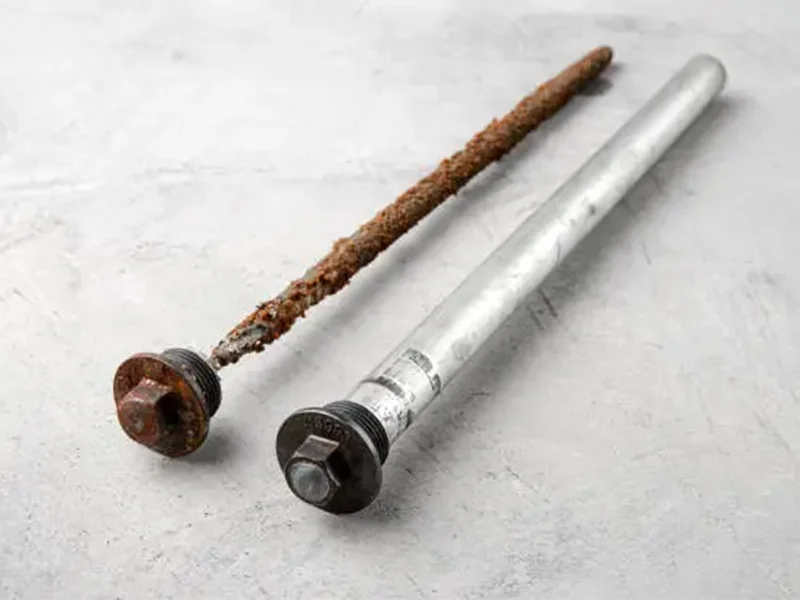
Inside every conventional tank water heater in Winchester, MA 01890 there is a part most homeowners never see and almost never think about: the anode rod. It is a long metal rod, usually magnesium or an aluminum-zinc alloy, threaded into the top of the tank and hanging down into the stored water. Its entire job is to corrode on purpose. Through a basic electrochemical reaction, the rod sacrifices itself so the steel tank wall does not rust, and as long as the rod has metal left to give, the tank lining stays protected. Once the rod is consumed down to a bare wire, that protection stops, and the tank begins rusting from the inside out. We replace spent anode rods for Winchester homeowners as a planned maintenance visit: a straightforward service call that can add years to a tank that is otherwise in good shape.
How an Anode Rod Protects Your Tank
A glass-lined steel tank is never perfectly lined. Microscopic cracks and pinholes in the glass coating expose bare steel to hot water, and hot water is an aggressive environment. The anode rod exploits galvanic corrosion on purpose: because magnesium and aluminum-zinc are more electrochemically active than steel, they become the anode in a tiny galvanic cell and corrode first, while the steel tank wall becomes the cathode and is spared. This only works while the rod still has sacrificial metal. A fresh rod is roughly three-quarters of an inch thick; when we pull a rod that has been reduced to a thin wire or bare steel core, the tank has been unprotected for a long time, and every month after that is borrowed time.
Magnesium rods protect more aggressively and are the default in most residential tanks, while aluminum-zinc rods are the standard answer when a home has a rotten-egg sulfur smell in the hot water, because the zinc content suppresses the sulfate-reducing bacteria reaction that magnesium can encourage. Either way, the rod is a wear item, like brake pads on a car. Replacing it on schedule is the single highest-leverage maintenance action a tank owner can take, because a tank with a live anode and intact glass lining has no reason to rust, while a tank with a dead anode is rusting whether or not it has started leaking yet.
Signs Your Anode Rod Is Spent
The most famous symptom is a rotten-egg smell in the hot water only. Cold water smells fine, hot water smells like sulfur. That pattern points at the anode rod reacting with naturally occurring sulfates and harmless bacteria in the water, and the fix is usually an aluminum-zinc replacement rod rather than a new tank. A second sign is rusty or discolored hot water that clears after a few seconds of running the tap. When the rod is gone, the tank wall starts rusting, and the first rust shows up as tinted hot water at the fixtures closest to the heater.
Age is the quietest sign of all. If your tank is more than five or six years old and nobody has ever checked the rod, assume it is significantly depleted. Rumbling or popping sounds during heating cycles can also relate: sediment bakes onto the tank bottom while the rod quietly disappears above it, so a noisy older tank is a candidate for both a flush and a rod inspection in the same visit. The honest diagnostic is visual. We shut the water off, relieve pressure, break the hex head loose on top of the tank, and pull the rod to look at it. What we see tells us exactly how much protection your tank has left, and that is the basis for a straight recommendation: replace the rod, or start planning for a tank.
Partial MWRA Supply and the No-Assumptions Rule
Winchester's water supply is partial MWRA supplemented by local town sources, which puts it in the same honest category as Wakefield and Lynn: we do not assert specific water-chemistry claims for Winchester. The rod interval is set by inspection, not by assumption. We pull the rod, read its actual depletion, assess the tank's sediment load, and let the evidence determine the maintenance plan. In a partial-supply town, the calendar is a guess and the inspection is the answer, and our Winchester visits are built around that principle.
What we can say with confidence is about the housing, not the water. Winchester's 1920s to 1950s colonials and capes run on original galvanized laterals or early copper, and the rod visit includes the standard older-home assessment: shutoff operability, dielectric union condition at the heater connections, and base-ring state. The 1920s to 1940s colonials with original galvanized laterals have seized shutoffs as the norm, so we budget valve replacement into the visit recommendation as a matter of course. The failure analysis stays grounded in age, installation, and environment, which is everything the inspection can actually verify.
Finished Basements and the Lakeside Water Table
Winchester's price bracket means finished basements are common, and the rod visit carries the same financial logic as Newton and Lexington: the inspection is inexpensive protection for expensive finished space. We recommend the rod check on a calendar schedule rather than waiting for symptoms, and we pair it with the pan-and-shutoff conversation as a matter of course. The rod protects the tank from the inside; the pan and the smart shutoff protect the finished basement from the tank.
The Mystic Lakes shoreline and the Aberjona River lowlands add Winchester's distinctive environmental factor: high water tables in some of the town's most desirable neighborhoods. Heaters in the shoreline and lowland zones sit over groundwater that keeps basements damp and corrodes tank bases from the outside, which means the rod visit in those zones inspects the base ring with the same care as the rod. Elevation on a stand, a corrosion-resistant pan, and sump verification are the standard shoreline recommendations, quoted with the rod work as one system, because the lakeside water table is the variable the rod cannot address.
What Happens When You Call
When you call (833) 713-2101, you reach a real person who takes down your tank's age, brand, and symptoms, and schedules a service window that fits your day. On arrival, our technician shuts off the water and power or gas to the heater, relieves tank pressure, and breaks loose the anode rod's hex head on top of the tank. Old rods are often seized, so we carry the breaker bars and impact tools to free them without damaging the tank threads. We pull the rod, show you its condition, and install the correct replacement: rigid magnesium where it fits, flexible or segmented aluminum-zinc where ceiling clearance or sulfur odor calls for it. Then we refill the tank, purge air from the hot lines, restore power or relight the pilot, and verify normal heating before we leave.
The 01890 Anode Rod Inspection, Step by Step
An anode rod inspection in Winchester starts before we touch the heater: we check the tank's age, because a rod swap on a 14-year-old tank with rust at the base is money pointed at the wrong problem. Then we shut off the cold supply, relieve pressure through the T&P valve, and drain a few gallons so the rod can come out without a flood. The rod lives under a hex head at the top of the tank — on older Winchester installations, Mystic Lakes and Aberjona shoreline homes combine high water tables with finished basements — the worst combination for a tank leak, and the head may need a breaker bar and some patience rather than force that would twist the tank.
What comes out tells the story. A rod with pitting and surface wear but solid diameter has life left; a rod reduced to wire means the tank ran unprotected, and we look hard for rust weep at seams and the base before recommending anything. We stock magnesium rods for standard tanks and aluminum-zinc rods for homes where hot water has a sulfur or rotten-egg odor — partial-MWRA supply supplemented by town sources — specific water-chemistry claims are avoided and failure analysis stays on age, installation, and environment doesn't cause that smell, bacteria reacting with a magnesium rod does, and switching rod alloy often fixes it. 1920s–40s colonials with original galvanized laterals bring seized shutoffs — include valve work in quotes. After the new rod goes in, we refill, purge air at the nearest hot tap, and confirm the burner or elements cycle normally.
Signs Your Winchester Tank's Rod Is Spent
You can't see the anode rod without pulling it, but a spent rod leaves clues. Rust-colored hot water at a single tap usually points to the tank's steel showing through where the rod stopped protecting it. A sulfur or rotten-egg smell in hot water — cold water smells fine — means bacteria are reacting with a depleted magnesium rod. Rumbling or popping during heating means sediment has baked onto the tank bottom, which accelerates in tanks whose rods are gone because the same neglected maintenance schedule skips flushing too.
finished basements are common at this price point — automatic shutoffs and sensors fit the market, and Mystic Lakes and Aberjona shoreline homes combine high water tables with finished basements — the worst combination for a tank leak. None of these symptoms alone condemns a tank, but together they describe a heater running without its primary defense. In Winchester the practical move is an inspection, not a guess: pull the rod, read what's left, check the base and seams, and then decide between a rod replacement that extends the tank's life and a planned replacement on your schedule instead of the tank's. Planned beats emergency every time — especially in Winchester Center, the Mystic Lakes shoreline, and the Wedgemere area, where 1920s–40s colonials with original galvanized laterals bring seized shutoffs — include valve work in quotes.