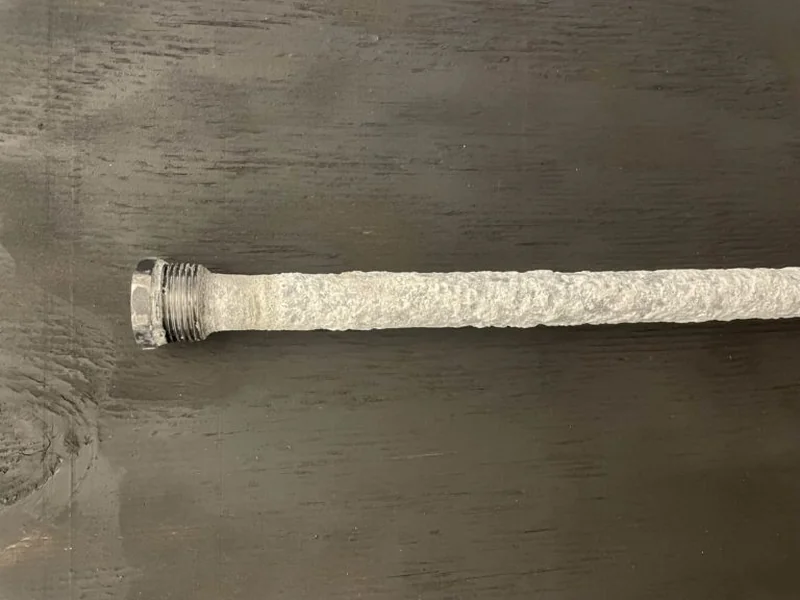
Inside every conventional tank water heater in Waltham, MA 02451 there is a part most homeowners never see and almost never think about: the anode rod. It is a long metal rod, usually magnesium or an aluminum-zinc alloy, threaded into the top of the tank and hanging down into the stored water. Its entire job is to corrode on purpose. Through a basic electrochemical reaction, the rod sacrifices itself so the steel tank wall does not rust, and as long as the rod has metal left to give, the tank lining stays protected. Once the rod is consumed down to a bare wire, that protection stops, and the tank begins rusting from the inside out. We replace spent anode rods for Waltham homeowners as a planned maintenance visit: a straightforward service call that can add years to a tank that is otherwise in good shape.
How an Anode Rod Protects Your Tank
A glass-lined steel tank is never perfectly lined. Microscopic cracks and pinholes in the glass coating expose bare steel to hot water, and hot water is an aggressive environment. The anode rod exploits galvanic corrosion on purpose: because magnesium and aluminum-zinc are more electrochemically active than steel, they become the anode in a tiny galvanic cell and corrode first, while the steel tank wall becomes the cathode and is spared. This only works while the rod still has sacrificial metal. A fresh rod is roughly three-quarters of an inch thick; when we pull a rod that has been reduced to a thin wire or bare steel core, the tank has been unprotected for a long time, and every month after that is borrowed time.
Magnesium rods protect more aggressively and are the default in most residential tanks, while aluminum-zinc rods are the standard answer when a home has a rotten-egg sulfur smell in the hot water, because the zinc content suppresses the sulfate-reducing bacteria reaction that magnesium can encourage. Either way, the rod is a wear item, like brake pads on a car. Replacing it on schedule is the single highest-leverage maintenance action a tank owner can take, because a tank with a live anode and intact glass lining has no reason to rust, while a tank with a dead anode is rusting whether or not it has started leaking yet.
Signs Your Anode Rod Is Spent
The most famous symptom is a rotten-egg smell in the hot water only. Cold water smells fine, hot water smells like sulfur. That pattern points at the anode rod reacting with naturally occurring sulfates and harmless bacteria in the water, and the fix is usually an aluminum-zinc replacement rod rather than a new tank. A second sign is rusty or discolored hot water that clears after a few seconds of running the tap. When the rod is gone, the tank wall starts rusting, and the first rust shows up as tinted hot water at the fixtures closest to the heater.
Age is the quietest sign of all. If your tank is more than five or six years old and nobody has ever checked the rod, assume it is significantly depleted. Rumbling or popping sounds during heating cycles can also relate: sediment bakes onto the tank bottom while the rod quietly disappears above it, so a noisy older tank is a candidate for both a flush and a rod inspection in the same visit. The honest diagnostic is visual. We shut the water off, relieve pressure, break the hex head loose on top of the tank, and pull the rod to look at it. What we see tells us exactly how much protection your tank has left, and that is the basis for a straight recommendation: replace the rod, or start planning for a tank.
Mill-Era Plumbing and the Wall-Chase Trap
Waltham's identity as a former mill city is written into its plumbing: 1890s to 1920s triple-deckers and workers' housing with hundred-plus-year-old plumbing chases, layered retrofits, and supply lines running inside walls that have been opened and closed a dozen times. This creates Waltham's signature diagnostic trap for anode rod visits: supply-line leaks inside wall chases get blamed on the heater, because the water appears at the base of the tank having traveled down the chase. Our Waltham visits therefore pressure-test and inspect before touching the rod, distinguishing wall-chase leaks from tank issues, because a rod replacement cannot fix a pipe leaking inside a wall two feet away.
The rod itself depletes on the standard three-to-six-year curve in Waltham's soft MWRA water, around 15 to 20 parts per million. But the visit's value is the full old-mill assessment: rod condition, chase plumbing integrity, tank-top fittings on the layered galvanized-to-copper systems, shutoff operability, and base state in the old full basements. In a city where the plumbing is older than the water heater by half a century, the system inspection is the service and the rod is one line item in it.
Student Rentals, Landlords, and Floodplain Basements
The student-rental multis near Brandeis and Bentley universities run on landlord economics: deferred maintenance, tanks that get replaced on failure rather than on schedule, and summer turnover as the natural service window. Anode rod inspections are a harder sell in this market until the landlord does the portfolio math: a scheduled rod check across the building's tanks versus a semester's worth of emergency calls. We frame it exactly that way, because it is true, and we schedule around the academic calendar, with August turnover season as the natural window for planned heater work.
The Charles River floodplain along the Moody Street area adds the exterior dimension: high water tables, basement flooding in heavy storms, and the submersion rule for any heater that goes under. Our floodplain rod visits inspect the base ring, verify the sump, and check for prior submersion corrosion, because a rod cannot protect a tank whose base is rotting in floodplain groundwater. In North Waltham, the 1950s ranches contribute the crawl-space pattern: freeze risk on heater supply lines in unconditioned spaces, which we note during the visit even though it is a piping concern, with winterization quoted where the exposure warrants it.
What Happens When You Call
When you call (833) 713-2101, you reach a real person who takes down your tank's age, brand, and symptoms, and schedules a service window that fits your day. On arrival, our technician shuts off the water and power or gas to the heater, relieves tank pressure, and breaks loose the anode rod's hex head on top of the tank. Old rods are often seized, so we carry the breaker bars and impact tools to free them without damaging the tank threads. We pull the rod, show you its condition, and install the correct replacement: rigid magnesium where it fits, flexible or segmented aluminum-zinc where ceiling clearance or sulfur odor calls for it. Then we refill the tank, purge air from the hot lines, restore power or relight the pilot, and verify normal heating before we leave.
Why Anode Rods Wear Out Faster in Waltham
The anode rod is the quiet part of a water heater that decides how long the tank lives. It is a magnesium or aluminum-zinc rod threaded into the top of the tank, and it works by sacrificing itself: galvanic corrosion attacks the rod first and spares the steel tank wall. That only works while the rod still has metal on it. In Waltham, soft MWRA water (about 15–20 ppm hardness), and soft water keeps sediment lighter but does nothing to slow galvanic action — in fact, soft water can deplete anodes on a different schedule than hard water, so the 'check it at year five' rule of thumb from hard-water regions doesn't transfer cleanly here.
1890s–1920s mill-era triple-deckers and workers' housing, South Side Victorians, North Waltham 1950s ranches, and Brandeis/Bentley student rentals in Waltham often means tanks that have been running on the original rod for a decade or more — and mill-era plumbing chases hide supply-line leaks inside walls that get blamed on the heater — pressure-test before quoting. When we inspect a rod, we pull it and measure what's left: a fresh rod is roughly three-quarters of an inch in diameter, and a rod worn to a thin wire or a bare steel core means the tank has been unprotected for a long time. Replacement is a straightforward service — drain a few gallons, unthread the old rod, thread in the new one — but the inspection tells you whether the tank is worth saving or already on borrowed time. That judgment call is the real value of the visit.
How Rod Condition Changes the Replacement Decision
Most homeowners hear 'your tank is ten years old' and assume replacement is the only option. The anode rod is what lets us give a better answer. If the rod still has substantial metal and the tank shows no base rust, no seam weeping, and no pilot or burner issues, a rod replacement can buy real years — we've seen protected tanks run well past their rated life. If the rod is gone and the tank is weeping anywhere, the honest recommendation is replacement, because a new rod cannot heal a compromised steel wall. North Waltham ranches carry crawl-space freeze risk on heater supply lines.
In Waltham, 1890s–1920s mill-era triple-deckers and workers' housing, South Side Victorians, North Waltham 1950s ranches, and Brandeis/Bentley student rentals, and that stock profile shapes what we find: original rods in 12-year-old tanks are common, and so are tanks that failed at year nine because the rod was spent at year six and nobody looked. A periodic rod check — roughly every three to five years on a tank you intend to keep — is the cheapest life-extension a water heater can get. It takes under an hour, disturbs nothing else in the plumbing, and gives you a dated, factual read on where your tank stands instead of a guess.