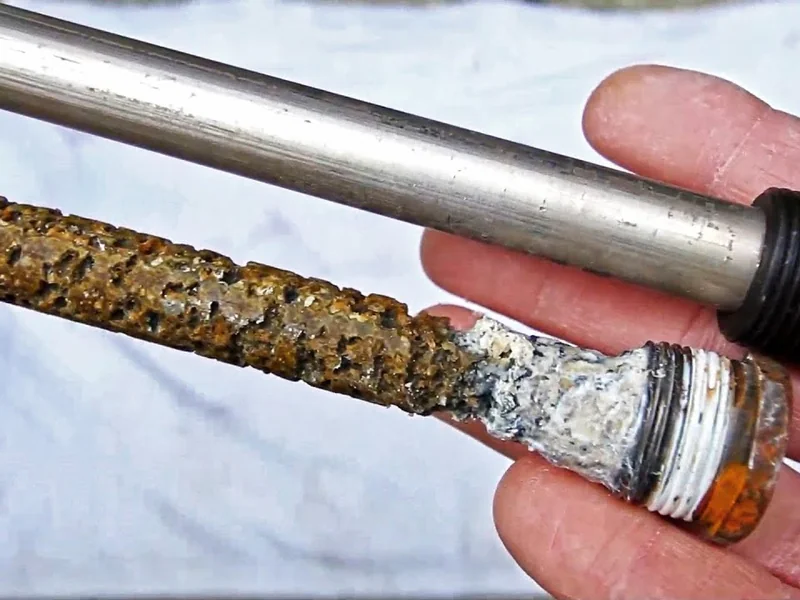
Inside every conventional tank water heater in Lexington, MA 02420 there is a part most homeowners never see and almost never think about: the anode rod. It is a long metal rod, usually magnesium or an aluminum-zinc alloy, threaded into the top of the tank and hanging down into the stored water. Its entire job is to corrode on purpose. Through a basic electrochemical reaction, the rod sacrifices itself so the steel tank wall does not rust, and as long as the rod has metal left to give, the tank lining stays protected. Once the rod is consumed down to a bare wire, that protection stops, and the tank begins rusting from the inside out. We replace spent anode rods for Lexington homeowners as a planned maintenance visit: a straightforward service call that can add years to a tank that is otherwise in good shape.
The Science of Sacrificial Protection
Steel wants to return to iron oxide. That is the entire story of tank failure, and the anode rod is the engineered answer to it. Glass lining slows the process, but lining always has flaws: hairline cracks from thermal cycling, thin spots from manufacturing, chips around fittings. At every flaw, hot oxygenated water meets bare steel, and corrosion begins. The anode rod changes the electrical potential of the whole system. Connected to the tank through the threaded hex head, the rod holds the steel at a protective voltage as long as it has active metal to dissolve. Engineers call this cathodic protection, and it is the same principle used on ship hulls and buried pipelines, just miniaturized into a three-foot rod inside your basement.
Water chemistry sets the pace. Hotter water, higher conductivity, and certain dissolved minerals all accelerate rod consumption, which is why there is no universal replacement interval printed on the tank. Three to six years covers most homes, but the only number that matters is the condition of the rod in your tank right now. Flexible or segmented replacement rods exist for tanks under low basement ceilings: they link together in sections so a full-length rod can be installed where a rigid one would hit the joists. When we service a tank, we match the rod alloy to the home's water history, because the right rod in the right water is what buys the extra years.
When Replacement Makes Sense, and When It Does Not
Anode rod replacement is a maintenance play, not a rescue play. It makes the most sense on a tank between roughly five and ten years old that is not leaking, heats normally, and has sound fittings and shutoffs. On that tank, a fresh rod resets the corrosion clock and is a fraction of the disruption of a full swap: no tank to haul out, no re-piping, no disposal. It also makes sense as a diagnostic visit on any tank of unknown age. Pulling the rod is the closest thing to an X-ray a tank gets. A rod with half its metal left on an eight-year-old tank tells a very different story than a bare wire on the same tank, and we give you that information straight so you can plan instead of reacting.
There are tanks where a new rod is not the right call. A tank that is already leaking from the shell has failed; no rod will un-rust steel. A tank past twelve to fifteen years with a heavily depleted rod, significant sediment, and corroded fittings is usually better replaced than nursed, because you would be buying a rod for a tank with multiple other end-of-life problems. And a tank with a seized, broken-off rod stub that cannot be extracted without risking the tank threads may not be a candidate at all. Our job on the visit is to tell you which situation you are in. If the rod will genuinely buy you years, we say so. If the tank is done, we say that instead, and explain why.
Original Copper, Finished Basements, and the Rod
Lexington's dominant housing stock, the 1950s to 1970s colonials, split-levels, and ranches, sits at an interesting plumbing age: the original copper supply systems are now sixty to seventy years old, approaching the end of their reliable life, while the water heaters have typically been replaced once or twice in that span. This creates the signature Lexington diagnostic trap for anode rod visits: pinhole leaks developing in the aging copper lines near the heater get blamed on the tank, when the tank and its rod may be perfectly fine. Our rod visits in Lexington therefore start with a pressure test and a careful look at the hot-water lines around the heater before anyone touches the anode, because replacing a rod to fix a pipe leak helps nobody.
The finished basement changes the maintenance calculus the way it does everywhere at Lexington's price point: a fifty-gallon tank failure over finished flooring is a five-figure event, which makes the rod inspection the cheapest protection available. We recommend Lexington homeowners treat the rod check as scheduled maintenance around year four or five, not as a reaction to symptoms, because by the time a depleted rod announces itself through rusty water or odor, the tank has been unprotected for a long while. Planned replacement of the rod, and planned replacement of the tank at ten to twelve years, both resonate in a market that maintains its homes deliberately.
Split-Levels, Teardowns, and Soft Water
Lexington's split-levels tuck water heaters into low utility rooms under stairwells or into half-buried lower levels with exterior-wall exposure, and those spaces rival triple-decker basements for access difficulty. Clearances are tight, lighting is poor, and a rigid anode rod often cannot be installed where a flexible or segmented rod goes in easily. We ask about the heater's location when you call and bring the right rod type, because the service visit should not discover the access problem. Heaters in semi-conditioned utility rooms with exterior-wall exposure also face real freeze risk in cold snaps when the room goes unheated, which we note during the visit even though it is a piping concern rather than a rod concern.
The teardown-rebuild cycle scattered through Lexington adds a second equipment type to our rod work: newer high-efficiency homes with tankless or heat-pump water heaters, which have no anode rod at all but need descaling and condensate maintenance instead. When we encounter one, we say so plainly and quote the right service rather than forcing a tank-maintenance visit onto equipment that does not use a tank. For the conventional tanks that remain the majority, Lexington's soft MWRA water, around 15 to 20 parts per million, means the standard three-to-six-year rod depletion curve applies, driven by use and temperature rather than scale.
What Happens When You Call
When you call (833) 713-2101, you reach a real person who takes down your tank's age, brand, and symptoms, and schedules a service window that fits your day. On arrival, our technician shuts off the water and power or gas to the heater, relieves tank pressure, and breaks loose the anode rod's hex head on top of the tank. Old rods are often seized, so we carry the breaker bars and impact tools to free them without damaging the tank threads. We pull the rod, show you its condition, and install the correct replacement: rigid magnesium where it fits, flexible or segmented aluminum-zinc where ceiling clearance or sulfur odor calls for it. Then we refill the tank, purge air from the hot lines, restore power or relight the pilot, and verify normal heating before we leave.