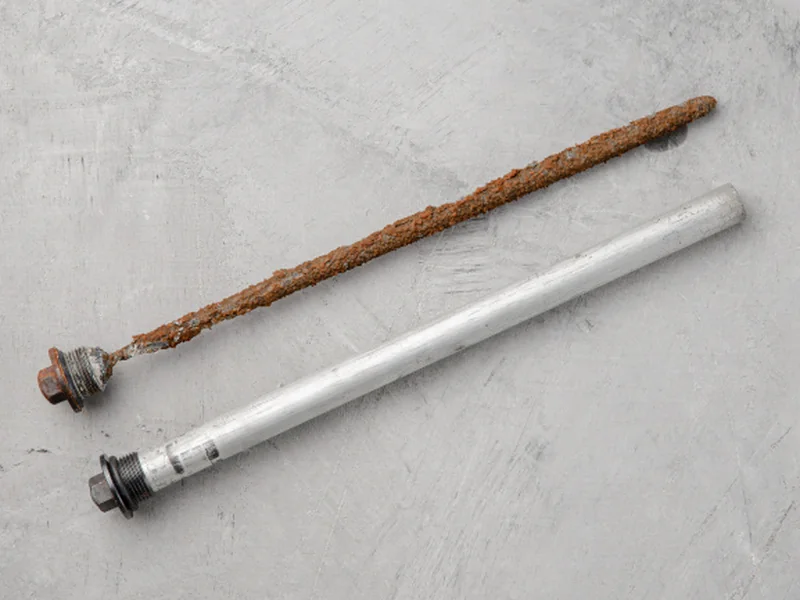
Inside every conventional tank water heater in Everett, MA 02149 there is a part most homeowners never see and almost never think about: the anode rod. It is a long metal rod, usually magnesium or an aluminum-zinc alloy, threaded into the top of the tank and hanging down into the stored water. Its entire job is to corrode on purpose. Through a basic electrochemical reaction, the rod sacrifices itself so the steel tank wall does not rust, and as long as the rod has metal left to give, the tank lining stays protected. Once the rod is consumed down to a bare wire, that protection stops, and the tank begins rusting from the inside out. We replace spent anode rods for Everett homeowners as a planned maintenance visit: a straightforward service call that can add years to a tank that is otherwise in good shape.
How an Anode Rod Protects Your Tank
A glass-lined steel tank is never perfectly lined. Microscopic cracks and pinholes in the glass coating expose bare steel to hot water, and hot water is an aggressive environment. The anode rod exploits galvanic corrosion on purpose: because magnesium and aluminum-zinc are more electrochemically active than steel, they become the anode in a tiny galvanic cell and corrode first, while the steel tank wall becomes the cathode and is spared. This only works while the rod still has sacrificial metal. A fresh rod is roughly three-quarters of an inch thick; when we pull a rod that has been reduced to a thin wire or bare steel core, the tank has been unprotected for a long time, and every month after that is borrowed time.
Magnesium rods protect more aggressively and are the default in most residential tanks, while aluminum-zinc rods are the standard answer when a home has a rotten-egg sulfur smell in the hot water, because the zinc content suppresses the sulfate-reducing bacteria reaction that magnesium can encourage. Either way, the rod is a wear item, like brake pads on a car. Replacing it on schedule is the single highest-leverage maintenance action a tank owner can take, because a tank with a live anode and intact glass lining has no reason to rust, while a tank with a dead anode is rusting whether or not it has started leaking yet.
Signs Your Anode Rod Is Spent
The most famous symptom is a rotten-egg smell in the hot water only. Cold water smells fine, hot water smells like sulfur. That pattern points at the anode rod reacting with naturally occurring sulfates and harmless bacteria in the water, and the fix is usually an aluminum-zinc replacement rod rather than a new tank. A second sign is rusty or discolored hot water that clears after a few seconds of running the tap. When the rod is gone, the tank wall starts rusting, and the first rust shows up as tinted hot water at the fixtures closest to the heater.
Age is the quietest sign of all. If your tank is more than five or six years old and nobody has ever checked the rod, assume it is significantly depleted. Rumbling or popping sounds during heating cycles can also relate: sediment bakes onto the tank bottom while the rod quietly disappears above it, so a noisy older tank is a candidate for both a flush and a rod inspection in the same visit. The honest diagnostic is visual. We shut the water off, relieve pressure, break the hex head loose on top of the tank, and pull the rod to look at it. What we see tells us exactly how much protection your tank has left, and that is the basis for a straight recommendation: replace the rod, or start planning for a tank.
Corrosive Basement Air and the Rod Decision
Everett's 1900 to 1930 triple-deckers and two-families, particularly in the Glendale and Woodlawn neighborhoods and the industrial-era housing near the Malden River, share a basement atmosphere that is unusually hard on water heaters: damp, poorly ventilated, and corrosive to steel jackets and fittings. In that air, the anode rod's interior protection is necessary but not sufficient. We inspect Everett rods on the standard three-to-six-year curve for the city's soft MWRA water, but we give equal weight to the tank's exterior: jacket corrosion, fitting corrosion at the tank top, and base-ring condition. On tanks where the outside is deteriorating faster than the inside, we discuss stainless-steel-jacket options and powered anode rods at replacement time, because a conventional tank in corrosive basement air is fighting on two fronts.
The stacked-bathroom layout of Everett's triple-deckers adds urgency to the maintenance. Bathrooms stacked above the heater mean a tank failure does not just flood a basement; it follows the plumbing chases and threatens finished lower units. A rod inspection that catches a tank in its final years, while replacement can still be planned, is worth far more in a stacked triple-decker than in a single-family ranch. For Everett landlords, we frame the rod visit as portfolio maintenance: a scheduled look at every tank in the building beats a 2 a.m. rupture call every time.
Soft Water, Old Galvanized, and Access Realities
Everett is a full MWRA water and sewer member with soft water around 15 to 20 parts per million, so interior scale is minimal and rod depletion is driven by conductivity, temperature, and use. The sediment in Everett tanks comes predominantly from the buildings' own aging galvanized supply lines, not the municipal supply, which is worth knowing because it means flushing helps but the sediment source is the building's pipes. During a rod visit we check the dielectric unions at the heater connections, since Everett's layered galvanized-to-copper retrofits are exactly where dissimilar-metal corrosion concentrates.
Access in Everett's older neighborhoods is a genuine planning item. Narrow residential streets with tight parking in Woodlawn and Glendale, bulkhead-only basement access, and heaters tucked into cramped corners of shared basements all shape the visit. A rod replacement is a small-equipment call, which helps, but we still confirm parking, basement entry, and ceiling clearance when you schedule. The newer large apartment developments near the casino district are a different world: commercial-scale systems, property-management contracts, and mechanical rooms rather than basement corners, and we service those on commercial terms with the management company, not as homeowner calls.
What Happens When You Call
When you call (833) 713-2101, you reach a real person who takes down your tank's age, brand, and symptoms, and schedules a service window that fits your day. On arrival, our technician shuts off the water and power or gas to the heater, relieves tank pressure, and breaks loose the anode rod's hex head on top of the tank. Old rods are often seized, so we carry the breaker bars and impact tools to free them without damaging the tank threads. We pull the rod, show you its condition, and install the correct replacement: rigid magnesium where it fits, flexible or segmented aluminum-zinc where ceiling clearance or sulfur odor calls for it. Then we refill the tank, purge air from the hot lines, restore power or relight the pilot, and verify normal heating before we leave.
One last Everett note: newer casino-district apartment complexes run commercial-scale systems under property-management contracts Rod checks pair naturally with a flush, since the tank is already partly drained — two maintenance jobs in one visit, and a dated record of both for the next homeowner or the next service call.