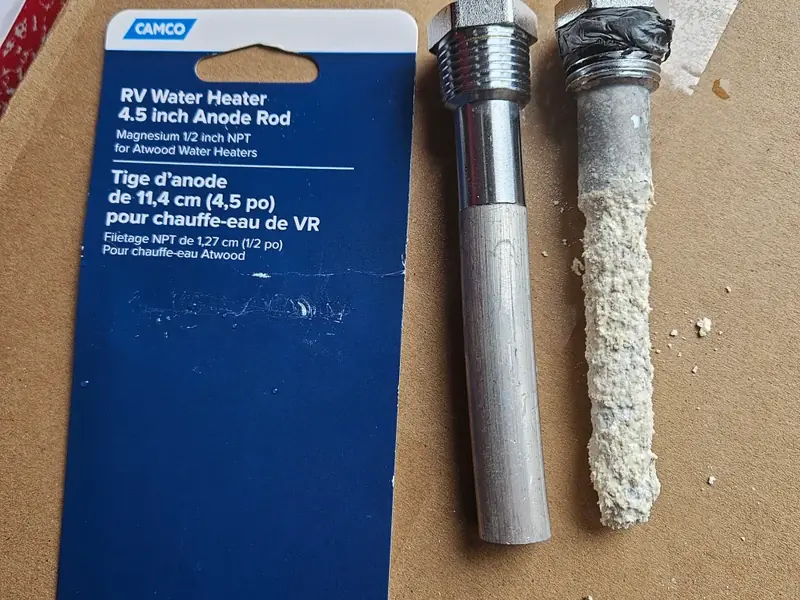
Inside every conventional tank water heater in Boston, MA 02114 there is a part most homeowners never see and almost never think about: the anode rod. It is a long metal rod, usually magnesium or an aluminum-zinc alloy, threaded into the top of the tank and hanging down into the stored water. Its entire job is to corrode on purpose. Through a basic electrochemical reaction, the rod sacrifices itself so the steel tank wall does not rust, and as long as the rod has metal left to give, the tank lining stays protected. Once the rod is consumed down to a bare wire, that protection stops, and the tank begins rusting from the inside out. We replace spent anode rods for Boston homeowners as a planned maintenance visit: a straightforward service call that can add years to a tank that is otherwise in good shape.
How an Anode Rod Protects Your Tank
A glass-lined steel tank is never perfectly lined. Microscopic cracks and pinholes in the glass coating expose bare steel to hot water, and hot water is an aggressive environment. The anode rod exploits galvanic corrosion on purpose: because magnesium and aluminum-zinc are more electrochemically active than steel, they become the anode in a tiny galvanic cell and corrode first, while the steel tank wall becomes the cathode and is spared. This only works while the rod still has sacrificial metal. A fresh rod is roughly three-quarters of an inch thick; when we pull a rod that has been reduced to a thin wire or bare steel core, the tank has been unprotected for a long time, and every month after that is borrowed time.
Magnesium rods protect more aggressively and are the default in most residential tanks, while aluminum-zinc rods are the standard answer when a home has a rotten-egg sulfur smell in the hot water, because the zinc content suppresses the sulfate-reducing bacteria reaction that magnesium can encourage. Either way, the rod is a wear item, like brake pads on a car. Replacing it on schedule is the single highest-leverage maintenance action a tank owner can take, because a tank with a live anode and intact glass lining has no reason to rust, while a tank with a dead anode is rusting whether or not it has started leaking yet.
Signs Your Anode Rod Is Spent
The most famous symptom is a rotten-egg smell in the hot water only. Cold water smells fine, hot water smells like sulfur. That pattern points at the anode rod reacting with naturally occurring sulfates and harmless bacteria in the water, and the fix is usually an aluminum-zinc replacement rod rather than a new tank. A second sign is rusty or discolored hot water that clears after a few seconds of running the tap. When the rod is gone, the tank wall starts rusting, and the first rust shows up as tinted hot water at the fixtures closest to the heater.
Age is the quietest sign of all. If your tank is more than five or six years old and nobody has ever checked the rod, assume it is significantly depleted. Rumbling or popping sounds during heating cycles can also relate: sediment bakes onto the tank bottom while the rod quietly disappears above it, so a noisy older tank is a candidate for both a flush and a rod inspection in the same visit. The honest diagnostic is visual. We shut the water off, relieve pressure, break the hex head loose on top of the tank, and pull the rod to look at it. What we see tells us exactly how much protection your tank has left, and that is the basis for a straight recommendation: replace the rod, or start planning for a tank.
Anode Rods in Beacon Hill's Cramped Rowhouse Basements
The 02114 ZIP covers Beacon Hill, the West End, and the North Station area, and its water heaters live in some of the most constrained spaces in the metro. Beacon Hill's 1800s brick rowhouses have full basements, but they are low, cramped, often with six-foot ceilings and narrow stairs, and the heater is frequently shoehorned into a corner that was never designed for service access. A rigid three-foot anode rod simply cannot be installed in many of these basements, which is why flexible and segmented rods are not a specialty item for our Boston calls but the default. We ask about ceiling clearance and stairwell dimensions when you call, because showing up with the wrong rod type in Beacon Hill wastes everyone's time.
There is a meaningful regulatory advantage to rod replacement in the historic district: it is entirely interior work. Beacon Hill's landmark review governs exterior changes, including venting terminations and tankless exhaust work, but an anode rod swap touches nothing outside the building envelope. For rowhouse owners who have been putting off heater maintenance because they dread the landmark process, the rod inspection is the maintenance you can do with no exterior review at all, and it is the highest-leverage one for extending the life of the existing tank.
High-Rises, HOAs, and Old-Pipe Rowhouses
The West End's mid-century residential towers and the newer buildings near North Station change the job from residential service to building logistics. Individual unit heaters in condos often sit in tight mechanical closets, and any work that touches common water risers falls under building management and HOA rules, which means the shutoff coordination has to be arranged with the building engineer before we arrive, not improvised on site. We are set up for that coordination: when you call from a 02114 high-rise, we ask about building work rules, elevator reservations for any equipment, and who controls the riser shutoffs, because a leaking-heater call in a tower is a building-systems call as much as a plumbing call.
In the rowhouses, the plumbing history matters more than the building type. Beacon Hill homes have seen 150-plus years of retrofits: galvanized and even lead-era service lines layered with copper over the decades, and Boston Water and Sewer Commission's aggressive lead-service-line replacement program is active context for these homes. The water itself is soft MWRA supply at roughly 15 to 20 parts per million, so rod depletion follows the standard three-to-six-year curve, but the fittings around the tank in a much-retrofitted rowhouse deserve the same inspection the rod gets. We check dielectric unions and shutoff condition on every Boston rod visit, because the rod protects the tank, not the century of plumbing decisions above it.
What Happens When You Call
When you call (833) 713-2101, you reach a real person who takes down your tank's age, brand, and symptoms, and schedules a service window that fits your day. On arrival, our technician shuts off the water and power or gas to the heater, relieves tank pressure, and breaks loose the anode rod's hex head on top of the tank. Old rods are often seized, so we carry the breaker bars and impact tools to free them without damaging the tank threads. We pull the rod, show you its condition, and install the correct replacement: rigid magnesium where it fits, flexible or segmented aluminum-zinc where ceiling clearance or sulfur odor calls for it. Then we refill the tank, purge air from the hot lines, restore power or relight the pilot, and verify normal heating before we leave.
One last Boston note: rowhouse basements often have six-foot ceilings and tight stairs, so compact 40-gallon or lowboy models are frequently the only fit Rod checks pair naturally with a flush, since the tank is already partly drained — two maintenance jobs in one visit, and a dated record of both for the next homeowner or the next service call.