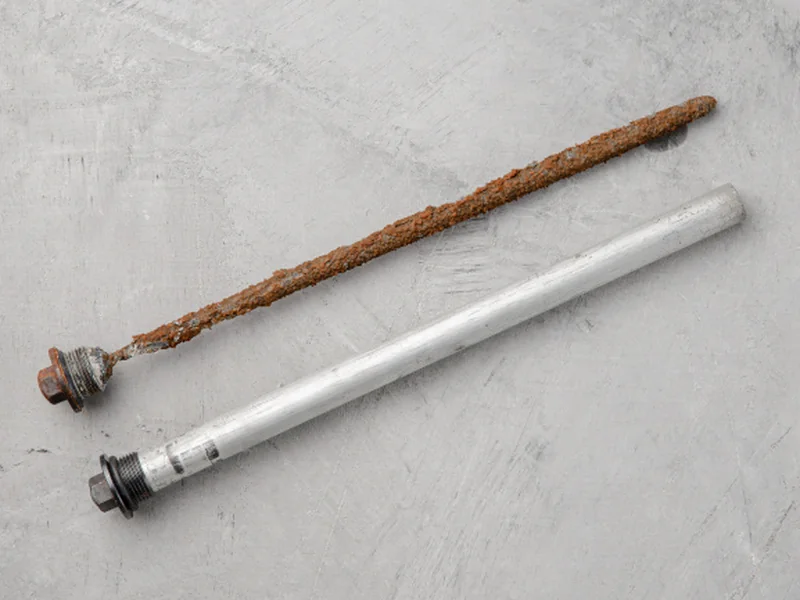
Inside every conventional tank water heater in Arlington, MA 02474 there is a part most homeowners never see and almost never think about: the anode rod. It is a long metal rod, usually magnesium or an aluminum-zinc alloy, threaded into the top of the tank and hanging down into the stored water. Its entire job is to corrode on purpose. Through a basic electrochemical reaction, the rod sacrifices itself so the steel tank wall does not rust, and as long as the rod has metal left to give, the tank lining stays protected. Once the rod is consumed down to a bare wire, that protection stops, and the tank begins rusting from the inside out. We replace spent anode rods for Arlington homeowners as a planned maintenance visit: a straightforward service call that can add years to a tank that is otherwise in good shape.
How an Anode Rod Protects Your Tank
A glass-lined steel tank is never perfectly lined. Microscopic cracks and pinholes in the glass coating expose bare steel to hot water, and hot water is an aggressive environment. The anode rod exploits galvanic corrosion on purpose: because magnesium and aluminum-zinc are more electrochemically active than steel, they become the anode in a tiny galvanic cell and corrode first, while the steel tank wall becomes the cathode and is spared. This only works while the rod still has sacrificial metal. A fresh rod is roughly three-quarters of an inch thick; when we pull a rod that has been reduced to a thin wire or bare steel core, the tank has been unprotected for a long time, and every month after that is borrowed time.
Magnesium rods protect more aggressively and are the default in most residential tanks, while aluminum-zinc rods are the standard answer when a home has a rotten-egg sulfur smell in the hot water, because the zinc content suppresses the sulfate-reducing bacteria reaction that magnesium can encourage. Either way, the rod is a wear item, like brake pads on a car. Replacing it on schedule is the single highest-leverage maintenance action a tank owner can take, because a tank with a live anode and intact glass lining has no reason to rust, while a tank with a dead anode is rusting whether or not it has started leaking yet.
Signs Your Anode Rod Is Spent
The most famous symptom is a rotten-egg smell in the hot water only. Cold water smells fine, hot water smells like sulfur. That pattern points at the anode rod reacting with naturally occurring sulfates and harmless bacteria in the water, and the fix is usually an aluminum-zinc replacement rod rather than a new tank. A second sign is rusty or discolored hot water that clears after a few seconds of running the tap. When the rod is gone, the tank wall starts rusting, and the first rust shows up as tinted hot water at the fixtures closest to the heater.
Age is the quietest sign of all. If your tank is more than five or six years old and nobody has ever checked the rod, assume it is significantly depleted. Rumbling or popping sounds during heating cycles can also relate: sediment bakes onto the tank bottom while the rod quietly disappears above it, so a noisy older tank is a candidate for both a flush and a rod inspection in the same visit. The honest diagnostic is visual. We shut the water off, relieve pressure, break the hex head loose on top of the tank, and pull the rod to look at it. What we see tells us exactly how much protection your tank has left, and that is the basis for a straight recommendation: replace the rod, or start planning for a tank.
Arlington's Two-Families: Old Pipes Meet the Anode Rod
Arlington's housing stock is dominated by 1890s to 1930s two-family homes and colonials, and a remarkable number of them still feed the water heater through original galvanized steel lines with the original gate-valve shutoff on top. Those gate valves seize. It is the rule, not the exception, in pre-1940 Arlington homes, and it changes how an anode rod service goes: we plan on replacing that seized shutoff with a full-port ball valve as part of the visit, because there is no point installing a fresh rod on a tank you cannot isolate the next time it needs attention. The layered copper retrofits common in these houses also mean we check the dielectric unions at the heater connections while we are there, since mixed galvanized and copper systems without intact unions corrode faster at exactly the fittings we are working around.
Access is the other Arlington reality. Water heaters here live in basements, and in the oldest homes those basements have fieldstone walls, low ceilings, and narrow bulkhead stairs. A rigid three-foot anode rod often cannot be maneuvered into place under a six-and-a-half-foot joist bay, which is why we carry flexible and segmented rods for Arlington calls and measure stairwell clearance before the visit, not after. The rod that protects your tank is only useful if it can physically be installed, and in Arlington's older basements, that takes planning.
Soft MWRA Water and High Water Tables Change the Math
Arlington is a full MWRA water and sewer member, which means the supply is soft, roughly 15 to 20 parts per million, or about one grain per gallon. That is good news for scaling: Arlington tanks do not bake up with mineral scale the way hard-water towns do. But soft water does not mean the anode rod lasts forever. Rod depletion is driven by water conductivity, temperature, and use as much as by hardness, and in soft water the failure mode shifts: instead of scale, you get steady galvanic consumption of the rod and sediment that comes mostly from the home's own aging galvanized pipe rather than the supply. On older Arlington tanks we inspect the rod on the shorter end of the interval, because a depleted anode in soft water gives no warning symptoms until the tank wall itself starts rusting.
The second local factor is groundwater. Homes near Spy Pond and the Alewife Brook corridor sit over a high water table, and heaters placed directly on damp concrete corrode at the base faster than identical tanks in dry basements. When we service a tank in those neighborhoods, we look hard at the base ring and the bottom head, and we talk honestly about a corrosion-resistant drain pan and elevating the tank on a stand. The anode rod protects the tank from the inside; the pan and elevation protect it from the outside. In damp-basement Arlington, you need both.
What Happens When You Call
When you call (833) 713-2101, you reach a real person who takes down your tank's age, brand, and symptoms, and schedules a service window that fits your day. On arrival, our technician shuts off the water and power or gas to the heater, relieves tank pressure, and breaks loose the anode rod's hex head on top of the tank. Old rods are often seized, so we carry the breaker bars and impact tools to free them without damaging the tank threads. We pull the rod, show you its condition, and install the correct replacement: rigid magnesium where it fits, flexible or segmented aluminum-zinc where ceiling clearance or sulfur odor calls for it. Then we refill the tank, purge air from the hot lines, restore power or relight the pilot, and verify normal heating before we leave.